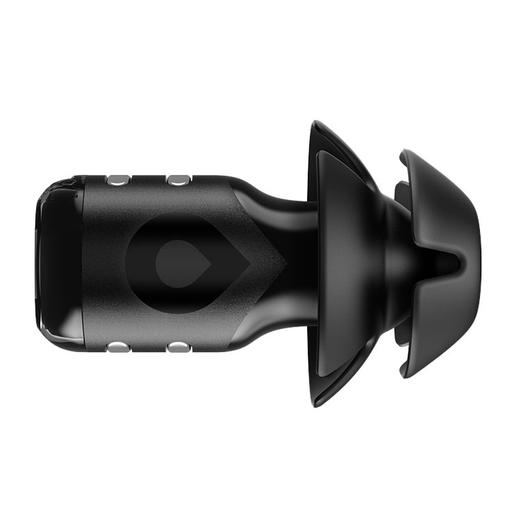
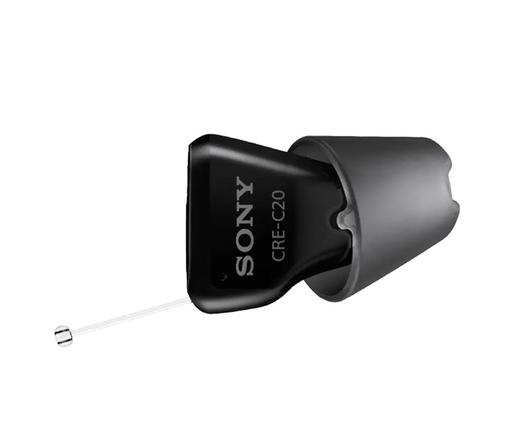
The Sony CRE-C20 measured 3.2/5 for speech in noise after tuning, far ahead of the Eargo 8's 0.3/5. This is one of the largest measured gaps between the two devices.
Eargo 8 vs. Sony CRE-C20
Check out our comparison of the Eargo 8 vs Sony CRE-C20. Listen to audio samples and see how the two hearing aids differ in terms of sound performance, features, accessories, and more.
Published Updated
Quick Verdict
AI summarizedSummarized with AI assistance from our human-researched product information, in-lab testing, objective sound measurements, and expert ratings.
The real choice here is performance and price versus support: the Sony CRE-C20 measured far ahead on speech clarity and costs about $1,700 less per pair, while the pricier Eargo 8 trails badly in our noise testing and only makes sense if its longer battery reserve and lifetime support team matter more to you than sound performance.
8
Choose the Eargo 8 if you want the longest battery life and case runtime in this pair and prioritize Eargo's lifetime customer support team, but be aware its 2.6/5 HearingTracker score and 0.3/5 speech-in-noise result sit well below average.
CRE-C20
Choose the Sony CRE-C20 if you want notably stronger measured speech clarity in quiet (4.7/5) and noise (3.2/5) after tuning, and you'd rather spend roughly $1,700 less for a pair.
What actually separates them
AI summarizedMeasured speech understanding
Lab measuredAfter tuning, the CRE-C20 scored 4.7/5 for speech in quiet and 3.2/5 for speech in noise, both well above the site-wide average, while the Eargo 8 measured 2.6/5 and just 0.3/5 on the same tests — a category-low result for noise performance.
Price for the pair
PriceThe CRE-C20 costs roughly $1,700 less than the Eargo 8, which is a large gap for two OTC devices in the same completely-in-canal form factor.
Overall expert rating and value score
Expert ratingThe CRE-C20 earned a 3.4/5 HearingTracker score and a 3.3/5 value rating versus the Eargo 8's 2.6/5 overall and 2.0/5 value score, reflecting our reviewer's view that the Eargo 8's price isn't matched by its lab performance.
Battery runtime
SpecThe Eargo 8 is rated for up to 16 hours per charge with a case offering up to two weeks of extra power, while the CRE-C20 runs up to 28 hours per charge with one additional day from its case — an advantage for the Sony on daily runtime despite Eargo's longer case reserve.
Product Overview
8
CRE-C20
Form Factor
Form FactorNon-custom device that typically sits completely inside the ear canal. Some of the device may be visible to the naked eye.
Form FactorNon-custom device that typically sits completely inside the ear canal. Some of the device may be visible to the naked eye.
Expert Rating
Score
3.1
Score
3.7
User Rating
—
4.84 reviews
Hearing Loss LevelHearing Loss LevelThis represents HearingTracker's best guess on suitability. Please consult a licensed audiologist to confirm your own candidacy for this device.
MildModerate
MildModerate
Product Features
RechargeableIP68
RechargeableIP68
Expert Ratings
Compare comprehensive test results and expert opinions.
8
CRE-C20
HearingTracker Score
8
3.1BELOW AVERAGE
Eargo 8 is Eargo's latest flagship OTC hearing aid, featuring automatic sound environment adjustments, enhanced audio fidelity, and patented device-health monitoring. Designed for adults with mild to moderate hearing loss, it emphasizes user convenience, extended battery life, and robust customer support.
Read full reviewCRE-C20
3.7AVERAGE
The Sony CRE-C20 is a discreet, over-the-counter hearing aid designed for individuals with mild to moderate hearing loss, featuring a compact size and rechargeable battery for up to 28 hours of use. While it offers a user-friendly setup and an Auto Sound Analyzer for enhanced speech clarity, it lacks Bluetooth streaming capabilities, which may be a consideration for users seeking more advanced connectivity options.
Read full reviewHearAdvisor SoundScore
8
3.4BELOW AVERAGE
Eargo 8 achieved a SoundScore of 3.4/5 and a SoundGrade of B in HearAdvisor lab testing. It ranked #47 of 65 OTC Hearing Aid devices tested. The OTC Hearing Aid category average SoundScore was 3.71/5.
CRE-C20
3.6AVERAGE
Sony CRE-C20 achieved a SoundScore of 3.6/5 and a SoundGrade of B in HearAdvisor lab testing. It ranked #37 of 65 OTC Hearing Aid devices tested. The OTC Hearing Aid category average SoundScore was 3.71/5.
Build Quality
8
4.3AVERAGE
Eargo 8 hearing aids appear to be well build with an IP68 rating, offering great protection against moisture and debris. The portable charging case is also a nice addition and should protect Eargo well when not in use.
CRE-C20
4.8EXCELLENT
Sony CRE-C20 has an excellent IP rating of 68, which aligns with our hands-on experience as we observed an improved build quality compared to CRE-C10.
Battery
8
3.3BELOW AVERAGE
Eargo are extremely small making their 16 hour rechargeable battery life impressive. The case offers additional on-the-go power and I found the magnetic charging bays a nice easy to use addition.
CRE-C20
4.4ABOVE AVERAGE
CRE-C20 offer an impressive battery life of up to 28 hours. I also liked the portable charging case which offers you Qi wireless charging.
App Features
8
3.5BELOW AVERAGE
I found Eargo's app to be packed full of useful features like the Sound Match hearing assessment and automatic noise reduction controls. You have plenty of options for personalization though adjustments are not always reliable as Eargo relies on phone speaker commands instead of Bluetooth.
CRE-C20
3.0BELOW AVERAGE
Sony's Hearing Control app includes good features and allows your to further personalize CRE-C20 with their on-ear hearing assessment. One downside though is that the hearing aids and app communicate with sound cues from your phone. I find this method of wireless communication less reliable that Bluetooth, and it overall makes the pairing process more complicated.
Comfort
8
3.9BELOW AVERAGE
Comfort will vary by individuals depending on your tolerance to a deeper fitting hearing aid. Overall, I found them moderately comfortable through they can cause a tickling ear sensation due to their fit.
CRE-C20
4.0AVERAGE
CRE-C20 are good comfortable once you find the best tip for your ears. They are not overly plugging though it can take some time to get used to having a hearing aid so deep in your ear canal.
Design
8
5.0EXCELLENT
Eargo's instant-fit, completely-in-the-canal, style is unique discrete. If you are interested in a nearly-invisible OTC hearing aid you will love their design.
CRE-C20
5.0EXCELLENT
CRE-C20 are surprisingly small and sit mostly invisible in your ears. The style works well and was originally designed as an "instant-fit" prescription hearing aid from Signia.
Value
8
2.5BELOW AVERAGE
Eargo 8 has a value score of 2.5/5 based on lab performance and public display price.
CRE-C20
3.6AVERAGE
Sony CRE-C20 has a value score of 3.6/5 based on lab performance and public display price.
Handling
8
3.0BELOW AVERAGE
Handling can be challenging with Eargo 8 due to the small size and reliance on tap controls. Furthermore, Eargo relies on acoustic indicators for wireless communication, which is less reliable than Bluetooth and caused me several problems.
CRE-C20
4.0AVERAGE
CRE-C20's smaller size and method of wireless communication make it more difficult to manage than many other hearing aids. However, Sony has improved upon the design as CRE-C20 now uses internal rechargeable batteries, as opposed to disposable ones. It is a unique offering with many pros but be sure to consider this against your needs and abilities.
Pro Support
8
1.0BELOW AVERAGE
Eargo is one of the first direct to consumer hearing aids, but support is unfortunately limited to to their Client Care team and personal hearing professionals. While Eargo claims they work alongside audiologists, it is not the same as direct professional hearing care.
CRE-C20
1.0BELOW AVERAGE
Sony does not offer great support with their hearing aids. You are limited to phone and email based technical assistance which is a downside to many OTC products.
Lab Recordings
Listen to direct output recordings from our acoustic test lab.
8
CRE-C20
Busy CafeBusy CafeSpeech intelligibility improvement in loud environments
Hear this scene unaided, for comparison
8
CRE-C20
Quiet OfficeQuiet OfficeSpeech intelligibility improvement in quiet and moderate environments
Hear this scene unaided, for comparison
8
CRE-C20
HearingTracker partners with HearAdvisor to provide recordings and performance data from an acoustic laboratory that follows standard scientific procedures. All hearing aids are fitted and performance-tested for mild sloping to moderate hearing loss. All audio samples cutoff above 10kHz.
Accessories
Compatible accessories for each hearing aid
8
CRE-C20
Battery Charger
Charger (Eargo 8)
The Eargo 8 charger is a compact, USB-C and wireless-compatible case that provides up to 14 full charges, with clear LED indicators for device and case battery levels, Bluetooth pairing, and error states. It includes cradles with charging contacts, a reset button, and requires regular cleaning to ensure optimal device performance and hygiene.
None
Remote Control
Eargo App+1
The Eargo app allows users to perform Sound Match personalization, select listening programs, and control volume and tone.
None
Hardware
8
CRE-C20
IP RatingIP RatingIP Ratings rate sealing effectiveness of hearing aids against intrusion from foreign solid matter (dirt, dust) and moisture.
IP68
IP68
Rechargeable BatteriesRechargeable BatteriesCharge your batteries overnight in a docking station and get a full day's use (in most cases) of battery life the following day.
Lithium-ion
Lithium-ion
Software Features
8
CRE-C20
Adjustment SynchronizationAdjustment SynchronizationThis feature allows for a more pleasant listening experience by ensuring that both hearing aids process sound the same way. If one hearing aid changes its processing in response to noise or speech, it will send a wireless signal to the other hearing aid so both process sound in the same way.
No
Ear-to-Ear Wireless LinkEar-to-Ear Wireless LinkHearing aids will adjust as a pair to your surroundings.Also covers Spatial Noise Cancellation
DirectionalityDirectionalityDepending on the types and number of microphones a hearing aid has, the hearing aid may be able to boost sounds from specific directions (by reducing sounds from other directions). This can be helpful to focus on a speaker directly in front of the hearing aid user, as well as to give the user information about where different sounds are coming from.
No
Yes
Environmental AdaptationEnvironmental AdaptationThe hearing aid can detect different acoustical environments, like speech in noise, and adjust the sound of the hearing aid accordingly to drive comfort or speech understanding, etc.
Smart Sound AdjustSmart Sound AdjustAutomatically detects your surroundings and applies fast-acting noise reduction without manual adjustments.
Situation AnalyzerSituation AnalyzerThe situation analyzer within the hearing aid adjusts sound based on your surroundings to improve listening experiences in environments with background noise.
Extended bandwidthExtended bandwidthHearing aid provides amplification at frequencies (pitches) higher than the typical hearing aid.
No
12kHz
Feedback SuppressionFeedback SuppressionIf any sound amplified by the hearing aid escapes the ear canal, it may reach the hearing aid’s own microphone and cause a harsh whistling noise. Some hearing aids are able to recognize when this feedback occurs and reduce or eliminate it.
No
Yes
Listening ProgramsListening ProgramsNumber of manually accessible listening programs (using push button, remote, app, or other switching method)
4
No
Noise ReductionNoise ReductionThis feature uses modern hearing aids’ processing power to examine the incoming sound signal, determine if noise is present and reduce the volume of the troublesome sound to increase comfort.
Yes
Yes
Processing ChannelsProcessing ChannelsThese are all the frequency-divided sections the hearing aid is able to examine at a single time. The hearing aid uses this information to determine whether the contents of each section are noise, speech, or something else and amplify the sound in each section accordingly.
No
48
Self-fittingSelf-fittingThis hearing aid allows you to fit yourself without professional assistance. Typically found in OTC products.
- Tuned based on hearing test through device
- Tuned based on audio preference selections
- Tuned based on hearing test through device
Spatial Noise CancellationSpatial Noise CancellationThis feature recognizes where sounds are coming from and can reduce noise coming from behind or to the side of the listener. This helps the listener focus on the speaker, usually in front of them.
No
Ear-to-Ear Wireless LinkEar-to-Ear Wireless LinkWith Ear-to-Ear Wireless Link, hearing aids wirelessly work together to produce effective, high-quality noise reduction and deliver an optimal hearing strategy for your environment.Also covers Adjustment Synchronization
Sudden Loud Noise ReductionSudden Loud Noise ReductionThis feature detects loud sounds and reduces their volume to a comfortable level. Though not a replacement for hearing protection, this technology can greatly improve listener comfort.
No
Yes
Unique Amplification StrategyUnique Amplification StrategyHearing aids all process sounds a little bit differently. Sometimes it varies even within one model.
Superior HD SoundSuperior HD SoundEnhanced sound quality with improved distinction across frequencies for more natural listening.
No
Wind Noise ReductionWind Noise ReductionAs wind blows against the microphones of hearing aids, unpleasant noise may be generated. Some hearing aids have the ability to recognize this wind noise and reduce its level. Such reductions may also affect the audibility of desired sounds, like speech.
No
Yes
Bottom Line
AI summarizedThe Verdict
The data here points strongly toward the Sony CRE-C20: it beat the Eargo 8 on every measured speech metric, carries a higher overall HearingTracker score (3.4 vs 2.6) and value rating (3.3 vs 2.0), and costs roughly $1,700 less per pair.
The Eargo 8's case only closes if you specifically need its longer battery reserve or its lifetime support team, since its 0.3/5 speech-in-noise score and 2.0/5 value rating are hard to justify at its price.
Which is right for you?
Neither device streams Bluetooth audio, so don't buy either expecting music or hands-free calling — that capability is absent from both. If sound performance in real-world noisy settings is your priority, the CRE-C20's tuned lab results make it the more defensible pick in this pair.
Before you buy
AI summarizedUse the return window to test in noise
Both are OTC purchases you can return, so wear each in a genuinely noisy room during the trial period — the CRE-C20's 3.2/5 lab score for speech in noise suggests it should perform far better there than the Eargo 8's 0.3/5.
Get a hearing test before buying either
Both devices are self-fit through in-app hearing assessments (Eargo's Sound Match, Sony's Auto Sound Analyzer), so confirm your loss is actually mild-to-moderate before choosing between them.
Weigh the $1,700 gap against Eargo's support
If ongoing help matters to you, factor in that Eargo offers lifetime phone/email/chat support while Sony's assistance is limited to phone and email — decide if that's worth the price difference.
Frequently Asked Questions
AI summarizedBased on lab and expert scoring, no — the CRE-C20 outperformed the Eargo 8 on speech in quiet, speech in noise, overall HearingTracker score, and value rating. The Eargo 8's higher price mainly buys longer battery life and Eargo's lifetime support team, not better measured sound performance.
No, neither device streams Bluetooth audio or supports hands-free calling. Both rely on acoustic or app-based communication with your phone instead of Bluetooth.
The Sony CRE-C20 runs up to 28 hours per charge versus the Eargo 8's 16 hours, though Eargo's charging case offers up to two weeks of extra power compared to the CRE-C20's one additional day.
Eargo offers lifetime phone, email, and chat support from its Client Care team, while Sony's CRE-C20 support is limited to phone and email assistance. Neither reaches the level of dedicated professional hearing care.