


Hearing protection devices like earplugs and earmuffs often use two different ratings systems (both in decibels, or ) to gauge noise reduction: (Noise Reduction Rating) and (Single Number Rating). Both are standardized ways of estimating how much sound the earplugs block, but they come from different testing systems. The U.S. commonly uses NRR, which tends to be more conservative; SNR is the European standard and often shows slightly higher values. In practical terms, they give you a ballpark idea of how much quieter the world will seem when you wear the plugs, but your actual experience will depend on fit and how well the plugs seal in your ears.
Earplugs
Loop Earplugs Review: Lab and Real-life Testing of Engage 2, Experience 2 , Quiet 2 & Switch 2
We put four Loop earplugs to the test both at a real-life concert and in the HearAdvisor lab. Here's what we found.)
Published on Aug 20, 2025
Featured Products
Compare allHearing aid glossary
Looking that up…
Terms are matched automatically. A definition may not fit every context.
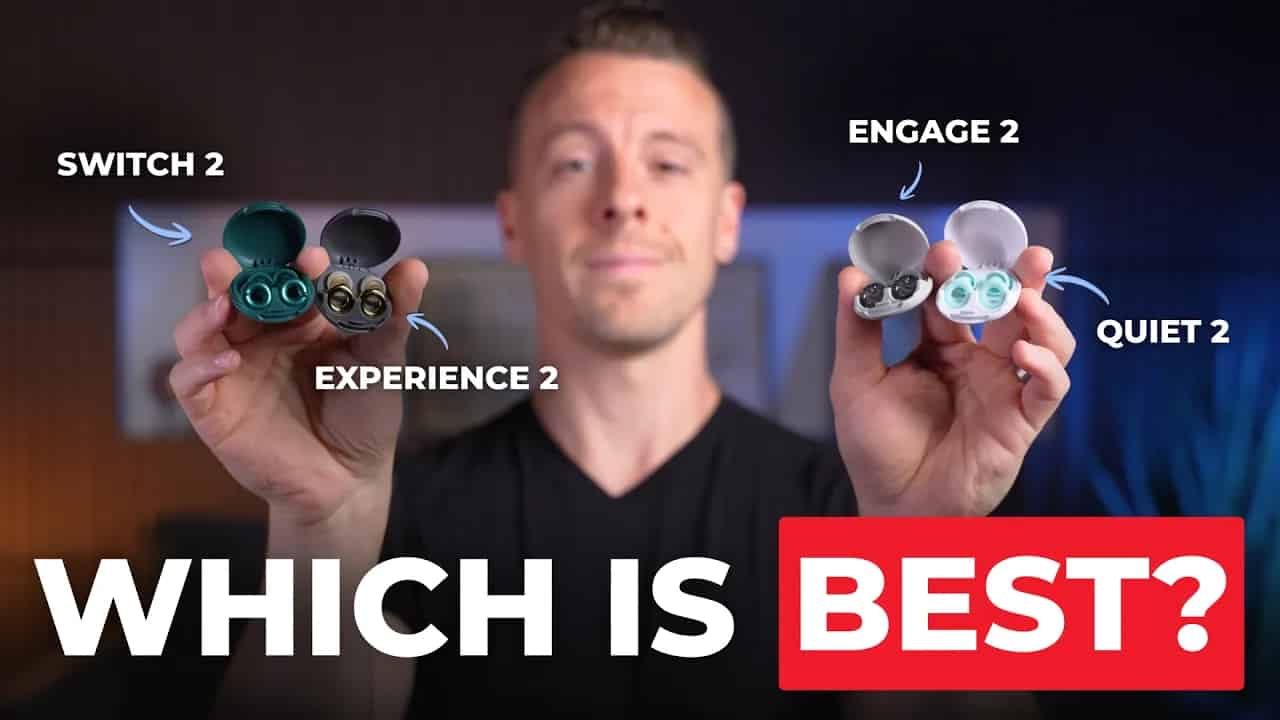
Listen for yourself! In this video, Dr. Steve Taddei provides a hands-on and lab-tested review of Loop Engage 2, Experience 2, Quiet 2, and Switch 2 that includes ratings and sound samples.
I’ve been using Loop earplugs for several years—at concerts, woodworking in my garage, and even during nights out in busy restaurants. They’re stylish, affordable, and easy to wear. But do they actually perform well, protecting your hearing and providing good sound fidelity on the specific models? That’s what I set out to answer in this hands-on and lab-tested review.
At the HearAdvisor lab, I ran each of Loop’s four latest models—Engage 2, Experience 2, Quiet 2, and Switch 2—through testing. I also wore them in real-world environments, from music venues to quiet study spaces.
Overall, I found Loop earplugs work very well, but with a few caveats.
What Are Loop Earplugs?
I’m an audiologist, I've played in bands, and have also done some freelance audio engineering. So, I'm very interested in earplugs, and have always emphasized the importance of protecting your ears. As with most chronic conditions, it's easier to prevent hearing loss and tinnitus than to treat them. That’s why I’m always on the lookout for hearing protection that works and people will actually want to use.
Loop is one of the few companies that has made earplugs both effective and stylish. Founded in Belgium in 2016, they’ve grown into a global brand with a wide lineup of reusable earplugs designed for different situations—whether you’re out at a concert, grabbing dinner in a noisy restaurant, trying to focus at work, or just getting a good night’s sleep.
Below, I’ll walk you through Loop’s four latest models—Engage 2, Experience 2, Quiet 2, and Switch 2—and share how they perform in both the lab and in real-world use. And, for those of you looking for a quick overview, here's a table that quickly summarizes each of the Loop earplugs I'm reviewing.
Model | Use-case Examples | NRR | SNR | Price* | HearAdvisor SoundGrade | Notes |
|---|---|---|---|---|---|---|
Engage 2 Plus | Noisy social settings | 8 dB | 16 dB | $34.95/$44.95 | B | Comfortable, but reduces speech clarity more than ideal |
Experience 2 Plus | Concerts and as musician plugs | 12 dB | 17 dB | $34.95/$44.95 | B | Solid choice for concerts; not the most natural, but secure fit |
Quiet 2 | Sleep, study, max quiet | 14 dB | 24 dB | $24.95 | B | Best for noise blocking, soft and comfortable |
Switch 2 | Three-in-one solution | 14/17/20 dB† | 16-24 dB | $59.95 | A-B (across modes) | Versatile, pricier, may be slightly more fragile |
Summary of the four Loop earplugs reviewed in this article, including pricing and HearLab SoundGrade (please use gray scroller to see entire table). NRR and SNR ratings are from values cited on the Loop website; see the HearAdvisor website and our lab findings below for independently tested measurements. *Engage 2 and Experience 2 are offered in "Plus" versions for $10 more that include mute accessory (stronger hearing protection) and an additional set of more pliable foam eartips. †Switch 2 comes with double-loop eartips that provide about 3 dB more SNR filtered noise reduction.
Purchasing and Unboxing Loop Earplugs
You can buy Loop earplugs in numerous places online, including the Loop website and Amazon. When ordering, you'll see they are available in 4-7 color choices and styles, depending on the model. The earplugs come in a small, pocket-friendly plastic clamshell case.


If you order the "Plus" package of Loop Engage 2 or Experience 2 for $10 extra, you'll receive a Loop “Mute” accessory, which is a handy removable insert ring that further reduces the noise by several decibels. You also get 3 sets of foam eartips (S, M, and L) that are more pliable than the silicon eartips you receive in the standard package.
When I first unboxed the Loop earplugs, I noticed the presentation was clean and consistent across all four models. Each set comes with performance test data printed on the back, along with a user manual that I actually recommend people read; there are helpful tips for getting the right fit—and as I'll note below, a proper fit makes or breaks any earplug.
:format(webp))
Quiet 2 immediately stood out because they’re made from a softer material, clearly designed for sleep or long wear. Switch 2, on the other hand, was the most intricate, with its three-position selector and unique multi-layered ear tips. That extra layering gave them a more secure feel in my ears compared to the others.
Attending a Concert with Loop Earplugs
Right after unboxing, I took them out for a local show to see how they handled real-world use. The venue wasn’t extremely loud, averaging in the low 90 range, but it gave me a good chance to swap between models. When I wanted to chat with the server or friends, the Engage 2 earplugs worked best, taking the edge off without completely muting speech.

Once the music kicked in, I switched to Experience 2, which gave me a fuller, more balanced sound. Quiet 2 offered the most reduction, though at that volume I didn’t need it, and Switch 2 let me move between all three modes on the fly.
That first outing reinforced what I’d later see in the lab: each model has its own personality, and the key is picking the one that matches your environment.
Here are the HearAdvisor lab findings and my own personal perspectives on using Loop earplugs in real life. (For interested readers, I've published an article about how HearAdvisor tests earplugs.)
:format(webp))
Loop Engage 2: Conversation-Friendly Protection
The Engage 2 is Loop’s “conversation plug,” designed for social situations where you want some noise relief but still need to hear people clearly. They cost $34.95 ($44.95 for the Plus version, which includes extra foam tips and “mute” inserts for a touch more protection). In the HearAdvisor test lab, Engage 2 Plus was not impressive relative to sound quality but did offer good loudness reduction, earning it a B SoundGrade. At a common concert level of 100 , you would have about 2.1 hours before reaching your daily sound exposure limit.


My take: Loop Engage 2 is comfortable and useful for their intended use in restaurants or cafés. However, I noticed they cut a little too much in the 3-6 kHz range—right where speech clarity lives. That’s not ideal for a conversation earplug, but it’s not a dealbreaker. If you opt for the Plus version, you can use the mute inserts which make them more versatile.
:format(webp))
Loop Experience 2: For Concerts and Musicians
If you’re heading to a show or you’re a musician, Experience 2 is the model Loop markets for you. These plugs use an acoustic filter designed to evenly reduce bass, mids, and treble, helping music retain its character. Pricing is the same as Engage 2: $34.95, or $44.95 for the Experience 2 Plus.

In the HearAdvisor lab, Loop Experience 2 Plus earned a B SoundGrade; it offers fair sound quality and good loudness protection. At a common concert level of 100 , you would have approximately 2 hours before reaching your daily sound exposure limit.
My take: These are solid concert earplugs, but not the most natural-sounding I’ve used. Competing plugs like Eargasm High Fidelity and Westone TRU Music sound flatter (more natural) and transparent in my ears. Still, I keep coming back to Loop because they fit me better. Other earplugs tend to slip out of my ears after a few minutes, while Loops stay secure through an entire set. For me, the fit trumps everything else, and this is part of the highly personalized facet of choosing earplugs; everyone is different. Experience 2 is what I usually wear at concerts.
:format(webp))
Loop Quiet 2: Maximum Protection
Quiet 2 is Loop’s simplest and cheapest plug, at $24.95. Instead of using filters, it’s made of a soft material that blocks as much sound as possible while being comfortable. With a published of 21, this is Loop’s best option if you want peace and quiet or maximal hearing protection—and I didn't test this product for filtered sound quality for that reason.
My take: These are great for sleep, studying, or travel. The softer design makes them especially comfortable for side sleepers, and they do an excellent job cutting down noise. They also come with double-looped eartips that provide a couple of decibels more of noise reduction and, at least in my case, provide enhanced comfort. If your goal is maximum quiet, this is the Loop for you.
:format(webp))
Loop Switch 2: Three Earplugs in One
Switch 2 is Loop’s premium option at $59.95. It combines Engage, Experience, and Quiet into a single earplug with a small sliding switch on the loop. You can toggle between three modes depending on your environment. They're not exactly the same as what you'll hear when using the specific models, but they're pretty close.
HearAdvisor lab testing of Loop Switch 2 in the Experience mode showed it offers good sound protection and loudness reduction with an of 14. In this setting, you could attend a 100 concert for about 3 hours before reaching your daily sound exposure limit. Using Switch 2 in the Engage mode, it offers fair sound quality and good noise reduction with an NRR of 17 , giving you about 3.2 hours at a 100 dBA concert before reaching your daily sound exposure limit. The lab gave Switch 2 a SoundGrade of "A" and "B" for these modes, respectively. The Quiet mode does a great job of muffling most of the sound.
My take: The versatility of Loop Switch 2 is fantastic. At a concert, I might use Engage mode between sets to chat with friends, then switch to Experience when the music starts, and Quiet if things get painfully loud. The tradeoffs? They’re pricier, a bit bulkier, and possibly less durable due to the mechanical design. Still, if you want a “do-it-all” plug, Switch 2 is an excellent option.
:format(webp))
Final Verdict
Loop is my favorite brand of earplugs for one key reason: they offer good hearing protection while fitting my ears reliably and comfortably—and they're reasonably priced. I can wear them for the length of a concert, jam session, woodworking project, etc., without them slipping out of my ears or constantly fussing with them.
Even the best-sounding earplugs are mostly useless if they keep falling out of your ears—or if you don't use them due to these types of retention or comfort issues. Additionally, good-sealing eartips are important: just a small leak in the eartip seal can dramatically affect the sound quality and protection rating of the device.
As far as a good hearing conservation product goes, Loop earplugs are a solid pick and check most of the boxes.
And, in case you're asking: No, Loop did not in any way, shape, or form sponsor this article or the above video.
:format(webp))
Alternatives to Loop Earplugs
Of course, just because Loop works well for me doesn't necessarily mean it'll be the best earplugs for you and your ears. In my opinion, Loop earplugs, offered at about $25-$60 per set, are very good, but there are concert and musician's earplugs that achieve a flatter response across frequencies—for a more natural sound—like Sennheiser SoundProtex Plus ($100), Eargasm High Fidelity ($46), and Westone TRU Music ($29).
Loop earplugs also do a good job of sealing the ear canal, which is good for hearing protection but bad for the occlusion effect. This means your own voice sounds barrel-like, and your chewing can sound abnormally loud. If this is a problem for you, you might want to try Etymotic Research's ER-20XS High Fidelity Earplugs ($25), which fit deeper in your ears.
Although more expensive, I increasingly find myself turning to the transparency and noise reduction modes found in Apple Airpods Pro 2 ($170) music earbuds, which can serve double-time as both decent electronic earplugs and as fairly good over-the-counter hearing aids.
And if you're looking for an absolutely no-compromise hearing protection solution, then it's probable you won't find anything better than custom musicians' hearing protection that provide maximal sound quality, minimal occlusion (own-voice annoyance), and a great seal with comfort. It's best to get these from a music audiologist, as there are also some important caveats and considerations for these types of earplugs.
I've ranked and placed SoundGrades of earplugs for concerts tested by the lab in the HearAdvisor Earplug Leaderboard, and you can find a lot more sound samples of Loop earplugs (and many other brands) on the individual earplug web pages of HearAdvisor. I've also published an article about the Best Earplugs for Concerts that you may wish to check out.
Dr Steve Taddei
Doctor of AudiologySteve Taddei, Au.D., is an audiologist, co-founder and lab director of HearAdvisor, and a hands-on hearing aid and earplug reviewer for HearingTracker. He holds an audio engineering degree from Columbia College Chicago and a doctorate in audiology from Northern Illinois University. He also teaches as an adjunct faculty member at several colleges.