Telehealth in Audiology: Where Does Validity Really Live?
Can auditory processing disorder (APD) testing be improved via telehealth? In this commentary, audiologist Kaitlyn Lepore argues that, for selected APD assessments—and for patients with tinnitus, hyperacusis, or misophonia—clinical validity can be supported through controlled stimulus delivery, consistent testing conditions, strong patient engagement, and careful alignment between the assessment method and the clinical question being asked.Kaitlyn Lepore, AuD
Featured Products
Compare allHearing aid glossary
Looking that up…
Terms are matched automatically. A definition may not fit every context.
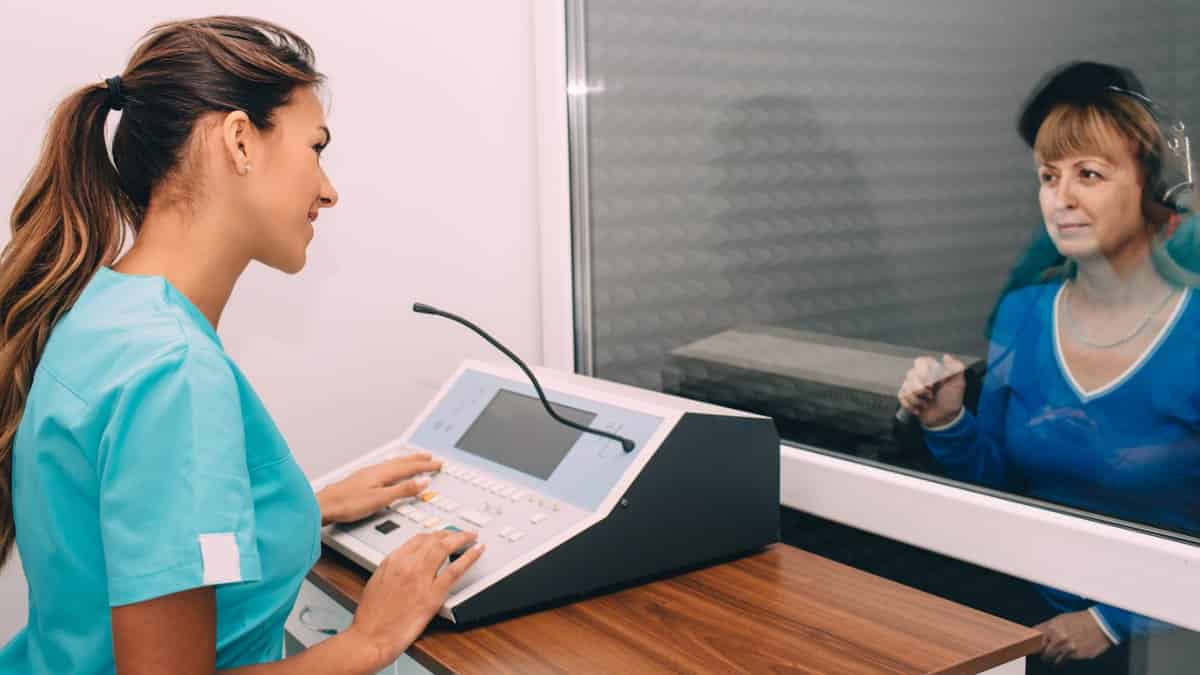
For most audiologists, there is an unspoken line in the sand: If it is not done in a sound booth, it cannot be trusted.
It is a rule that has shaped training, clinical protocols, and professional identity for decades. In many areas of audiology, it is entirely justified. The booth provides control, standardization, and confidence that what we are measuring is not being distorted by the environment.
But the problem emerges when that rule is applied universally.
Not every audiological measure depends on acoustic perfection. Not every patient benefits from being placed in an unfamiliar, highly controlled environment to understand how they hear in the real world. In some areas of practice, the very conditions we impose to ensure control may interfere with what we are trying to measure.
When the Testing Environment Shapes the Results
This tension is especially clear in auditory processing disorder (APD), tinnitus, hyperacusis, and misophonia, where attention, arousal, and sensory regulation are central to performance. In these cases, the testing environment is not neutral; it can actively shape the outcome.


Telehealth in these areas is often framed as a COVID-era workaround: something improvised or temporary. But that framing misses what actually shifted. What emerged was not just feasibility but a more uncomfortable realization: in some areas of audiology, the sound booth may not be essential for validity.
How Telehealth APD Testing Can Work
If you strip away assumptions, APD assessments delivered via telehealth are conceptually straightforward:
- A stable internet connection.
- Standardized stimulus delivery.
- Wired headphones.
- A patient in a quiet environment.
During COVID-era adaptations of the Central Test Battery, the core requirement was not perfect acoustic calibration in the traditional sense. It was controlled bilateral delivery, consistent presentation, and reliable patient engagement.
The key question quietly shifted: not whether the environment was booth-calibrated, but whether the stimulus was equally accessible to both ears and whether the task was performed under stable conditions.
Once that shift is made, the perceived barrier to telehealth becomes much smaller.
This matters even more when considering the populations involved. Patients with , tinnitus, hyperacusis, and misophonia often experience comorbid neurodivergent traits. For many, the clinic itself is not a neutral environment. The act of entering a sound booth or even a clinic can introduce sensory load, cognitive strain, or physiological arousal that directly affects performance. For some patients, that added burden is the difference between meaningful participation and overload.
:format(webp))
Telehealth does not remove structure. It changes it. Patients remain in familiar environments, with access to their own sensory regulation strategies. They are not navigating unfamiliar lighting, seating, or clinical pressure. In some cases, this could allow for a more representative measure of functional ability than clinic-based testing.
Rethinking Clinical Validity in Teleaudiology
This is where the most common objection arises. It is not emotional or philosophical. It is methodological.
It is not calibrated.
Calibration, standardization, and acoustic control are foundational to audiology. In procedures such as hearing aid verification, threshold testing, and electroacoustic measures, testing requires a sound booth, calibrated equipment, or both. Removing these controls would compromise the validity and reliability of the results.
But testing sits in a different category. Auditory processing measures are less about absolute acoustic precision and more about relative performance under controlled conditions. When stimuli are delivered symmetrically, when listening levels are set to comfortable ranges, and when known asymmetries are accounted for, the clinical signal remains intact.
There are edge cases, particularly in asymmetric hearing loss, but these are manageable clinical variables rather than fundamental barriers to validity.

The deeper question is not whether telehealth meets every calibration standard. It is whether those standards were ever fully aligned with the clinical questions being asked.
Re-examining the Criteria for Clinical Rigor
Some resistance to telehealth is therefore not purely technical. It is also cultural.
Audiology has long defined clinical rigor through control, instrumentation, and environment. The sound booth is not just a tool; it is a symbol of legitimacy. It represents the belief that good data requires strict environmental constraints.
This is why telehealth discussions often become entangled with concerns about remote hearing aid fitting. Those concerns are valid in that context, but they can unintentionally reinforce a broader assumption that anything outside the clinic is inherently less reliable.
When that assumption goes unchallenged, important distinctions between very different types of audiological work are flattened. Not all measurements depend on the same kind of control. Not all clinical questions require the same environment. And not all patient populations respond to the same conditions in the same way.
When telehealth is treated as a legitimate clinical environment rather than a compromised substitute, the practical implications are immediate. Access improves for patients who struggle with travel, fatigue, sensory overload, or anxiety. Attendance improves when barriers to entry are reduced. And in some cases, patients produce more consistent and representative results in familiar environments than in clinical settings.
For and related sensory conditions, this shift is particularly meaningful. These are conditions where attention, arousal, and sensory regulation are central to interpretation. Reducing environmental friction does not reduce clinical rigor. In some cases, it enhances it.
The future of audiology is not defined by whether we adopt telehealth. It is defined by where we decide rigor actually lives.
The sound booth will remain essential for many forms of audiological assessment. But it should not automatically remain the default benchmark for validity across the entire profession.
Telehealth for APD is not a technological breakthrough. It is a conceptual correction. It asks a simple but uncomfortable question: Are we so focused on control that we risk letting it get in the way of helping patients hear and function better?
Expanding telehealth is not about lowering standards. It is about applying the right standards to the right clinical questions. In doing so, it opens the door to a version of audiology that is more accessible, more flexible, and, in some cases, more representative of real-world listening than the one we inherited.
References
Musiek FE, Baran JA, Bellis TJ, et al. Clinical practice guidelines: Diagnosis, treatment, and management of children and adults with central auditory processing disorder [PDF]. August 2010. Available at: https://audiology-web.s3.amazonaws.com/migrated/CAPD Guidelines 8-2010.pdf_539952af956c79.73897613.pdf
Chaytor N, Schmitter-Edgecombe M. The ecological validity of neuropsychological tests: A review of the literature. Neuropsychol Rev. 2003;13(4), 181-197.
Paglialonga A, Cleveland Nielsen A, Ingo E, Barr C, Laplante-Lévesque A. eHealth and the hearing aid adult patient journey: a state-of-the-art review. Biomed Eng Online. 2018 Jul 31;17(1):101. doi: 10.1186/s12938-018-0531-3. PMID: 30064497; PMCID: PMC6069792
Swanepoel DW, Hall JW. A systematic review of telehealth applications in audiology. Telemedicine and eHealth. 2010;16(2), 181-200.
Nixon G, Shiels L, Patrick CJ, Tomlin D. Assessing the agreement between auditory processing test results of children with listening difficulties obtained in a clinical setting and in a Zoom-based remote environment. Int J Audiol. 2026;65(3):344–357.
About the author:
Dr. Kaitlyn Lepore is a Doctor of Audiology with over a decade of clinical experience and a specialization in the conditions most clinics aren't equipped to treat: tinnitus, sound sensitivity, and auditory processing disorder. She founded the website Auditory Pathway to give patients a real path forward—which she says starts with a proper evaluation, and ends somewhere other than being told there's nothing more to be done.
:format(webp))
- K
Kaitlyn Lepore, AuD