Hearing Aids Not Enough in Noise? How Auditory Training Helps
Audiologist Brian Taylor explains how structured auditory training works, who may benefit, and what improvements people with hearing loss can realistically expect.)
Featured Products
Compare allHearing aid glossary
Looking that up…
Terms are matched automatically. A definition may not fit every context.

Modern hearing aids can make speech and other important sounds more audible. They can also improve speech understanding, help reduce tinnitus symptoms, and reduce some of the effort involved in listening. However, even very good, properly fitted hearing aids cannot remove every communication difficulty associated with hearing loss.
A noisy restaurant, a fast talker, or a group conversation can still be challenging. When that happens, people sometimes conclude that their hearing aids have failed them, or that nothing more can be done. A broader view of hearing care suggests another possibility: the technology may be doing its job, while the person could still benefit from instruction, counseling, communication strategies, and structured listening practice.


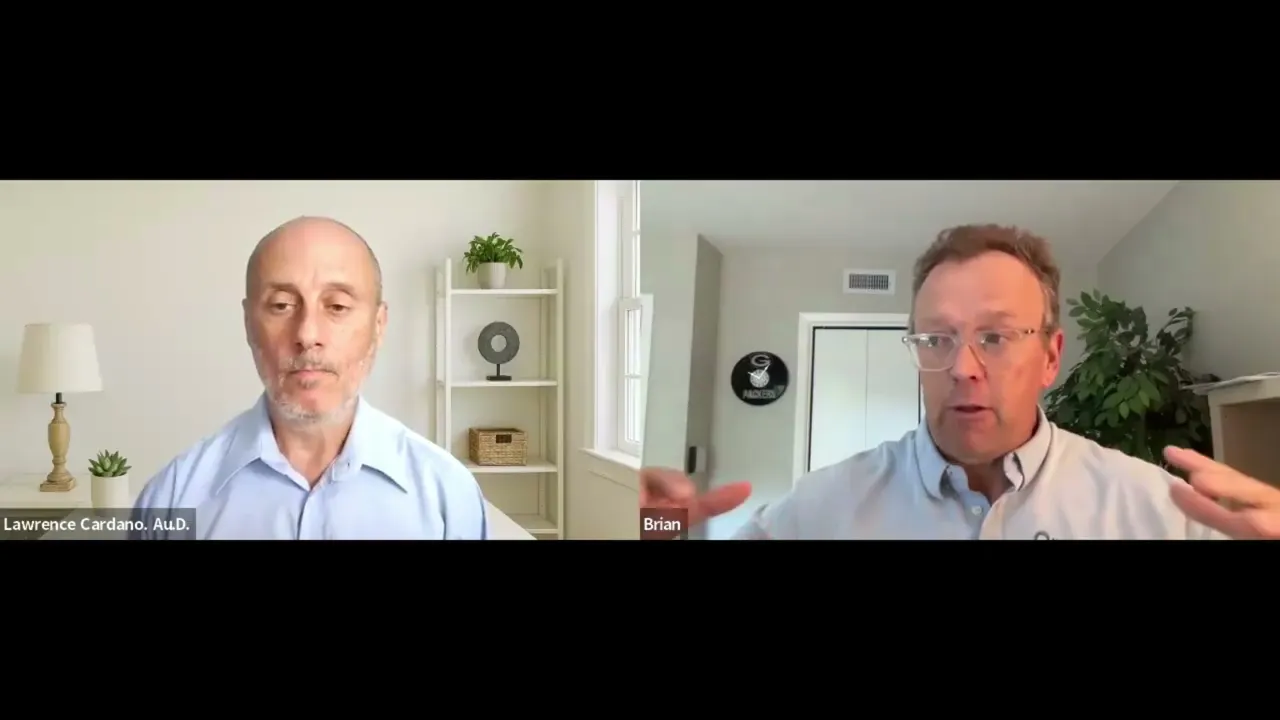
I spoke with audiologist Brian Taylor, AuD, Vice President of Clinical Research and Professional Relations at Neurotone, the company that provides the Listening and Communication Enhancement program (LACE). I have recommended LACE for my patients, and they have generally experienced good results.
Dr. Taylor has more than 35 years of experience in the clinical, teaching, publishing, and hearing industry. Our conversation focused on what auditory training may add after hearing aids have restored access to sound.
:format(webp))
Dr. Lawrence Cardano: What is one of the biggest misconceptions people have when they first receive hearing aids?
Dr. Brian Taylor: Many people expect instant results. That is understandable, especially because glasses often produce an immediate improvement in vision. Hearing loss is different. For many people, hearing declines gradually over 10 or 20 years. Then amplification restores sounds that may not have been heard clearly for a long time.
The brain may need time to sort through those sounds, focus on the ones that are meaningful, and learn to give less attention to sounds that are not important. In a crowded social setting, there may be many sounds you don’t want to hear.

Adjustment can take weeks or months, and the experience varies from person to person.
Cardano: You have described holistic hearing care as a three-legged stool. What are the three legs?
Taylor: The three legs are hearing technology, instruction and counseling, and aural rehabilitation. I want to credit audiology researcher Arthur Boothroyd for the concept. The basic idea is that if one leg is missing or out of proportion, the stool becomes unstable.
As a profession, we have sometimes placed too much emphasis on technology alone. Technology is essential, and it needs to be selected, fitted, and verified properly. People also need to understand how to use it and how to manage difficult listening situations. Finally, they need to develop or strengthen the skills involved in effective communication—and this is too often viewed as an “add-on” rather than an essential component of hearing care. When those elements work together, the treatment plan is more complete.
Brian Taylor, AuDIf technology, counseling, instruction, and aural rehabilitation are not aligned as equal parts of care, the treatment plan is going to be a little wobbly.
Cardano: How would you explain auditory training to someone who has never heard the term?
Taylor: Auditory training is structured practice designed to strengthen the skills used when listening and communicating. Hearing involves signals traveling from the ear to the brain, but successful conversation also draws on attention, comprehension, processing speed, language knowledge, and auditory memory.
A useful comparison is learning or improving any other skill. If you wanted to improve at tennis, you would not expect a new racquet to do all the work. You would practice—ideally with a plan and some coaching. In the same way, hearing aids provide access to sound, while systematic practice can help a person make better use of that access, especially in challenging situations.
Cardano: Who is most likely to benefit?
Taylor: Many adults with hearing difficulties may be candidates, but benefit is not identical for everyone. In clinical practice, I would pay particular attention to people who have more than a mild hearing loss, are older, have measurable difficulty understanding speech in noise, or continue to struggle in daily life despite appropriately fitted hearing aids.
Motivation is also important. Auditory training requires consistent participation. Someone who has clear communication goals and is willing to practice regularly is more likely to complete the program and make useful progress. A hearing care professional can help determine whether training fits the person’s needs and can establish realistic goals.
Cardano: What does someone actually do in the LACE auditory training program?
Taylor: The current program is delivered through a smartphone app. The exercises address four broad areas: understanding speech in background noise, understanding rapid speech, filling in missing words, and auditory working memory.


These abilities work together during conversation. If a talker turns away, speaks quickly, or is partly masked by noise, then the listener may need to use context, remember what was said earlier, and make reasonable inferences about a missed word. The training is adaptive, so the difficulty can change as the user’s performance changes.
The newer version of LACE is also designed to be more engaging than the original CD and DVD versions. Users can select topics that interest them, and the app can incorporate a familiar voice into some exercises. Those features are intended to reduce repetition and make sustained practice more appealing.
Cardano: How much practice does the program require?
Taylor: A practical and effective starting dose is about 20 minutes a day, 5 days a week, for approximately 4 weeks.
The key is consistency. One or two sessions are not enough to judge the value of a training program, just as one or two trips to the gym would not be enough to judge a fitness program.
That doesn’t mean every person will follow exactly the same schedule forever. After an initial period of consistent training, the user and provider can review progress, decide whether more practice is appropriate, and consider a later booster period if skills or confidence begin to slip.
Cardano: What improvements should people realistically expect, and where should expectations be limited?
Taylor: The exercises are designed to improve performance on speech-in-noise, rapid-speech, missing-word, and auditory-memory tasks.
A provider using LACE can review the user’s performance within those training modules. Improvement on an exercise can show that learning is taking place, but the larger question is whether the learning carries over into everyday communication.
In daily life, some people report following conversations more closely, participating more actively, or feeling more confident about what they heard.
Confidence is a big thing. A person who is continually wondering whether they missed something may hesitate to join a conversation even when much of it was understood.
And results can vary. Some people begin with stronger listening and cognitive skills and may have less room to improve. Others may improve on trained tasks without noticing a large change in every real-world situation.
Auditory training should be presented as one component of comprehensive care, not as a cure for hearing loss or a guarantee that noisy environments will become easy.
Cardano: How can someone and their provider measure progress?
Taylor: There are several levels of progress to consider. The first is improvement in performance within the training program. The second is performance on measures that were not used as training exercises. A hearing care professional might use a speech-in-noise test, such as the Quick Speech-in-Noise [] test, before and after a training period.

Questionnaires can also help measure the social and emotional effects of hearing difficulties. The Revised Hearing Handicap Inventory [RHHI] is included in the LACE app and can be completed before training and again afterward.
Finally, the person should identify one or two real-life goals, such as following dinner-table conversation or understanding a spouse in the car, and track whether those situations become more manageable. In addition, the LACE- test is included in the LACE Pro app to measure speech-in-noise performance and improvement.
Cardano: How important is the hearing care professional’s involvement?
Taylor: The provider’s involvement can make a major difference. Auditory training works best when it is introduced as part of a treatment plan, connected to the person’s goals, and supported over time. For a new hearing aid user, I would introduce the concept early, without overwhelming them on the fitting day. Starting after the first follow-up visit may make sense once the person is comfortable with basic hearing aid use.
The provider can help set expectations, choose meaningful goals and outcomes, monitor participation, and encourage the person when progress feels slow. In some cases, the provider may emphasize a particular area, such as speech in noise, while still recognizing that the listening skills trained by the different modules work together.
Cardano: Could someone get the same benefit by listening to audiobooks?


Taylor: Listening to audiobooks can be enjoyable and may provide useful listening practice. It is still different from an adaptive training program that requires the listener to respond, changes difficulty based on performance, and deliberately works on several listening and cognitive skills. Passive listening does not provide the same type of systematic challenge or feedback.
The broader principle is active participation. People generally get more from rehabilitation when they take ownership of the process and practice consistently. The provider and program can supply structure and encouragement, but the individual still has to do the work.
Cardano: What would you say to someone who has been told that everything possible has already been done with hearing aids?
Taylor: Hearing aids do an excellent job of restoring audibility, but audibility is not the same as effortless understanding in every situation. If the hearing aids have been properly fitted and verified, and the person still struggles with noise, fast speech, or complex conversations, auditory training is one option worth discussing.
The goal is conversational fluency, the ability to follow and participate in communication with greater confidence. Technology, counseling, communication strategies, and structured training can all contribute to that goal.
Brian Taylor, AuD, NeurotoneHearing aids do a good job of restoring audibility, but the brain may still need training to make sense of all those sounds.
Cardano: What does the research show about auditory training, and where should we be careful about overpromising?
Taylor: There is a body of research supporting auditory training, and much of it is based on neuroplasticity.1-7 With deliberate, systematic engagement with sound, people can improve specific listening skills. The important point is that it takes more than a brief trial.
Consistency matters. A typical initial period is about 20 minutes a day, 5 days a week, for approximately a month. Some people may improve sooner, while others need more practice. Research has also found that some improvements can remain for months after training, and a person can return to the program later for additional practice.
We also have to recognize individual differences. Some people may begin close to their performance ceiling, so their measurable improvement may be smaller. Others may improve on the training exercises without noticing the same degree of change in every real-world situation.

The practical outcomes I would look for are improved performance in speech in noise, rapid speech, missing-word, and auditory-memory tasks, along with greater confidence and participation in real conversations. We should not promise that everyone will improve by the same amount or that auditory training will make every difficult listening environment easy.
Cardano: One of the four LACE modules focuses on auditory memory. Some people might wonder, “I’m trying to hear better, so why am I working on memory?” How would you explain the connection?
Taylor: Successful conversation depends on more than hearing individual words. You need to remember what was said at the beginning of a sentence or conversation, use context, and connect ideas as the speaker continues.
In a difficult listening situation, you may miss part of what was said because of noise, rapid speech, or a talker turning away. You then draw on your knowledge of language and what you have already heard to help fill in the missing information. Auditory-memory training is intended to strengthen the cognitive resources you rely on in those situations.
Cardano: If readers remember only one point from this conversation, what should it be?
Taylor: Continued difficulty in noise does not automatically mean that hearing aids have failed or that nothing more can be done. It may mean that the person needs a broader plan. Appropriate hearing technology, professional guidance, communication strategies, realistic expectations, and structured listening practice can work together.
Auditory training requires time and active participation, and individual results vary. If someone remains frustrated after the hearing aids have been properly fitted, it is reasonable to ask a hearing care professional whether there is an opportunity to train the listening skills that technology alone cannot provide.
References
- Olson AD, Preminger JE, Shinn JB. The effect of LACE DVD training in new and experienced hearing aid users. J Am Acad Audiol. 2013 Mar;24(3):214-30.
- Chisolm TH, Saunders GH, Frederick MT, McArdle RA, Smith SL, Wilson RH. Learning to listen again: The role of compliance in auditory training for adults with hearing loss. Am J Audiol. 2013 Dec;22(2):339-42.
- Song JH, Skoe E, Banai K, Kraus N. Training to improve hearing speech in noise: Biological mechanisms. Cerebral Cortex. 2012 May;22(5):1180-1190.
- Henshaw H, Ferguson MA. Efficacy of individual computer-based auditory training for people with hearing loss: A systematic review of the evidence. PLoS One. 2013 May 10;8(5):e62836.
- Henshaw H, Ferguson MA. (2013). Efficacy of individual computer-based auditory training for people with hearing loss: A systematic review of the evidence.
- Lawrence BJ, Jayakody DMP, Henshaw H, et al. Auditory and cognitive training for cognition in adults with hearing loss: A systematic review and meta-analysis. Trends in Hearing. 2018.
- Neurotone. Publications and research bibliography.
Disclosure: Brian Taylor is an executive at Neurotone. Lawrence Cardano is a LACE Pro provider. The interview has been edited and condensed for length and clarity. Product descriptions and statements attributed to Taylor reflect his comments during the interview.
Lawrence Cardano, AuD, CPD
Hearing Tracker ContributorLawrence Cardano, AuD, CPD© is a Doctor of Audiology and Certified Dementia Practitioner with more than 30 years of experience helping adults with hearing loss improve their communication and quality of life. He is the founder of Meaningful Pursuits, a personal coaching practice dedicated to helping adults with hearing loss live with greater purpose, connection, and vitality. Correspondence can be sent to Dr. Cardano at LawrenceCardano365@gmail.com.