Fortell AI 2.0: Next-level Speech-in-Noise Performance Update for Hearing Aids
New software update retrains Fortell's Spatial AI on more real-world sound, with company testing showing an average 2.1 dB SNR improvement over its first-generation model. And the update is free for current owners of Fortell hearing aids.)
)
Hearing aid glossary
Looking that up…
Terms are matched automatically. A definition may not fit every context.
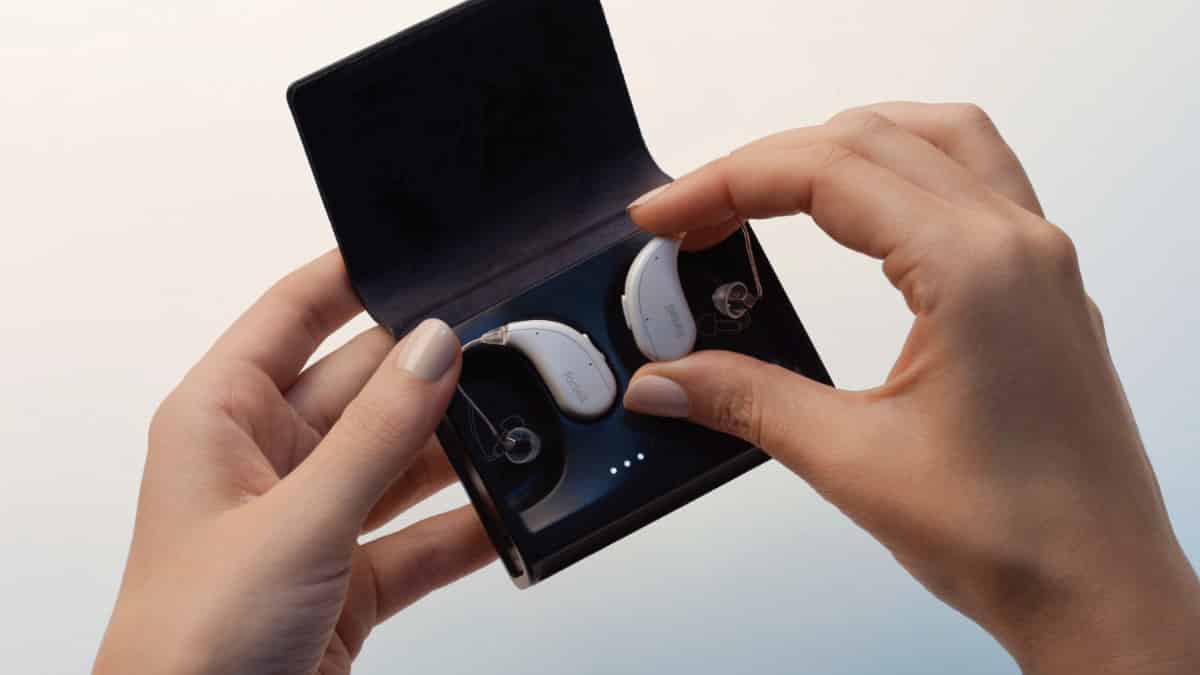
Fortell is launching its first major upgrade to the artificial intelligence inside its receiver-in-canal () prescription hearing aids, promising better speech clarity in noise and more natural-sounding voices—without asking existing users to buy new devices.
Fortell AI 2.0, launching August 26, 2026, is a free hearing aid software update designed to improve speech understanding in noise for new and existing Fortell users. Delivered through the Fortell iOS app, AI 2.0 runs on the same custom hardware introduced with the company’s hearing aids late last year.
According to the company’s latest testing, the improvement in Fortell AI 2.0 is substantial in those listening situations most challenging for hearing aid wearers. Across a battery of speech-in-noise measurements, the company reports that AI 2.0 improved the signal-to-noise ratio () by an average of 2.1 compared with its original AI algorithm (now dubbed Fortell AI 1.0). In one condition with several competing talkers, the improvement reached 4.1 dB.
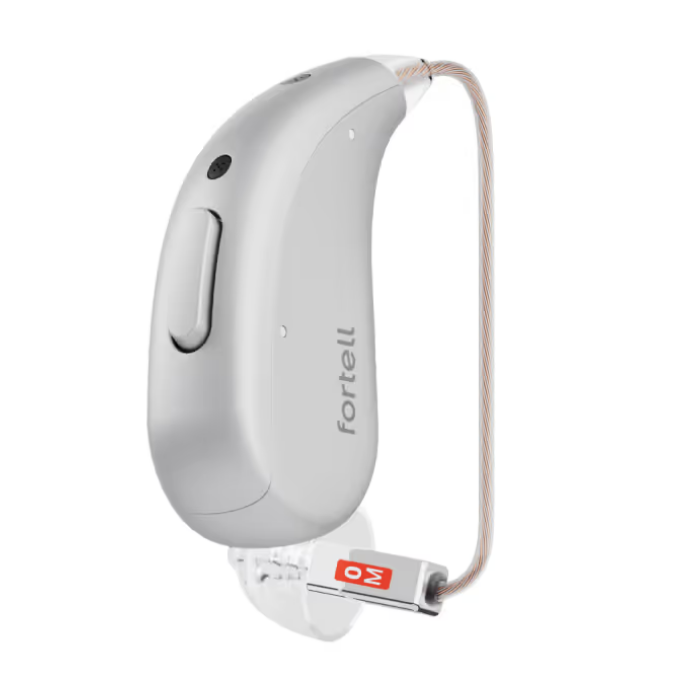
Fortell delivers the best background-noise performance we've seen, but its aggressive processing, lack of Android connectivity, and limited in-person clinic network are important tradeoffs.
Expert Review
That might not sound like a big change, but even small improvements can make a significant difference in some listening situations. As a general rule of thumb, a 1 dB improvement in SNR can translate into roughly an 8-10 percentage-point improvement in speech recognition in noise when a listener is on the steeper end of the speech-understanding curve (although the actual benefit varies with the listener and listening conditions).
Fortell is a relative newcomer to hearing healthcare, founded in New York City in 2021 by Matthew de Jonge, Andrew Casper, Igor Lovchinsky, and Cole Morris. The Fortell Hearing Aid is a rechargeable prescription device intended for adults with mild to severe hearing loss. It offers All Voices, Front Voices, Conventional, and Live Music listening options, and uses a companion iPhone/iPad app for controls, remote adjustments, and software updates. Fortell currently requires a compatible iPhone or iPad and does not support Android devices.
The hearing aids sell for $6,800 per pair, and this includes 5 years of in-person and/or tele-audiology care, a 3-year warranty, and a 100-day home trial. Fortell currently operates clinics in New York, Greenwich, and Palm Beach. Other clinics are opening soon, starting with Boston, San Francisco, Palo Alto, Los Angeles, and Miami.
:format(webp))
Fortell has attracted substantial backing along the way. Forbes recently named Fortell Research one of its 2026 “Next Billion-Dollar Startups,” reporting that the company has raised $163 million and has a $740 million valuation. The company has also reportedly drawn an unusual number of high-profile users, including comedian Steve Martin, actor Bob Balaban, and KKR cofounder Henry Kravis, helping generate considerable word-of-mouth attention before the company’s broader rollout.
Retraining the AI on the messiness of real life
Fortell’s core technology is based on deep neural networks () and direct speech enhancement, unlike most -driven hearing aids, which mainly sort the environment into various “listening buckets” and then apply a corresponding set of conventional processing settings.
The company’s Spatial AI is designed to separate speech from interfering sounds in real time, allowing speech and noise to be processed differently. Fortell’s All Voices mode reduces background noise while preserving voices coming from around the listener. Front Voices goes further by suppressing voices coming from behind the wearer when the desired talker is in front.
Company co-founder and CEO Matthew de Jonge describes the system as “full AI source separation,” in which the hearing aid divides incoming sound into streams that should and should not receive amplification. “We built AI 1.0 to do full source-separation,” de Jonge told HearingTracker. “The AI actively separates incoming sound into distinct channels on the basis of its importance to the wearer. In contrast to the only other competitor doing full source separation, Spatial AI understands both what the sounds are and where they’re coming from, so it can remove distracting talkers in multi-speaker noise.”
:format(webp))
For 2.0, Fortell says it substantially expanded the real-world audio used to train its neural network. Engineers collected recordings in restaurants, cafés, construction sites, trains, buses, and cars, as well as in reverberant offices and living spaces. The company then retrained the model on the larger dataset while modifying several of its conventional signal-processing algorithms—in real-life settings with real-life users.
AI 1.0 relied extensively on synthetic training data, in which computers simulate large numbers of acoustic environments. That approach remains useful, but de Jonge said they wanted the second-generation model to learn from more of the acoustic unpredictability that people actually encounter.
“The biggest innovation was new and better data collected from the real world—in places where people struggle,” de Jonge says. “The first model benefited tremendously from a technique called synthetics, where you use computers to simulate vast quantities of real-world acoustic scenes. That’s really nice because you can generate unlimited amounts of training data. But it comes with a concern: Does it perfectly reflect the acoustic nuances of the real world?”
For AI 2.0, he said, Fortell augmented that synthetic material with authentic real-world recordings collected by its team “at great effort in the wild in New York City,” including conversational recordings captured with complex, specialized microphone setups.
Machine-learning systems are ultimately constrained by the data used to train them. Simulated noise can help teach an algorithm, but only a real restaurant with moving conversation partners, reverberation, overlapping voices, clattering plates and utensils, and constantly changing sound levels—all factors that are difficult to recreate fully in a laboratory—can provide an optimum learning dataset for the AI system.
Fortell’s bet is that exposing its model to more acoustic complexity will make speech separation work better when wearers are thrust into the same chaotic listening situations.
:format(webp))
Clinical testing: Putting AI 2.0 through 80 noisy sound scenes
For its pre-release 2.0 white paper, Fortell tested the new and previous software using 80 speech-in-noise scenes recorded through a KEMAR acoustic manikin wearing the same pair of Fortell hearing aids. Half contained environmental background noise and half included interfering talkers.
The hearing aids were fitted to targets (the “gold standard” prescriptive fitting method for hearing aids) for a typical moderate sloping hearing loss. Environmental recordings included cafés, food courts, a train station, street noise, and a dinner party from the established ARTE acoustic database. The competing-talker testing used speech from 56 different speakers, and none of this audio used for the testing had been included in AI 2.0’s training data, says Fortell.
was the primary factor they wanted to measure, but the company also evaluated HASPI v2, an intelligibility metric developed for listeners with hearing loss; PESQ, which measures speech quality; and STOI, another speech-intelligibility measure.
The results consistently favored Fortell AI 2.0 over AI 1.0. With ordinary background noise, SNR benefit increased from 8.9 to 10.6 in All Voices and from 9.1 to 10.8 dB in Front Voices—gains of approximately 1.7 dB.
The largest change appeared when other people were talking. In the competing-talker condition, All Voices increased from just 1.9 dB of SNR benefit with AI 1.0 to 5.9 dB with AI 2.0—a 4.1 dB improvement. Front Voices, which already performed strongly in this scenario, reached an 11.0 dB SNR benefit, approximately 1 dB higher than AI 1.0.
De Jonge stressed that the 4.1 dB result represents the high end rather than the typical improvement. “The 2.1 dB was the average improvement in all the scenarios we tested,” he said. “And 4.1 dB was the best, or the high end, but 2.1 was actually the average. The bottom line is that users should notice these improvements in more challenging environments.”
Across the 16 combinations of listening programs, noise conditions, and measurement metrics, AI 2.0 produced a better average result in every case. Fifteen of the 16 comparisons reached statistical significance. The exception was STOI in Front Voices with competing talkers.
:format(webp))
Building on strong results for the original Fortell AI
Fortell 2.0 is starting from an already strong platform that has garnered consumer and media attention for its speech-in-noise performance. Fortell designed its own AI coprocessor rather than relying solely on a conventional hearing aid . According to the company, the TSMC-manufactured chip can perform up to 100 billion operations per second, offers 235 times the computing capacity of conventional hearing aid processors, and keeps end-to-end processing latency below 10 milliseconds.
The company’s original Spatial AI has also been evaluated against competing premium hearing aids. In a May 2026 study published in the International Journal of Audiology, Morris and colleagues compared Fortell’s Spatial AI with flagship hearing aids from five major manufacturers in multi-talker noise. A total of 20 adults with mild-to-moderately-severe bilateral sensorineural hearing loss compared recordings. Fortell was preferred in 99 of 100 comparisons, with one tie. Its average measured improvement over the unaided condition was 12.2 , compared with 3.0 to 5.9 dB for the five competing devices. (Read the full study.)
De Jonge was quick to acknowledge that laboratory studies are not always the most reliable measures. “The metrics we use to compare AI 2.0 to AI 1.0—are far from perfect,” he said. “The real way to measure a hearing aid is with clinical trials like we’ve done with professors from NYU, Cornell, and Sinai. That is how you determine with certainty: Is this actually a better hearing aid?”
A separate double-blind study published by Fortell involved 30 experienced hearing aid wearers. It found that, in the most challenging (-6 dB SNR) condition, participants correctly understood 50% of words with Fortell, compared with 7% with the competing AI hearing aid.
HearingTracker and HearAdvisor are currently conducting independent testing of Fortell AI 2.0. Preliminary results look very promising, but Dr. Steve Taddei in the independent HearAdvisor lab is still completing the analysis, and we’ll report the full results when they’re ready.
Better clarity with AI 2.0—but with a focus on natural sound
Fortell says 2.0 was designed to pull conversation more clearly out of noise without making the voices wearers want to hear sound less natural.
That second goal can be difficult as the speech-in-noise programs become more aggressive in separating speech from competing sounds. In its quest for better contrast, the processing can make voices sound robotic, tinny, clipped, or otherwise distracting.
De Jonge says this represents an inherent challenge in source-separation systems: pushing harder for noise reduction can expose small errors made when the AI decides which portions of the acoustic signal belong to desired speech and which belong to unwanted sound. “With AI 1.0—better than anyone else in the world, I think— we can get you both clarity and naturalness, but at a certain point we have to trade one off against the other.
“With AI 2.0,” he continues, “we were able to move both forward at once without having to choose. So, we’re able to deliver both more aggressive signal-to-noise ratios on the order of 2 to 4 , depending on the environment and the mode, and to do that all while improving the naturalness of speech.”
The tests on Fortell AI 2.0 offer support for improved sound quality. Additionally, PESQ scores improved across both listening modes and both types of noise, including a sizable improvement in the All Voices competing-talker condition.
A hearing aid that can improve after purchase
Perhaps the most consequential aspect of 2.0 is not any single test result, but the way Fortell is delivering it. The company has been making smaller software improvements approximately once a month since the hearing aid launched, but de Jonge says AI 2.0 marks the first time the company has replaced the core AI model itself.
“We’ve been making the product better once a month since we launched [via over-the-air (OTA) firmware updates],” de Jonge said. “But we actually never touched the core AI model weights—our AI team has been working their butts off on improvements since the day we launched.”
:format(webp))
The ability to update instead of requiring a new device purchase is extremely valuable for consumers. Typically, hearing aid manufacturers launch new hearing aids every 1-2 years and new chip platforms every 2-4 years, so purchasers sometimes experience buyer’s remorse when a highly desirable feature is added. Fortell’s approach is closer to the software-update model familiar to smartphone and computer users: improving the and software running on hardware already in consumers’ ears.
HearingTracker believes this could be an extremely valuable trend for hearing aid consumers—and a practice we hope future patient-centered manufacturers will adopt at least once per product cycle. In essence, it gives new purchasers exposure to as much as 4 years of the latest technology, rather than 1-2 years. Notably, Phonak recently provided a firmware update to previous users after upgrading from Infinio to Infinio Ultra.
The company also appears to have substantial room for additional software improvements on its existing hardware, and it deliberately left considerable processing headroom when developing the original platform.
Fortell's pre-release AI 2.0 white paper says the gains came from a larger training dataset and software changes rather than new hardware. Every existing Fortell wearer therefore receives the updated AI 2.0 processing on the hearing aids they already own.
“A lot of improvements can be made with this existing hardware platform because we over-engineered it,” says de Jonge. Of course, a hardware and chip upgrade will eventually be required when the and other upgrades require it; however, in the meantime, the value of the hearing aid might actually increase over time.
What Fortell AI 2.0 could tell us about the future of hearing aids
There will be plenty to watch once Fortell 2.0 reaches wearers.
A 2.1 average improvement in over an already strong-performing algorithm is impressive, while the 4.1 dB improvement in the toughest All Voices multi-talker condition is particularly noteworthy. So, as de Jonge notes, the next question is whether consumers experience significant improvements outside the laboratory—and whether greater noise suppression comes without sacrificing spatial awareness, voice naturalness, or listening comfort.
Still, the significance of Fortell AI 2.0 may extend beyond this particular update. For years, hearing aid buyers have generally had to purchase a new generation of hardware to obtain a manufacturer’s newest sound-processing technology. Fortell is demonstrating that a hearing aid’s core listening performance can improve substantially after it has already been introduced, fitted, and purchased.
If AI 2.0 performs in the real world as its early technical results suggest, that software-upgrade model could ultimately prove nearly as interesting as the improvements in speech-in-noise performance.
Karl Strom
Editor in ChiefKarl Strom is the editor-in-chief of HearingTracker. He was a founding editor of The Hearing Review and has covered the hearing aid industry for over 30 years.
Abram Bailey, AuD
Founder and PresidentDr. Bailey is a leading expert on consumer technology in the audiology industry. He is a staunch advocate for patient-centered hearing care and audiological best practices, and welcomes any technological innovation that improves access to quality hearing outcomes. Dr. Bailey holds an Au.D. from Vanderbilt University Medical Center.