Fortell AI Hearing Aids Lab Review: A New Leader for Hearing in Noise
Our expert team selects and tests products rigorously. We may earn commissions if you buy through our links. Here's how we keep reviews independent.
Hearing aid glossary
Looking that up…
Terms are matched automatically. A definition may not fit every context.
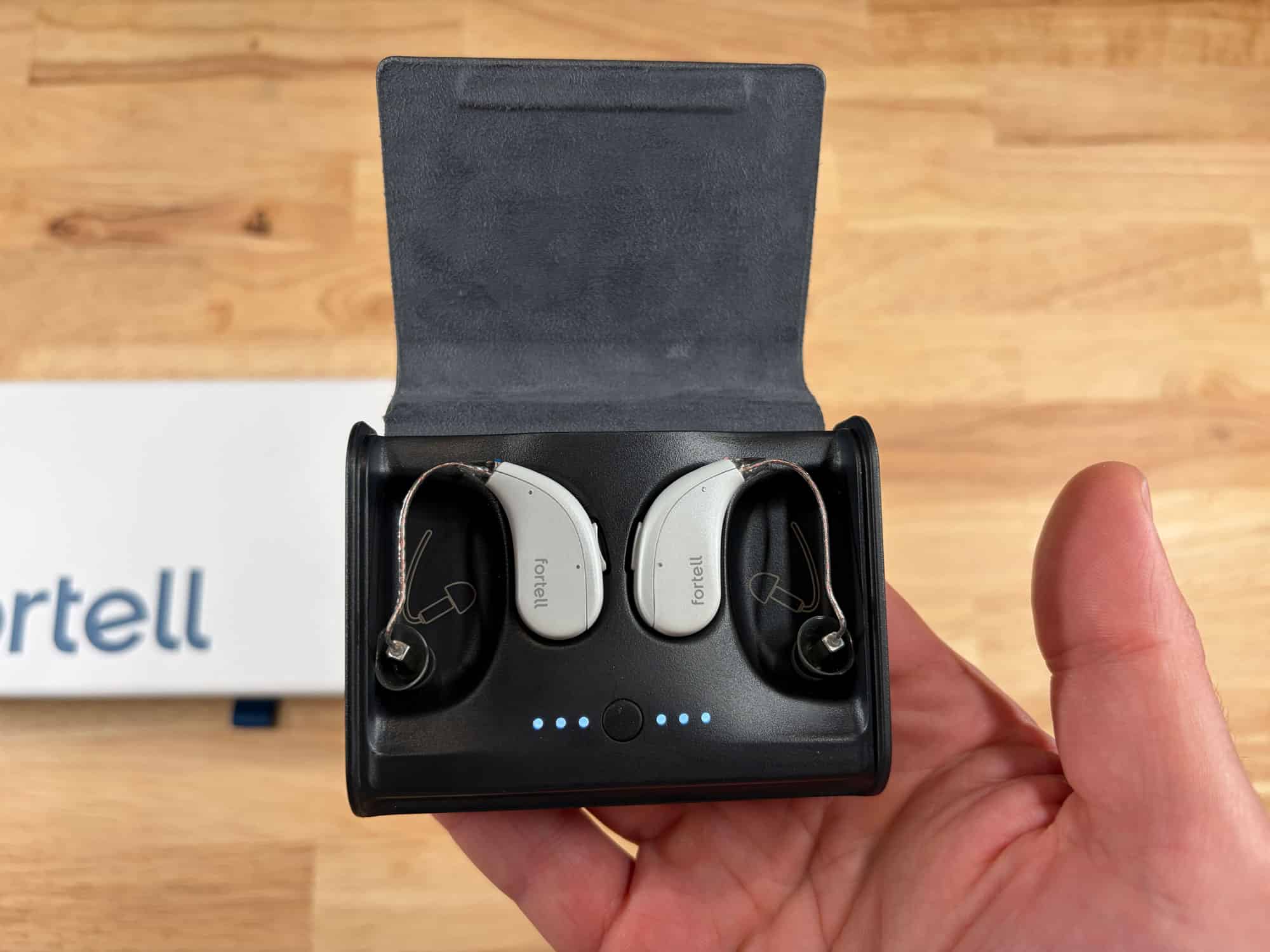
Fortell has made one of the boldest claims in hearing technology: that its Spatial can substantially reduce the “cocktail-party problem” by separating the voices you want to hear from competing speech and background noise. After wearing these prescription receiver-in-canal () hearing aids for several weeks and testing them extensively in the HearAdvisor lab, I can confirm that Fortell is doing something genuinely different than most other top prescription hearing aids.
Fortell earned a 6.0 HearAdvisor SoundScore, exceeding what had previously represented the top of HearAdvisor’s scale (5.0). Speech-in-noise scores also surpassed 6.0, making Fortell the strongest performer HearAdvisor has measured in background noise, and vaulting it into first place in HearingTracker’s ranking of the best hearing aids in background noise.
But that doesn’t mean Fortell is a magical hearing aid. It still falls victim to the same acoustic principle as every other hearing aid: to achieve exceptionally good background noise performance, a hearing aid must limit the amount of noise that can enter the ear canal naturally. Otherwise the noise entering the ear canal can overcome the cleaner signal delivered by the hearing aid, reducing its effectiveness.
In Fortell’s case, its standard fitting process recommends a type of ear tip called a “power dome”, which blocks out as much of that unwanted sound as possible, while simultaneously delivering as much of the cleaned signal to the eardrum as possible. The downside of this type of configuration is the “occlusion effect” which causes one’s own voice to sound boomy when speaking. With the technology currently available on the market, this is an unavoidable compromise. Fortell does make less “occluding” domes available for those who cannot tolerate this own voice effect, but keep in mind that this will reduce background noise performance to some degree.
At $6,800 per pair, Fortell is priced alongside other premium prescription products. The price includes 5 years of audiological care, a 3-year warranty, 3 years of loss-and-damage coverage, and a 100-day home trial.
About our testing: This review combines hands-on evaluation for HearingTracker with standardized laboratory testing from HearAdvisor. The companies are separate but have overlapping leadership, and author Steve Taddei is also HearAdvisor’s co-founder and lab director. HearAdvisor determines its testing methods and SoundScores independently of manufacturers; HearingTracker is responsible for this review’s editorial conclusions.
Compare prices & care
Compare sellers and the care included. Prices are per pair.

100-Day Home Trial
- Single price, no technology tiers
- Five years of audiological care included
- Three-year warranty plus loss and damage
- In-person and remote fitting
- Financing through Affirm
Never miss a price drop
Get notified when prices drop for this product
Quick Take
Fortell delivered exceptional speech-in-noise performance in the manufacturer-independent HearAdvisor lab, with a striking “voice-pop-out” effect in my everyday testing. It belongs on the shortlist for iPhone users whose greatest challenge is understanding speech in loud restaurants, parties, or other complex environments.
However, there are some tradeoffs to weigh against that exceptional performance. To get the very best performance in background noise, you will need to accept some degree of own-voice effect. I also experienced some iPhone streaming dropouts while moving around the lab, and Fortell does not support Android yet.
Another consideration is the limited number of Fortell-owned clinic locations. Unless you're in the handful of cities where Fortell has a footprint, you'll need to travel in for in-person care or check out Fortell's telehealth option.
Also, unlike the traditional hearing aid manufacturers, Fortell does not make a suite of proprietary accessories (like remote mics) available. However, Fortell argues that it supports “a rich ecosystem of third-party accessories via ,” the latest accessibility protocol from Bluetooth.
What Are Fortell AI Hearing Aids?
Fortell is a relatively new hearing aid company that built its first product around a custom machine-learning processor and a technology it calls Spatial .
Many modern hearing aids use artificial intelligence and deep neural networks () to identify whether you are in a restaurant, car, quiet room, or another acoustic environment. The hearing aids then adjust features such as directionality, compression, and noise reduction.
Fortell takes a different approach. Rather than simply identifying that you’re in a restaurant and turning on stronger noise reduction or directionality, as was common in the past, Fortell says its DNN continuously analyzes sound arriving at the microphones and attempts to separate important voices from competing sound in real time—and all of it happens inside the hearing aid.
:format(webp))
The company’s original software—now called Fortell 1.0—established this source-separation approach. It was trained extensively on what’s called synthetic data: computer-generated acoustic scenes that let Fortell expose the model to a wide variety of simulated listening environments. The system could then process separated sound sources differently based on what they were and where they originated.
Released as a free software update in August 2026, Fortell AI 2.0 runs on the same hearing aid hardware, but its neural network was retrained using a much larger collection of real-world recordings from restaurants, cafés, public transportation, construction sites, cars, and reverberant offices and homes. Fortell says it went to great lengths to obtain this data from real-life settings. It also revised several conventional signal-processing algorithms to improve speech clarity without making voices sound less natural. Read more about the Fortell AI 2.0 update.
Fortell says its Spatial AI approach operates deeper in the signal-processing chain: four microphones across the pair of hearing aids capture timing, level, spectral, and spatial information. The company has built a dedicated machine-learning coprocessor chip for this task that is said to perform up to 100 billion operations per second, offers roughly 235 times the computing capacity of a conventional hearing aid processor, and maintains end-to-end latency (the delay between sound entering the microphone and exiting the receiver/speaker) below 10 milliseconds.
Below are the major Pros and Cons of Fortell 2.0 hearing aids.
What we loved about Fortell 2.0 hearing aids
- Exceptional speech-in-noise performance: Fortell produced the strongest speech results measured under HearAdvisor’s current protocol.
- Noticeable voice separation: Front Voices can create a striking voice-pop-out effect in difficult listening environments.
- All-day battery life: Fortell reports more than 24 hours per charge with Spatial AI operating continuously.
- Excellent comfort and handling: The aids were comfortable behind my ears, and the physical controls and magnetic charging system were easy to use.
- Useful app and remote care: The app offers practical controls, adjustable AI strength, remote fittings, and over-the-air updates.
- Operational support: Wearers can connect to compatible Auracast broadcasts and devices through the Fortell app.
- Five years of care: Excellent audiologist-guided initial fitting, and a bundled professional-care package for 5 years of pro online/in-person support.
Drawbacks
- Own-voice tradeoff: The relatively occluding fitting contributed to a low own-voice score with its standard fitting approach.
- Aggressive processing: Sudden sounds can temporarily pull down speech along with the rest of the acoustic scene.
- Bluetooth instability: I experienced more streaming dropouts than with many established prescription hearing aids.
- No Android support: Direct streaming and the Fortell app are currently limited to Apple devices.
- Limited clinic footprint: In-person service is available in far fewer locations than with major hearing aid brands.
- Smaller accessory ecosystem: Fortell does not offer the same range of proprietary wireless accessories as larger manufacturers, although a larger universe of devices is quickly developing for -enabled hearing aids.
- Premium price: At $6,800 per pair, Fortell is expensive even with five years of care included.
:format(webp))
Lab Data: Move Over for a New Leader in Hearing in Noise
HearAdvisor is our partner lab, where I serve as lab director and conduct standardized acoustic testing. We evaluate every hearing aid using the same protocol, same hearing loss, same acoustic environments, and same laboratory setup so we can make apples-to-apples comparisons across products.
Fortell’s speech-in-noise results were so unusually strong—the best we had measured—that I went back, retested, and ran the numbers again to make sure it wasn’t a fluke. The results held.
Understanding the results
HearAdvisor uses a standardized mild sloping to moderate hearing loss and a KEMAR acoustic manikin to measure two hearing aid fit configurations. For Fortell, both fits used a closed power dome, standard receiver, and "All-day : All Voices" setting. Initial Fit was set to the defaults Fortell's software recommended for the mild sloping to moderate hearing loss; Tuned Fit used Fortell's gain controls to adjust toward prescribed amplification targets for the same hearing loss.
Fortell AI Hearing Aids
Fortell earned an overall 6.0 SoundScore, while its speech-in-noise scores exceeded 6.0 at both the Initial and Tuned fits. These are the strongest speech results HearAdvisor has measured to date.
So how do you get a 6.0 on a 5-point scale? HearAdvisor’s simplified scores are anchored to previous performance benchmarks. A 5.0 represents what had historically defined top-level performance, but it is not a “hard mathematical ceiling.” A score above 5.0 means Fortell exceeded the performance that previously established the top of HearAdvisor’s scale under the tested conditions.
It does not mean that every user will receive “6 out of 5” performance. These results apply to HearAdvisor’s standardized test hearing loss, fitting, acoustic coupling, listening scenes, and measurement methods.
And there’s an important fitting caveat. As mentioned in the introduction, Fortell recommends a more occluding power dome for HearAdvisor’s target hearing loss, which the company says reflects its normal fitting approach. However, a less occluding dome is more common for a typical mild-to-moderate hearing loss.
The power dome provides greater acoustic isolation and may help Fortell’s control the sound reaching the ear. But it also traps more of the wearer’s voice inside the ear canal. Fortell absolutely crushed the speech metrics; however, its Own Voice score was only 1.5, which is 1.1 points lower than average for all hearing aids we’ve tested.
:format(webp))
I plan to retest Fortell’s product with the optional open dome to see how well its performance holds up with a less closed ear canal. I also plan to conduct additional testing with another leading hearing aid using more closely matched acoustic coupling. That should help us better understand how much of Fortell’s measured advantage comes from its processing and how much may be influenced by the occluding fit.
For now, the takeaway is simple: Under the way Fortell says it would actually fit HearAdvisor’s target hearing loss, speech-in-noise performance was exceptional. You can hear for yourself in the recording samples below and the other sound files available on the HearAdvisor website.
Performance for speech in quiet and streamed music, as well as feedback handling, was exceptional.
:format(webp))
Overall Real-World Performance Testing
Acoustic performance is obviously essential, but even outstanding lab results don’t guarantee that you’ll enjoy everyday use of a hearing aid. Comfort, battery life, connectivity, app features, build quality, professional support, and cost all shape your day-to-day ownership experience. Our HearingTracker Score is designed to capture that broader picture.
Fortell earned an overall HearingTracker Score of 4.5 out of 5, combining its HearAdvisor lab SoundScore with those practical considerations. You can see the HearingTracker Scores for the individual attributes in the summary box below.
Fortell scored especially well for sound performance, comfort, handling, battery life, and app usability. Bluetooth reliability, premium pricing, and more limited access to local professional care reduced the overall rating.
Fortell delivers the best background-noise performance we've seen, but its aggressive processing, lack of Android connectivity, and limited in-person clinic network are important tradeoffs.
Expert Review
Design, Comfort, and Charging
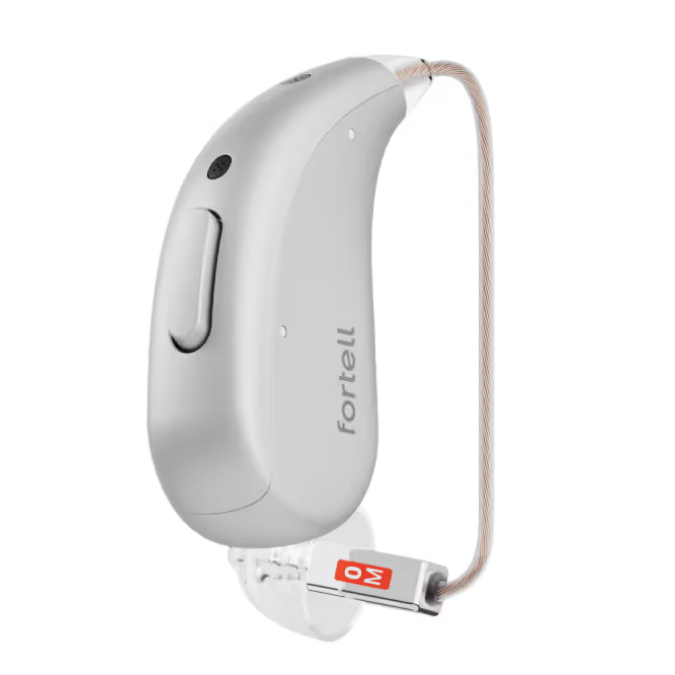
Physically, Fortell looks much like a contemporary rechargeable hearing aid. Each device has two microphones, a receiver wire, and a multifunction rocker switch.
The hearing aids are slightly larger than some of the newest “micro” RIC devices, like the Phonak EON or ReSound Sensia, which isn’t really surprising. Several manufacturers have produced larger hearing aids to accommodate the chips and battery capacity needed for intensive processing, and are now miniaturizing them. Fortell still fit comfortably behind my ears without interfering with my glasses or creating retention problems.
:format(webp))
The devices also feel well built, although their reported IP54 rating provides less waterproof protection than the IP68 rating commonly found on premium prescription hearing aids. Regular cleaning and careful handling, particularly around water, will therefore be important.
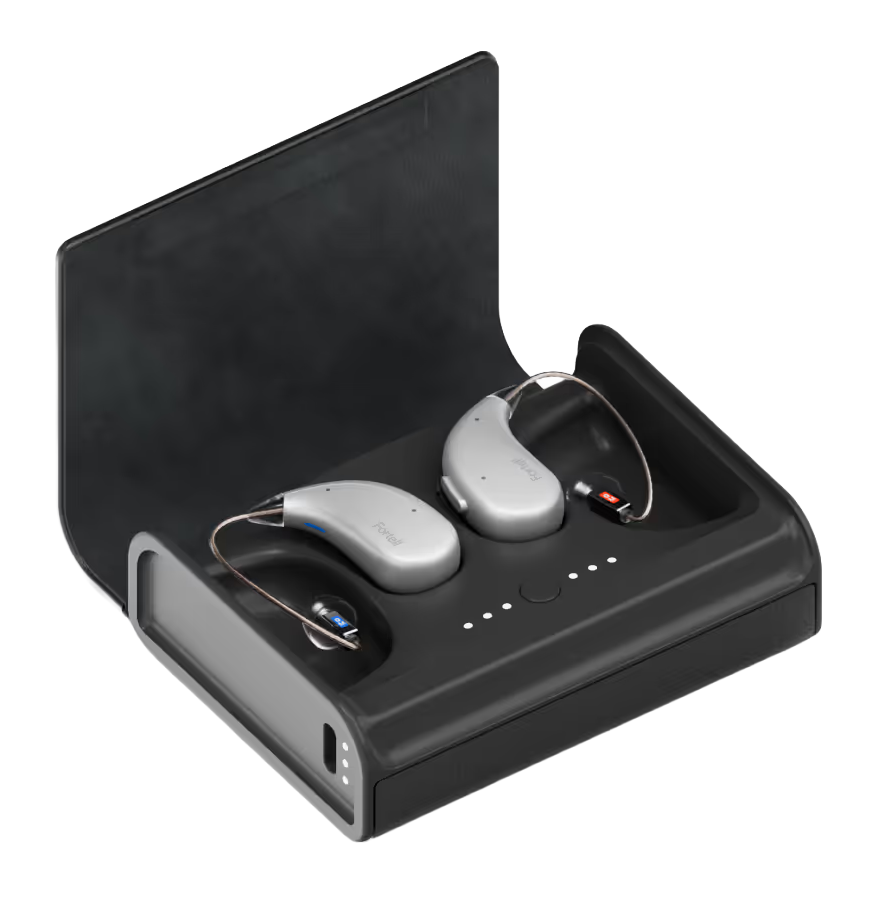
The portable charging case is one of the nicer cases I have used. It has a leather or leather-like exterior, strong magnets, and a side-loading design that makes the hearing aids easy to insert and remove. Because each aid fits only one way, there is little ambiguity about whether it has been positioned correctly.
:format(webp))
Separate LED indicators show the battery status of the left aid, right aid, and charging case. The case charges through USB-C and Fortell says it provides more than 72 hours of additional use—approximately three full recharges.
Fortell rates the hearing aids for more than 24 hours per charge with Spatial operating continuously. That is notable because -based processing can require considerable power. Even people who frequently use the more processing-intensive AI settings should generally have enough battery capacity for a full day.
Controls, App, and Listening Modes
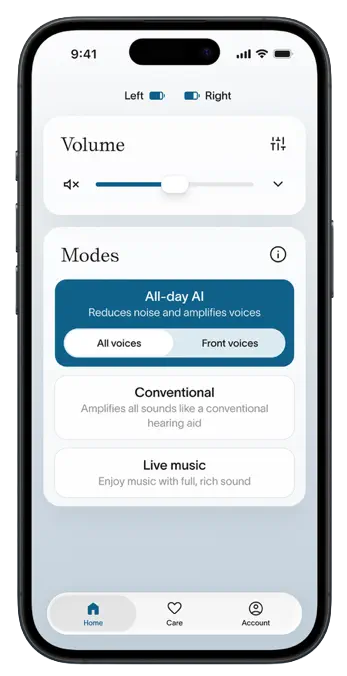
The Fortell app is relatively straightforward. Its main screen provides volume control, individual battery status, program selection, a three-band equalizer, separate streaming adjustments, and access to your Fortell audiology team.
Fortell provides three principal listening modes, with two voice settings within All-day AI:
- All-day AI is the default everyday mode. It emphasizes speech and suppresses other sounds, with two settings:
- All Voices maintains greater awareness of people and activity around the wearer, including voices behind you.
- Front Voices is the more aggressive option. It focuses on conversation in front of you while substantially reducing competing voices and noise from the sides and behind.
- Conventional turns off Fortell’s distinctive source-separation processing and behaves more like a conventional premium hearing aid.
- Live Music reduces speech-focused processing to preserve more of the dynamics and character of concerts and other live performances.
:format(webp))
Unlike many premium prescription hearing aids, Fortell does not automatically switch among these programs. After testing the devices, I understand why. The differences between the programs are large enough that selecting the wrong one automatically could remove something—or someone—you actually want to hear.
The physical controls also reduce the need to reach for the app. The left hearing aid controls volume, while the right hearing aid changes programs.
Now this next point will be a big disappointment to many of you: Connectivity is currently very Apple-centric. You get Made-for-iPhone connectivity across iPhone, iPad, and Mac, and Fortell is already Auracast-enabled—not merely -ready. However, Android devices are not supported, and Fortell currently has no announced timeline for adding Android support. Fortell also does not offer a telecoil for induction loop systems.
But Fortell’s remote care is more advanced than you might expect from a newer company. After the initial appointment, a Fortell audiologist can conduct a live remote-fitting session, send adjustments for you to install later, and deliver over-the-air software and firmware updates. And for those who can't make it into the clinic physically, there's a fully remote option as well.
What Fortell’s AI Was Like in Everyday Use
The laboratory results were not merely numbers on a graph. In everyday use, I heard a pronounced voice-pop-out effect, particularly in Front Voices. Speech directly in front of me could sound distinctly separated from the activity surrounding it.
However, Fortell’s approach can also be aggressive. Sounds such as clapping my hands, flipping a light switch, or opening my Yeti bottle could trigger a noticeable but temporary drop in the entire acoustic scene—including speech. If you listen closely, you can hear a pumping effect as the overall level falls and then recovers.
That response can be very helpful when dishes clatter or someone slams a door. Although this type of processing is inherently unnatural, Fortell responds quickly enough that the effect generally works well. Still, All-day AI may react more enthusiastically than some listeners prefer.
Fortunately, the app includes an adjustable AI control under:
Account → Preferences → App Customization → Adjustable AI Level
I would absolutely experiment with this setting. Fortell’s audiologists can also help adjust the AI level according to your hearing needs and sound preferences.
The occluding power dome deserves equal attention during the trial. Some people adapt to an occluded sensation and their amplified voice without much difficulty. Others strongly dislike it. Maximum speech-in-noise performance does not automatically equal the best overall fitting for every wearer.
Bluetooth and Streaming
Streaming music sounded perfectly respectable when the connection remained stable. My concern was reliability.
I experienced considerably more Bluetooth dropouts than I typically encounter with other premium prescription hearing aids. Dropouts sometimes occurred when my phone was in my pocket and my body moved between the phone and hearing aids (e.g., when I knelt to tie my shoe). Audio could also cut out when I left my phone on a table and walked into another room.
HearingTracker is discussing these results with Fortell to determine whether they reflect the product more broadly or were specific to my phone and test devices. Until we know more, people who depend heavily on Bluetooth streaming should pay particular attention to connection stability during the trial period.
Unfortunately, Android users have a more fundamental limitation: Fortell currently does not support Android phones.
:format(webp))
Price and Professional Care
Fortell costs $6,800 per pair. That is a substantial investment, but it is broadly consistent with what many clinics charge for premium prescription hearing aids with professional care.
The price includes 5 years of audiological care, a 3-year manufacturer warranty, 3 years of loss-and-damage coverage, and a 100-day trial. Note that Fortell’s return policy includes a non-refundable $300 fitting fee—a professional-service charge that is common, though not universal, when prescription hearing aids are returned.
Unlike many manufacturers, Fortell offers only one technology level rather than selling lower-priced versions with some processing features disabled. In addition to its free upgrades, this is another thing I like about Fortell.
One significant limitation is the availability of in-person service. Fortell is much smaller than Phonak, Oticon, ReSound, Signia, or Starkey, and currently operates clinics in New York City; Greenwich, Conn; and Palm Beach, Fla. A Boston clinic is coming soon. Fortell has also announced plans to expand to San Francisco, Palo Alto, Los Angeles, and Miami. Fully remote care is available in 35 states.
Fortell also lacks the same in-house accessory ecosystem offered by more established manufacturers. It doesn’t have the extensive selection of proprietary TV streamers and available from some major brands. However, with more and more third-party accessories (HDMI TV streamers, optical TV streamers, Type-C streamers for computers, Android phones, remote mics, etc.) appearing every day, I wouldn’t consider this a major drawback.
Another Wearer’s Experience with Fortell AI
Experienced hearing aid wearer and HearingTracker guest contributor Ben Gailor also tried Fortell 2.0 for approximately 50 hours during a weekend in New York City. He reported that Front Voices dramatically separated a speaker in front of him from another behind him on busy Park Avenue. He subsequently followed conversations on the subway, along a noisy Brooklyn street, at a luncheon filled with adults, children, and cross-talk, and inside a busy takeout restaurant. In the car, he found that Fortell substantially reduced road noise while allowing him to hear his wife and the radio. He also measured more than 25 hours of battery life without recharging.
:format(webp))
Ben came away believing Fortell performed considerably better for him than both his 3-year-old hearing aids and another premium model he tested. His full account, together with our AI 2.0 launch coverage, also summarizes three Fortell-backed research studies on the technology: a 30-participant speech-intelligibility study, a peer-reviewed listening-preference study involving 20 adults, and an 80-scene technical comparison between 2.0 and AI 1.0. All three reported significant advantages for Fortell, although people affiliated with the company funded, conducted, or coauthored the studies. Their findings are therefore best considered alongside the HearAdvisor results and real-world wearer experiences.
Final Verdict
Fortell is one of the most interesting prescription hearing aids I have tested in a long time. Its appeal is not based merely on placing “” on the box. The speech-in-noise performance is genuinely impressive—the best we’ve seen from both my listening experience and HearAdvisor’s objective measurements.
If you use an iPhone and your number-one complaint is difficulty understanding speech in loud restaurants, parties, meetings, or other complex environments, Fortell absolutely belongs on your shortlist—especially if recent conventional hearing aids have not provided enough separation between speech and competing sound.
I would be more cautious if you use Android, depend heavily on Bluetooth streaming, want access to a large proprietary accessory ecosystem, or cannot conveniently access Fortell’s clinics (and don't want remote care). And for those who can't stand hearing their own voice in their ears, you may want to wait for HearAdvisor's open-dome test results.
If you already own a recent flagship hearing aid and are satisfied with it, I would not rush out and spend another $6,800 simply because Fortell scored higher in HearAdvisor's lab. But for people whose primary hearing problem remains separating conversation from competing noise, Fortell produced some of the most convincing performance I have heard and measured.
)
Steve Taddei, AuD
Doctor of AudiologySteve Taddei, Au.D., is an audiologist, co-founder and lab director of HearAdvisor, and a hands-on hearing aid and earplug reviewer for HearingTracker. He holds an audio engineering degree from Columbia College Chicago and a doctorate in audiology from Northern Illinois University. He also teaches as an adjunct faculty member at several colleges.
)
Abram Bailey, AuD
Founder and PresidentDr. Bailey is a leading expert on consumer technology in the audiology industry. He is a staunch advocate for patient-centered hearing care and audiological best practices, and welcomes any technological innovation that improves access to quality hearing outcomes. Dr. Bailey holds an Au.D. from Vanderbilt University Medical Center.