Phonak Eon Debuts Smaller Sphere, Auracast, and WindBlock
The new platform shrinks Audéo Sphere, expands access to Spheric Speech Clarity, and adds Auracast, stronger wind-noise management, and up to 38 hours of battery life.)
Hearing aid glossary
Looking that up…
Terms are matched automatically. A definition may not fit every context.
Two years after introducing the extremely successful Audéo Sphere Infinio—and refining it in 2025 with the Sphere Infinio Ultra firmware update—Phonak is launching the third generation of its -driven Sphere hearing aid in a substantially smaller package.
The new Phonak Eon platform is built around three themes: clarity, connectivity, and a discreet design. The portfolio includes the rechargeable Audéo Eon Sphere, the conventional Audéo Eon R receiver-in-canal () hearing aid for people with mild to profound hearing loss, and Eon R for unaidable hearing in one ear (i.e., single-sided deafness).


Like the previous Infinio Sphere generation, Eon Sphere remains a dual-chip hearing aid, pairing the new Hypersonic chip for Spheric Speech Clarity 3.0 with Phonak’s ERA chip for Bluetooth, Roger, and connectivity. At the center of Eon are two complementary AI systems:
- Spheric Speech Clarity 3.0 uses deep neural network () processing to separate speech from background noise in real time, improving access to conversation in difficult listening environments.
- AutoSense OS AI 8.0 continuously analyzes the sound environment and automatically decides when to activate features, such as Spheric Speech Clarity, directional microphones, and noise reduction—and now keeps them engaged more consistently as conditions change.
The launch also brings Auracast broadcast audio, WindBlock 2.0, 4.0, two new chargers, enhancements to Phonak Target fitting software, and updates to the myPhonak and myPhonak Junior apps.
:format(webp))
“Eon stands for clarity you hear and connection you feel,” said Gareth Griffiths, Phonak Global Marketing and Campaign Director, during a preview held for members of the media in July. “We have created a better way to experience life through sound, through adaptive clarity, unlimited connections, and intuitive design.”
Phonak EON is available in the United States through hearing care professionals starting today, with Germany, France, the United Kingdom, Australia, and additional markets following in September. Unlike Infinio Ultra, which Phonak made available to existing Infinio users through a firmware update, Eon requires new hardware. Its smaller Sphere design and other new capabilities depend on the new Hypersonic chip, meaning current Infinio and Infinio Ultra hearing aids cannot be upgraded to Eon through software alone.
Making Sphere lighter, smaller, and more cosmetically appealing
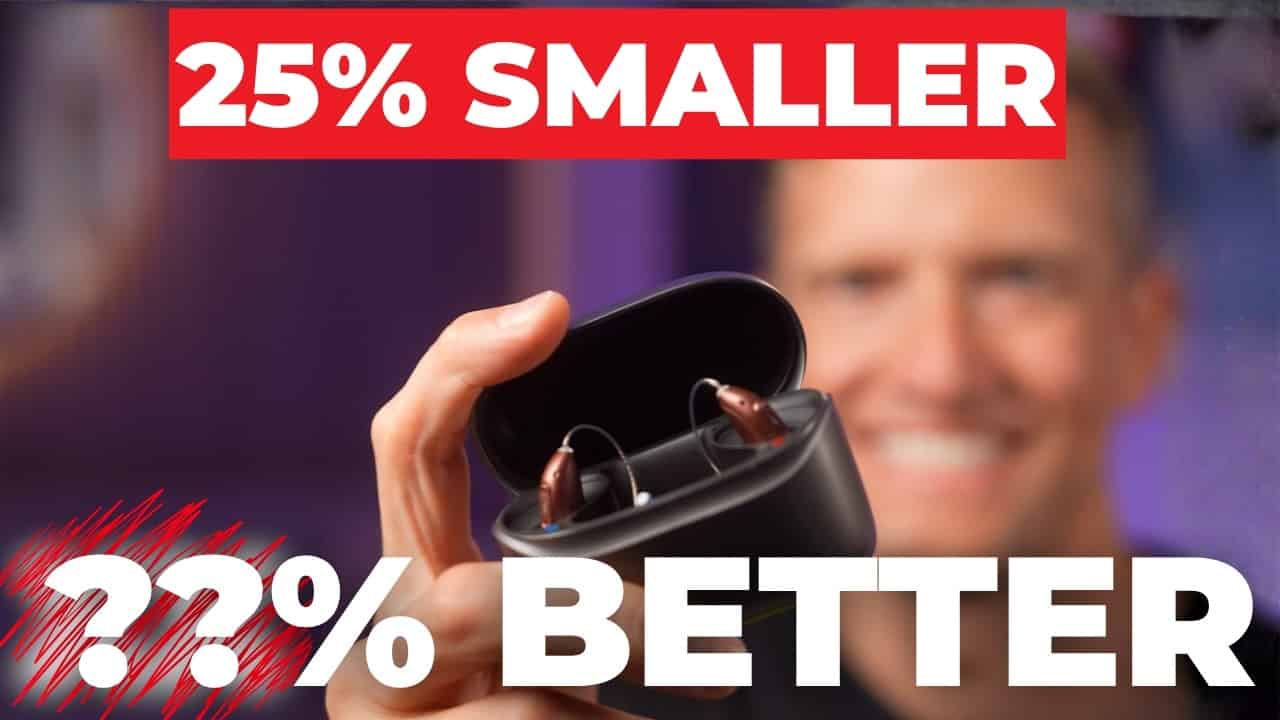
The most immediately visible change is the physical design of Audéo Eon Sphere. Phonak says it is 25% smaller and 20% lighter than the previous Sphere generation, bringing it considerably closer to the dimensions consumers expect from a conventional hearing aid.
That addresses one of the biggest trade-offs associated with the original Sphere and Sphere Ultra: while it delivered what HearAdvisor measured as the industry’s best speech-in-noise performance, it required a larger housing and substantial battery power than most competing -based hearing aids.
:format(webp))
With Eon, Phonak says its new Hypersonic chip and a more efficient speech-processing algorithm allow the company to maintain Sphere’s real-time performance while using 37% less power than the previous generation.
Phonak now specifies up to 38 hours per charge, although actual runtime will depend on factors like your hearing loss, audio streaming, listening environments, and battery age. In a more demanding example presented during the Eon preview, Phonak cited about 22 hours of operation with 8 hours of streaming and time spent in noise.
Michael Preuss, Phonak Senior Audiology Manager and a hearing aid wearer with severe-to-profound hearing loss, said that after a day involving nearly 7 hours in noise and roughly 5 hours of streaming, his Eon devices still showed about 20% to 25% battery capacity.
Two chargers are available for the new Eon: the Charger E desktop charger and the ChargerGo RIC I EON portable charger which includes its own battery for charging away from an outlet. Eon comes in 8 colors, including a new Sienna Red.
:format(webp))
Spheric Speech Clarity offered in more technology levels
At the center of Audéo Eon Sphere is Spheric Speech Clarity 3.0, the latest generation of Phonak’s speech-separation system for difficult listening environments.
The basic strategy remains the same as the original Sphere: speech is separated from background noise in real time so it can be enhanced before the acoustic scene is reconstructed. This allows Sphere to go beyond conventional directional microphone processing when several people or competing sounds surround the wearer.
Phonak’s new materials cite an benefit of up to 10 in complex group conversations and say Spheric Speech Clarity can make users twice as likely to understand every word from any direction compared with the same hearing aid settings without the feature.
Anders Rosengren, Sonova Chief R&D Officer in a press statement.With the HYPERSONIC™ chip, we have engineered a significant step forward in power efficiency without compromising real-time AI performance. This allows EON to deliver advanced speech processing in a smaller, lighter design while supporting the all-day reliability people expect from Phonak.
Importantly, Phonak is not claiming a dramatic jump in Sphere speech-in-noise performance over Infinio Ultra. Preuss said the goal with Eon was largely to preserve the performance already established by Sphere while delivering it more efficiently and in a much smaller device.
What has changed is access. Spheric Speech Clarity was previously confined to Phonak’s top two performance levels. With Eon Sphere, the “Sphere Mode” is now available at Premium 90, Advanced 70, and Standard 50, putting Phonak’s most powerful speech-separation technology in the ears of more users.
Preuss, who has worn hearing aids since age 3, described the technology as changing his assumptions about what was possible in noise. “Growing up with a severe-to-profound hearing loss, you often think that not being able to understand in noisy environments is a limitation caused by the hearing loss,” he said. “When I tested Spheric Speech Clarity, I realized that, until then, the technology had been the limiting factor.”
:format(webp))
AutoSense keeps Sphere Mode working longer
Eon also introduces AutoSense OS 8.0, Phonak’s latest automatic operating system. AutoSense continually analyzes the acoustic environment as often as 700 times per second and blends amplification, directional microphones, noise reduction, and other features according to the situation.
A key change in version 8.0 concerns not simply recognizing a noisy environment but deciding when to leave it. Consider a restaurant where the overall listening situation remains noisy but briefly gets quieter as conversations ebb and flow or people leave nearby tables. Previous versions could occasionally drop out of the Speech in Loud Noise program during those fluctuations. AutoSense 8.0 uses a different threshold for leaving the program than for entering it, so a more sustained acoustic change is required before the hearing aid switches away.
In a Phonak technical evaluation using the same 30-minute lunchtime recording with Infinio Ultra and Eon, the new system produced about 20% more Speech in Loud Noise activation. The practical aim is to keep features such as Spheric Speech Clarity operating more consistently when the wearer still needs them, rather than repeatedly switching on and off.
Clinicians can also adjust the activation level in Phonak Target for patients who want Sphere processing to engage more or less aggressively (i.e., in moderately noisy or only very loud environments).
APD 4.0 targets changing environments
Eon also introduces Adaptive Phonak Digital 4.0 ( 4.0), the latest version of Phonak’s proprietary fitting formula.
A hearing aid fitting formula determines how amplification is employed across frequencies and input levels. With APD 4.0, Phonak says the emphasis is on maintaining higher sound fidelity as listening environments change.
:format(webp))
One example offered during the launch was a conversation near a coffee machine that suddenly starts operating. Instead of requiring the wearer to fumble for the app or onboard button, Eon is designed to adjust automatically while preserving speech and sound quality as the listening environment changes.
WindBlock 2.0 tackles a persistent hearing aid problem
Although it’s a feature that might be overlooked by some, Eon also introduces WindBlock 2.0, which is said to reduce microphone wind noise by as much as 50 and improve by up to 30 dB under certain conditions. It’s available across all Eon tech levels.
Wind presents a peculiar problem for hearing aids because wind striking the microphone openings creates pressure fluctuations that can overwhelm the sound a wearer wants to hear. Rather than simply cutting low-frequency sound whenever wind is detected, WindBlock 2.0 compares the two microphones, then places greater emphasis on the microphone that is less affected by wind. The goal is to reduce the disruptive buffeting a user might hear, while preserving more speech and environmental sounds.
A Phonak Audiology Research Center study involving 19 experienced hearing aid users compared WindBlock 2.0 with the previous version under different wind speeds and directions. Participants generally preferred the new system for overall sound quality, listening comfort, effort, naturalness, and speech clarity, with the strongest advantage when wind came from directly in front.
Preuss said he has noticed its benefits while cycling, hiking, running, walking through windy streets, riding with a car window open, and even sitting near office fans. “For the first time, listening to the radio with the car window down was suddenly possible,” he said.
Auracast joins Phonak’s broad Bluetooth connectivity
Phonak has long differentiated its hearing aids through broad compatibility with standard Bluetooth devices. Eon retains the company’s “Made for All” approach and adds Auracast broadcast audio alongside Bluetooth Classic and RogerDirect.
can send audio from compatible public transmitters directly to hearing aids in theaters, conference centers, airports, museums, arenas, and other venues. Eon users can join a compatible broadcast by scanning a QR code in the myPhonak app or using the Auracast assistant on compatible smartphones.
:format(webp))
The hearing aids continue to support hands-free phone and computer calls, using the hearing aid microphones to pick up the wearer’s voice.
Griffiths described Eon as the first hearing aid to combine Phonak’s broad Bluetooth compatibility, RogerDirect, and in one device.
Tested near the North Pole
To demonstrate Eon outside the laboratory, Phonak gave a pair to Amanda Klekowski von Koppenfels, PhD, a University of Kent scholar and experienced Arctic adventurer who became the first person outside Phonak to test the platform.
She wore Eon during a weeklong ski expedition across glaciers in Svalbard, where temperatures dropped to around 3° F (-16° C). Klekowski von Koppenfels described hearing as both a safety issue and a way to remain fully involved with the group. Team members took turns on polar-bear watch, and she recalled spending about 90 minutes alone on watch near midnight.
:format(webp))
On another occasion, the group heard a cracking sound and stopped to determine whether it came from hard-packed snow or the glacier underneath. “The key point is that I was part of the discussion,” she said. “I wasn’t standing off to the side nodding and pretending that I had heard something. I heard the crack, and I could participate in the conversation.”
She also reported being able to converse while skiing through wind and crunching snow. At times, she said, expedition members without hearing loss were asking her to repeat what had been said. “With Eon, I didn’t have to think about hearing,” she said. “I just heard.”
:format(webp))
What Eon changes—and what it does not
HearingTracker thinks Eon looks more like a substantial evolution of Sphere than a reinvention of it. Phonak is retaining the core -powered speech-in-noise performance that made Infinio Sphere and Sphere Ultra successful, while addressing some of its more obvious limitations and extending its capabilities, namely:
- Sphere is now smaller and lighter;
- Spheric Speech Clarity 3.0 is now available down to the Standard 50 performance level;
- AutoSense 8.0 is designed to keep the processing active more consistent and appropriate;
- WindBlock 2.0 improves outdoor listening;
- 4.0 is designed to preserve higher sound fidelity as listening environments change, and
- expands Phonak’s already broad connectivity capabilities.
For people intrigued by Sphere but put off by its size, the redesigned housing alone could be Eon’s biggest improvement. For others, Eon may feel like a more complete realization of the dual-chip Sphere concept, combining its established speech-in-noise performance with broader access to Spheric Speech Clarity, more adaptive automatic processing, improved wind management, and connectivity.
Whether these changes make Eon worth upgrading to from Infinio Ultra will depend on the individual wearer. HearingTracker and the independent HearAdvisor lab will be testing the new platform and reporting the results in the near future.
Karl Strom
Editor in ChiefKarl Strom is the editor-in-chief of HearingTracker. He was a founding editor of The Hearing Review and has covered the hearing aid industry for over 30 years.