Starkey Launches Omega AI+ with Quad DNNs and DNN Dual Compression
The new platform adds DNN Dual Compression, enhanced Edge Mode, and Auracast support while extending DNN 360 to custom rechargeable hearing aids.)
Featured Products
Compare allHearing aid glossary
Looking that up…
Terms are matched automatically. A definition may not fit every context.
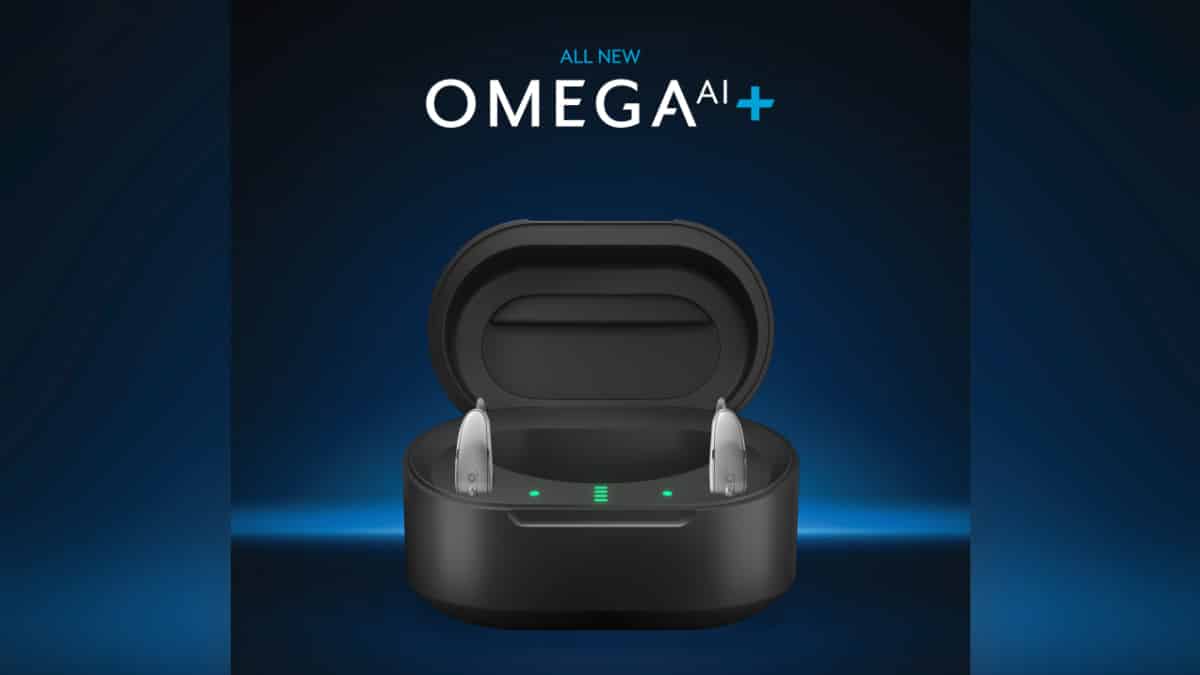
Starkey has launched Omega AI+, a new hearing aid family that expands its use of deep neural networks () to improve a fundamental hearing aid function: adjusting amplification so sounds remain audible, comfortable, and natural. The October 1 launch in Minneapolis also brings updated feedback management, expanded capabilities in custom hearing aids, a more flexible Edge Mode+, broadcast audio support, and a new sleep-tracking feature.
Building on Omega AI, the new AI+ platform uses Starkey’s G4 Gen AI Neuro Processing and what the company calls the new chip’s “breakthrough Quad DNN Architecture.” Four specialized neural networks work together on one super-fast chip to manage speech enhancement, noise reduction, directionality, spatial awareness, and—new with Omega AI+—an advanced DNN Dual Compressor.
Brandon Sawalich, Starkey president and CEOMost AI conversations focus on what's possible tomorrow. Our focus is on what can improve people's lives today. With Omega AI+, we bring brain-inspired technology into one of the most personal devices people wear, transforming hearing aids into intelligent systems to improve everyday life and give people an edge.


In an interview with HearingTracker ahead of the launch, Starkey CTO and VP of Engineering Achin Bhowmik, PhD, and Chief Hearing Health Officer David Fabry, PhD, emphasized that the goal extends beyond isolating speech in background noise; the technology also aims to preserve sound quality, listening comfort, and awareness of sounds around the wearer.
:format(webp))
What the fourth DNN adds
For decades, wide dynamic range compression () has helped hearing aids make soft sounds soft but audible while keeping louder sounds comfortable—fitting everyday sounds into the narrower usable hearing range of someone with hearing loss. As Fabry noted, a constant challenge is deciding how quickly the amplification should change. Fast-acting compression can help make brief speech sounds (e.g., sharp consonants) audible, while slower compression can reduce unwanted fluctuations in background noise, leading to a more stable, natural listening experience. Manufacturers have long used different combinations of these approaches to balance speech clarity, sound quality, and comfort across listening situations.
Starkey calls its new approach the world’s first Dual Compressor. According to Bhowmik, the system uses neural-network processing to determine when fast or slow compression is appropriate, reducing the need to compromise between speech audibility and sound quality. The goal, says Fabry, is to “use every bit of residual auditory area”—making the most of the wearer’s remaining hearing range while preserving clarity and comfort.
:format(webp))
“The loudness mapping is dynamic,” Bhowmik said. “It’s not doing slow or fast; it’s doing both, and it’s cognizant of the type of acoustic signals it’s dealing with.”
He explained that rapid changes in amplification can create a “pumping effect”—for example, when a brief keyboard click causes background sound to dip and then rise again. The new system is designed to reduce those artifacts when speech is absent while retaining the faster responses needed for speech.
Speech clarity with awareness of surrounding sounds
The other three functions build on Starkey’s DNN 360 technology introduced with Omega . Together, they target speech in noise, manage microphone directionality, and preserve awareness of sounds outside the wearer’s primary focus.
Strong directionality can help listeners follow someone in front of them while making other sounds harder to notice. But Fabry explains that the drawback is that it can be akin to wearing “acoustic blinders,” especially when someone behind the wearer is trying to get the hearing aid user’s attention.
Starkey’s approach also incorporates information from the hearing aids’ motion sensors. Whether the wearer is stationary or moving can help guide the directional response.
Additionally, the new G4 processor processes sound up to 2.7 times faster than leading hearing aids marketed with processing capabilities. Bhowmik says the new system helps preserve sound quality by reducing artifacts associated with delayed sound (latency), while Fabry notes that low latency also supports spatial awareness—the ability to identify where sounds are coming from. Additionally, faster processing can benefit people who wear a hearing aid in one ear and a cochlear implant in the other, helping bring the timing of acoustic and electrical sound delivery into closer alignment (Starkey partners with MED-EL in implant technology).
:format(webp))
Better feedback control and a more flexible Edge Mode
Omega + also introduces a redesigned feedback-management system to address the whistling that can occur when amplified sound leaks back to a hearing aid’s microphones.
Fabry said Starkey’s internal testing showed improvements in gain margin before feedback of 21 at mid frequencies and 11 dB overall, along with a 32 dB reduction in feedback artifacts. These changes could be particularly useful for people who need substantial amplification while also benefiting from venting to reduce the occlusion effect (i.e., the plugged-up or hollow perception of your own voice).
Starkey has also updated Edge Mode, its on-demand feature for additional help in particularly challenging listening situations. Bhowmik said the has been retrained using richer datasets. Users can now leave Edge Mode active, allowing it to continue adapting as their acoustic surroundings change rather than repeatedly activating it.
When working with patients, Fabry said he increasingly uses an everyday listening program plus Edge Mode, allowing them to gain immediate speech clarity or noise reduction when needed rather than having to switch among several preset programs.
Industry-leading battery life with more custom options and Auracast
The Omega + family extends DNN 360 to custom rechargeable hearing aids. Starkey is also adding custom non-wireless devices with Automatic Edge Mode—bringing environmental adaptation to its smallest custom styles.
Bhowmik said the additional DNN processing does not reduce battery life compared with the preceding Omega AI platform. In the interview, the executives cited up to 51 hours without streaming for the RT model and up to 42 hours for the mRIC and custom rechargeable products. However, actual runtime will depend on the model, audio streaming, listening environment, and the hearing aid’s age.
:format(webp))
Omega + also supports Auracast broadcast audio, with available broadcasts accessible through Starkey’s app. At equipped venues, the technology can deliver audio directly to compatible hearing aids—for example, from a television, public-address (PA) system, or presentation.
Sleep tracking and a reminder for misplaced hearing aids
Along with a balanced diet and regular exercise, good sleep is an important part of healthy aging—and an area Starkey is now addressing with its new Sleep Quality Tracking feature. The Omega AI+ feature uses onboard sensors to provide nightly sleep scores and information about sleep cycles and body position. It builds on Starkey’s broader wellness features, including activity tracking, fall detection, balance tools, and respiration-rate monitoring.
The company acknowledges that the practical requirement is that users wear their hearing aids while sleeping. However, the long battery life of Omega + makes both daytime and overnight use possible. Fabry noted that travelers with significant hearing loss often prefer sleeping with their hearing aids because they worry about missing a door knock or alarm. For these and other users interested in understanding their sleep patterns, the feature adds another reason to consider overnight wear, whether regularly or occasionally, depending on comfort and personal preference.
Fabry also pointed to potential interest among people with sleep apnea, noting that sleeping position can impact the condition. Along with sleep duration and restlessness, the feature provides information about whether users sleep on their back, side, or stomach—details they may want to discuss with a clinician.
However, he emphasized that the hearing aids do not diagnose or screen for sleep apnea or sleep disorders: “We’re not claiming that this is a diagnostic or even a screening tool.”
A new “hearing aid left behind” feature can also alert users when they walk away from their devices—a useful addition for someone who removes their aids briefly and then forgets to put them back in.
For Omega AI+, the central hearing advance remains the expanded role of processing. How those changes translate into everyday benefits will be a key question for clinical evidence, independent testing, and wearer experience as the new family reaches patients. The HearAdvisor lab will be testing these hearing aids soon and HearingTracker will report the results as soon as they’re available.
Karl Strom
Editor in ChiefKarl Strom is the editor-in-chief of HearingTracker. He was a founding editor of The Hearing Review and has covered the hearing aid industry for over 30 years.