ELEHEAR Delight Debuts at CES 2026: AI-Powered In-Ear OTC Hearing Aid
Leveraging its successful Beyond Pro platform, ELEHEAR has launched an impressively small, full-featured OTC hearing aid that targets speech clarity, comfort, Bluetooth streaming—and a wider user base.)
Featured Products
Compare allHearing aid glossary
Looking that up…
Terms are matched automatically. A definition may not fit every context.
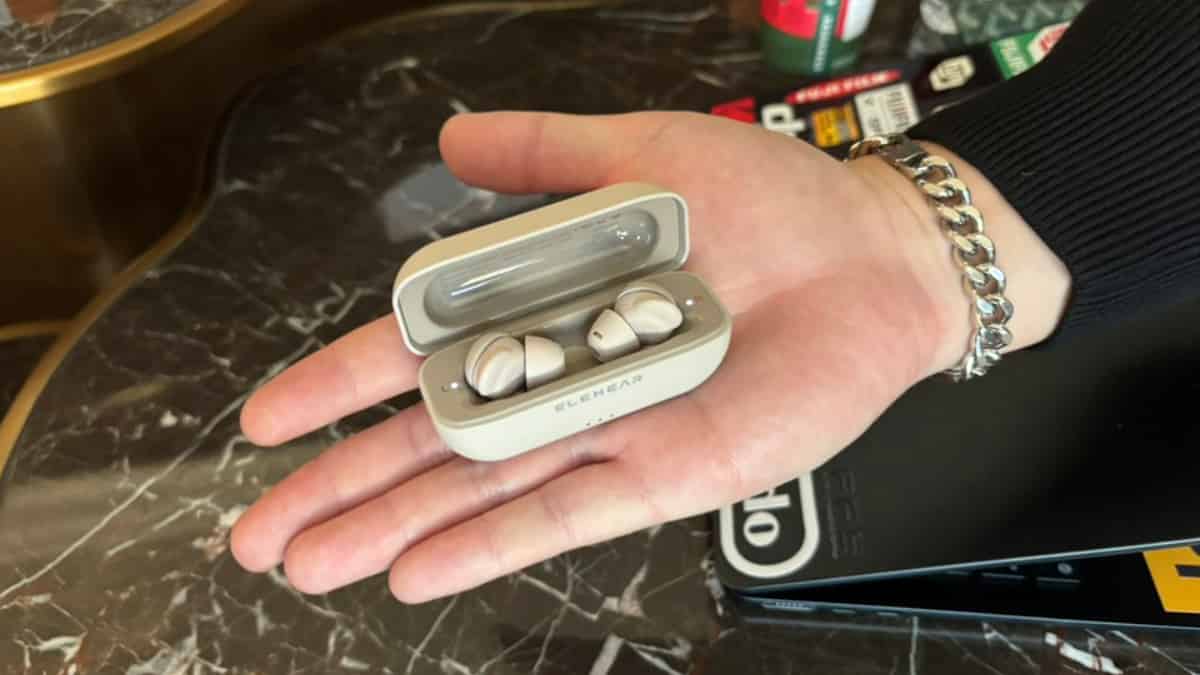
At CES 2026, ELEHEAR provided me with a peek at its new Delight over-the-counter () hearing aid - a small, -driven, hybrid in-the-ear device with Bluetooth audio streaming, and then let me take home a sample to try. I’ve been impressed. In my experience, Delight, priced at “above $349,” delivers clear speech in both quiet and noisy settings, with quality audio streaming and a versatile, easy-to-use app. Significantly, it builds on the company’s trusted Beyond Pro hearing aid platform—which has received an “A” SoundGrade and the 2025 Expert Choice Award from our independent HearAdvisor lab—and features a Deep Neural Network () sound-processing system for listening in noisy environments—the first that I’m aware of for OTCs.
From an industry perspective, the launch of Delight sends a meaningful signal: here is an in-ear, Bluetooth AI-powered OTC hearing aid that delivers credible speech-in-noise performance while competing with the comfort, “vibe,” and convenience expectations set by affordable mainstream consumer electronics earbuds. Delight’s regular price of "above $349” puts it around $100 of Apple’s AirPods Pro 3, but at this writing, ELEHEAR is offering a limited-time $329 early-bird pre-sale price.


At CES, I sat down for an interview and hands-on demo—primarily with ELEHEAR President/Managing Director David Hogan and VP of Sales Jeffrey Teng—to dig into what Delight is really trying to be, who it’s for, and why the company believes this smaller form factor may lead to some big things. (Disclosure: ELEHEAR helped sponsor my travel to CES, but my observations and conclusions remain independent and are my own.)
:format(webp))
Not Quite a “CIC,” but Small, Comfortable, and Built for Real Life
First, a point of contention: ELEHEAR calls Delight a (completely-in-canal) hearing aid. However, I think most hearing care professionals would likely consider it a small, hybrid in-the-canal () earbud rather than a traditional deep-canal CIC form factor. In fairness, the company's main product page and support materials lean heavily toward the consumer-audio aspect of the design as well.

I admit that I'm generally not a big fan of -type hearing devices, mostly because I have tiny ear canals. Although I wear earbuds like Apple AirPods Pro for short (1-2 hours) periods, I tend to have fit and comfort issues, as well as own-voice (occlusion) problems with them. As a hearing aid nerd/snob, I also have a bias for open-fit receiver-in-canal () hearing aids as the preferable all-day form factor, because they can pack more battery life, directional mics, and more processing behind the ear.
But Delight surprised me. It’s as comfortable as any in-ear-type device I’ve worn so far, and it includes a selection of tip sizes (both vented and unvented) plus “ear wings” that help secure it in the ear. Teng described the material as “wafer-soft silicone” and said the ear-wing design adds appeal for those who lead more active lives.
:format(webp))
If you dislike the aesthetics of behind-the-ear () hearing aids, or you want a discreet in-ear option but find many earbuds irritating, Delight’s new design is worth serious consideration.
Using Delight is, well, Delightfully Easy
ELEHEAR says its goal is to offer “best in show,” comfortable, clear sound with your choice of background noise attenuation. The company describes its VOCCLEAR 2.0® system as continuously learning and adapting to different environments to produce a more natural, immersive presentation, while features like Hybrid Feedback Cancellation are intended to reduce feedback/whistling and improve speech comprehension—especially in more challenging settings—helping lower listening fatigue over time.


Delight is designed for people on the go, and one thing I really like is its slick, pocket-friendly charging case. The hearing aids lock firmly into place when you release them inside the case, then turn off. While it’s possible to mix up the right/left, the aids protest with a noticeable squeal if you do.
ELEHEAR says Delight’s battery life depends primarily on how much audio you stream. In a mostly “hearing aid mode,” they estimate about 13.5 hours per charge; with some calls/streaming about 10 hours; and with continuous streaming about 5-6 hours. With its charging case providing about two additional full charges, the company told me that it can offer up to 40.5 hours of total battery life in hearing aid mode.
The ELEHEAR app, available for both Apple iOS and Android phones, handles the essentials—volume, tone/EQ, and program changes—while also offering more advanced tools, such as hearing tests and access to professional support via telecare. It does have a hearing test, but does not automatically calibrate the hearing aid in response to your test as some "self-fitting" hearing aids do. Instead, you can either rely on the presets or adjustments within the app, or submit the results of your hearing test to an ELEHEAR audiologist who will conduct remote programming for your hearing aid and then notify you when it's completed (usually in about 24 hours).
:format(webp))
The company is still refining the tap controls on Delight. For all hearing aids, I find tap controls often difficult to master, but the simple volume increase/decrease (with voice prompts) implemented in Delight’s tap controls make them easy enough to use.
Beyond amplification, ELEHEAR positions Delight as a broader “wearable” package, with Bluetooth streaming, multiple listening modes, multiple tinnitus relief sounds, and even real-time language translation.
Built for Life’s Situations and Activities
The most persuasive argument ELEHEAR made at CES wasn’t purely technical—it was practical. Delight is designed for more situations and user types, including for people who might be turned off by the look or feel of the traditional -type form factors.
BTE and receiver-in-canal () styles remain the most popular hearing aids for good reason. But Teng made a good point: for some people—especially glasses wearers—RICs can be finicky. Wire length, physical fit, and the interaction between frames and the hearing aid can become a daily nuisance. He described how ELEHEAR supports its RIC users by sending alternative wire sizes, helping them experiment, and assisting them via their telecare experts. But he also acknowledged that some people simply aren’t patient enough to troubleshoot fittings or reach out for help.
“For them, the idea of something simple that stays in your ear like Delight can be very appealing,” Teng said.

He rattled off a list of activities—“yoga, tennis, golfing, pickleball”—that are ideal for an in-ear solution. He also framed it as an exceptional second-pair option: something you might grab when you’re working out, playing sports, or just want a different style.
This idea gets to the heart of why a lot of consumers purchase hearing aids in the first place. Although hearing aids are generally designed for all-day use, many people with mild-to-moderate hearing loss don’t actually wear them for 12-16 hours a day. Instead, they buy them for the occasional moments they need help: restaurants, TV, meetings, and family gatherings. Meaningful benefit can be found in a product that succeeds as a “situational hearing device,” especially a lower-cost one.
“Delight can be used as a situational tool,” points out Hogan. "For example, if you wear a traditional model most of the time, Delight can step in when you’re active—or when you simply want something more discreet,” he said.
Hogan's background helps explain that approach. He has worked at GN and Jabra and spent the last decade-plus in wearable startups. Delight feels aimed at the overlap between hearing technology and consumer tech expectations—where comfort, aesthetics, and onboarding can determine whether a product becomes a daily tool…or a drawer ornament.
He described OTC hearing aids as part of a continuum. Some people try OTC products even when their hearing loss is beyond what OTC is designed to address. Sometimes it doesn’t work; sometimes it works enough to prove a point: “audibility matters.” That situational success can serve as encouragement, empowerment, and even an important stepping stone toward accessing professional care later in their hearing journey.
Striving for “Best in Class” and with Wider Appeal
Hogan says ELEHEAR is deliberate about its positioning in the OTC market. “If we’re going to do something, let’s try to be the best in class in what we do,” he told me. He described the goal of Delight as “stretching our boundaries and stretching the scope of potential users of the product.” ELEHEAR's objective was to build an exceptional hearing aid similar to Beyond Pro, but also something more first-time users will want to wear.
Hogan says a key unique selling point of ELEHEAR is its approach to product development and the use of what he calls “wellness ambassadors”—a collection of engaged customers who serve as an ongoing focus group for testing prototypes and new ideas. “It really keeps us close to the real person,” he said. “Rather than building products from a marketing hypothesis about a 'hole in the market,' we gather first-hand accounts of the pain-points that can make hearing aid adoption challenging...In that sense, for a smaller company like ours, every unit we sell is a kind of badge of honor, because every customer helps fuel growth.”
Teng said this approach makes their marketing less about a spec-sheet arms race and more about the customer feedback loop. “First of all, we are a great observer…We try to absorb all those great points that we can see from our customers,” he told me. “And second, we’re good listeners, because we listen instead of checking on all those numbers… ‘how many units our competitors sold last year.’” In other words, they care about “market numbers,” but they’re more interested in what real users say is working—and how they can make their journey to better hearing easier.
:format(webp))
The Larger Mission: Meeting an Urgent, Global Need
Toward the end of our conversation, ELEHEAR founder and CEO Eric Miao joined us briefly. Miao framed the company’s mission in straightforward terms: to deliver cutting-edge hearing technology at a price more people can afford, supported by -driven sound processing and noise reduction.
More broadly, ELEHEAR is responding to an urgent and growing worldwide need. Hundreds of millions of people could benefit from hearing help, yet many still go without due to cost, access, stigma, or the inconvenience and uncertainty of getting started. By pushing capable, user-friendly hearing aids at mainstream consumer electronics price points—and meeting consumers where they already shop and compare tech—Elehear is making quality amplification far more attainable.
My Early Take
ELEHEAR Delight is targeted at someone who wants a high-performing, low-cost hearing solution—but also wants a discreet, comfortable, and easy to use device. In my view, a better all-day, all-around solution is the ELEHEAR Beyond or Beyond Pro. However, I think you’d be hard-pressed to find a better in-ear solution for somewhere in the neighborhood of $349 that combines strong speech clarity in noise, meaningful noise reduction, Bluetooth audio streaming, and a versatile app in such a compact package. I’m very interested to see how this model performs in our HearAdvisor acoustic lab, and we’ll post results as soon as they’re ready.


Whether Delight becomes someone’s primary hearing solution or a secondary pair for gyms, golf, fishing, and other situations, it’s clearly aimed at a realistic adoption model: helping people hear better when they need it most.
For more information, please visit the ELEHEAR Delight pre-sale website or the ELEHEAR website.
Karl Strom
Editor in ChiefKarl Strom is the editor-in-chief of HearingTracker. He was a founding editor of The Hearing Review and has covered the hearing aid industry for over 30 years.