Fortell AI 2.0 Hearing Aids: A 50-Hour NYC Trial
What happens when an experienced hearing aid wearer tries Fortell AI 2.0 for 50 hours in some of New York City’s noisiest environments?
Featured Products
Compare allHearing aid glossary
Looking that up…
Terms are matched automatically. A definition may not fit every context.
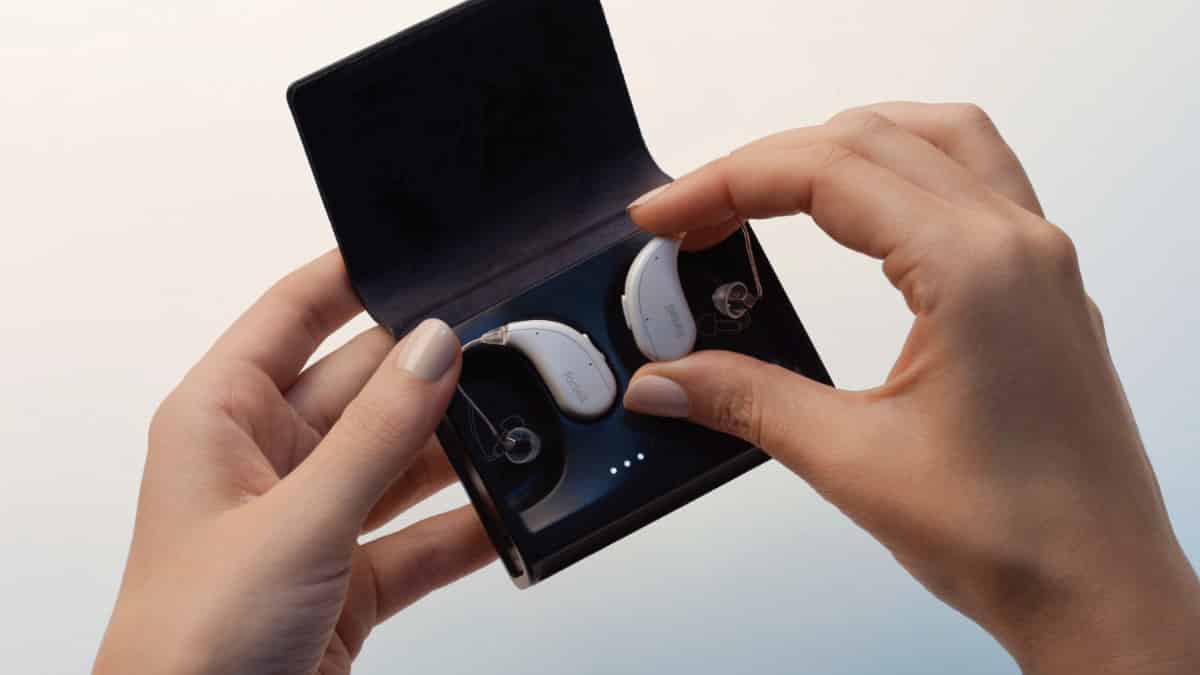
My wife and I traveled from our home in Ottawa to New York City on a recent summer weekend to visit family. During our stay, I tried out the second generation of Fortell Artificial Intelligence (AI) hearing aids. For about 50 hours, I had a chance to listen to the future.
You may have read or heard about Fortell’s AI hearing aids, but there haven’t been many firsthand accounts of how Fortell works from someone who has tried them while continuing to use another leading brand’s hearing aids.
I have moderate hearing loss and have worn hearing aids for eight years. A few years before I was fitted, an specialist told me I’d eventually need hearing aids, but not yet. At the time, I had mild tinnitus and some difficulty hearing in noisy places, especially receptions and dinners with music in the background. My first hearing aids made a huge difference, but as my hearing declined, I again found it increasingly difficult to follow speech in many situations. I was fitted with my second pair three years ago, and while they use and have helped quite a bit, even numerous tweaks by very patient audiologists haven’t solved everything.
In recent months, I’ve tested three high-end hearing aids as I look for newer technology that might help. Two were rechargeable, and one used disposable batteries. (Confession: I prefer batteries to rechargeables; I know that’s not everyone’s preference.) As I write, I’m midway through a 60-day trial and hearing many things better than with my old hearing aids. But the toughest problems remain: following conversations in noisy places, understanding our grandchildren, and dealing with road noise—which I find especially unpleasant at 65 mph on the Interstates, or about 105 km/h on Canadian freeways.
We planned a visit to New York City at the end of August. HearingTracker suggested that while there, I should try a demo of the Fortell AI 2.0 hearing aids and write about the experience. Fortell’s CEO, Matthew de Jonge, agreed and arranged a demonstration.
I went to Fortell’s maiden clinic on Park Avenue in Manhattan, which opened in December 2025. Since then, several thousand clients from 48 of the 50 states have purchased Fortell’s AI hearing aids. The new hearing aids were developed from the ground up over five years and use AI to reduce background noise in noisy situations.
Fortell has already opened new clinics in Palm Beach, Fla, Greenwich, Conn, and Boston. More are slated for San Francisco and Miami, with additional locations planned across the USA.
So how effective were the Fortell hearing aids, particularly in conversations over the weekend with friends and family? And how does Fortell’s AI system work and what might make it unique? Read on for the answers and my own observations.
My Experience Wearing Fortell 2.0 Hearing Aids in NYC
At Fortell’s Manhattan clinic, I met for almost 90 minutes on a Friday morning with Kathleen Wallace, , Director of Audiology at Fortell. CEO and cofounder Matthew de Jonge sat in for part of my visit.
Dr. Wallace reviewed my , discussed my hearing history, and programmed the demo pair of hearing aids to meet my unique hearing needs. The hearing aids ran Fortell AI 2.0, the new system that was rolled out to new and existing users’ hearing aids on August 26. Then Kathleen and Matt accompanied me out onto the sidewalk on busy, noisy Park Avenue.
:format(webp))
To demonstrate the effectiveness of Fortell’s system, Matt initially stood in front of me repeating the alphabet out loud. At the same time, Kathleen stood behind me counting aloud. I heard Matt perfectly and did not hear Kathleen at all. I was then asked to turn around; suddenly I heard Kathleen clearly, but not Matt. The noise of cars and trucks? Muted, almost silent.
We then changed the setting on the Fortell app on my phone from Front Voices (AI) to Conventional, and I instantly heard the sounds of the city, the din of traffic and voices of pedestrians amplified more clearly than the way I normally hear it.
“Front Voices” focuses on voices in front of the wearer while suppressing competing talkers from all directions (and is especially helpful in restaurants). The app also has settings for “All Voices,” which reduces background noise while keeping voices from all directions audible, and “Live Music.”
Before I left the Fortell clinic, Kathleen ran a comparative speech-in-noise test. She did it twice with different phrases, once with the high-end hearing aids I am trying at the moment, and a second time with the Fortell AI hearing aids. I heard many more words correctly with the Fortell hearing aids.
Then I wore the Fortell’s out into the world for a 2-day trial. On the subway, train noise was significantly quieter than on my trip into Manhattan earlier in the morning. I could hear announcements of the next station more distinctly.
Later, while walking down a busy street in Brooklyn, I was able to have a conversation with my wife and understood her well, despite the honking horns, roaring motorcycles, and passerby talking on their mobile phones.
Over the weekend, I was able to participate in conversations at a luncheon with five other adults and five children (and lots of cross-talk) and rarely had to say “I beg your pardon?” I had comprehensible chats in English and French with people I met for the first time at a small social gathering, where there were a lot of people speaking around the room. And I had an effective short conversation with the cashier when I picked up take-out pizza in a noisy restaurant.
Interim conclusions: “Front Voices” really seems to work well in noisy surroundings, and “All Voices” works nicely for hearing the birds outdoors and for a conversation with a friend while we walked on a quiet suburban street.
:format(webp))
I did not charge up the hearing aids on the first night to see how long they would last. The right hearing aid worked for 25 hours, and the left one lasted for over 26 hours.
One more trial before sending the hearing aids back to Fortell, this time using them in the car. With “ on,” the hearing aids did a very good job of reducing road noise on New York City’s freeways, bridges, and the streets of midtown. I could hear the radio. I had a conversation with my wife. Yes, I heard the rumble of a motorcycle that passed us, but it was not overwhelming or uncomfortable.
During the weekend, I did not have an opportunity to attend a live concert or a sporting event, watch TV, or make phone calls with the hearing aids. While this isn’t scientifically measurable, I got the impression that the Fortell 2.0 devices performed much better for me than my 3-year-old hearing aids and the ones I am testing right now.
How Fortell AI 2.0 Hearing Aids Work
HearingTracker readers may recall Carly Sygrove’s June 30, 2025, article, “Hearing Aids with Artificial Intelligence (AI).” Sygrove, who is a hearing loss coach with single-sided deafness (and now wears a cochlear implant), wrote:
Hearing aids are using AI to create smarter and more adaptive multipurpose devices that enhance speech, reduce noise, translate languages, track fitness and health metrics, and more…Advancements in artificial intelligence (AI) are having a transformative impact on today’s society. AI is now finding its way into virtually all industries, from social media monitoring and marketing chatbots to self-driving cars. And, with increasing sophistication, AI is also being applied to hearing devices.
I looked for a concise definition of how AI works in hearing aids and found none. So I reached out to Vijay Parsa, PhD, PEng, an associate professor with a joint appointment in the Department of Electrical and Computer Engineering, and the School of Communication Sciences and Disorders at Western University in London, Ontario. Here is his definition:
Vijay Parsa, PhD, PEngBroadly speaking, AI models for speech enhancement in hearing aids are typically trained using large collections of speech and noise recordings. Through this training, the AI models learn the patterns that distinguish speech from background sounds. Once trained, these AI models can identify and enhance speech within a mixture of sounds, while simultaneously reducing or lowering non-speech or noise-like patterns in the same mixture.
Many long-time hearing aid users may not yet have experienced -powered hearing aids. To understand how effectively AI filters out background noise and focuses on speech, I encourage you to visit Fortell’s website and watch the video of Matt de Jonge speaking in front of a construction site in New York City. It’s one of six short videos in which speakers appear in similarly noisy environments, including street scenes, a train station, a café, and a restaurant.
:format(webp))
In these videos, speakers are using Fortell hearing aids to record the audio. Below each video, you can toggle between “ off” and “AI on.” Selecting “AI on” instantly reduces background noise and makes the speaker’s voice and message clearer. The difference is astonishing. That’s what Fortell says its new AI hearing aids do in the real world.
For many hearing aid users, “AI off” may feel familiar. Conventional hearing aids can amplify a broad mix of wanted and unwanted sounds, even while using directional microphones and noise-reduction processing. These hearing aids amplify everything, including what we want to hear clearly, such as conversations at the dinner table or in meetings, music, birds chirping, or a movie soundtrack. However, they also amplify what we don’t want to hear, such as multiple simultaneous conversations, the clatter of dishes and cutlery, traffic noise on a busy street, or announcements at a nearby airport gate.
Some of the newest premium hearing aids use AI or deep neural networks () to enhance speech and reduce competing noise, while others use them primarily to identify and respond to different listening environments. However, I’ve found that even with hearing aids on the right program, it can still be a struggle to have conversations with family and friends in a restaurant, to do a transaction at the bank, to hear the radio or a phone call in the car over road and wind noise, or to catch someone’s name and have a meaningful conversation at a cocktail party or a hockey game.
Here is Fortell’s own take on their hearing aids:
We think hearing aids should have two jobs: 1) make sounds loud enough to hear, and 2) make conversations clear enough to understand.
Conventional hearing aids are very good at the former and struggle with the latter when environments get complicated. They are programmed using your [results of the hearing test done by your audiologist], so they know how much amplification to provide at the frequencies where you have lost audibility. This works well in a quiet room. But in a crowded restaurant, background noise occupies many of the same frequencies as the conversation you’re trying to hear.
Conventional hearing aids struggle to differentiate between signal and noise, so everything gets amplified. This is why clattering dishes or conversations at other tables can sound just as loud as the person who you want to hear.
Fortell is different. We built a unique AI processor that separates the conversation you want to hear from the noise around it, creating distinct audio tracks for each. Fortell can then amplify the conversation while reducing the background noise. The result is conversation that’s both louder and clearer in the situations where hearing aid wearers struggle most, even those wearing high-end devices.
Fortell’s AI differs from most other AI-driven hearing aids, which use DNNs primarily to identify the listening environment and select an appropriate processing strategy. Fortell instead uses its DNN directly for real-time speech enhancement through what CEO Matt de Jonge calls “full AI source separation.” This approach is similar to that used by Phonak in its Infinio Ultra and Eon Sphere devices, where the system separates incoming sound into streams, distinguishing wanted speech from competing noise and talkers.
Fortell says its Spatial AI goes further by identifying both what a sound is and where it is coming from. Since the launch of Fortell AI 2.0 in late August 2026, the company has kept this approach but retrained its DNN on a much larger collection of real-world recordings it made, while also refining some conventional signal-processing algorithms.
:format(webp))
What Fortell Hearing Aid Clinical Studies Show
Fortell has published two clinical studies evaluating its Spatial technology, along with a more recent technical study comparing Fortell AI 2.0 with the original AI 1.0 system.
In one study, the research team examined the Spatial AI in the 1.0 system, which was designed to enhance speech from the front and reduce background noise and competing talkers from other directions in real time. In the study, 30 hearing aid users underwent standard speech-in-noise testing while alternating between Fortell AI hearing aids and a state-of-the-art commercially available hearing aid that also uses -based noise-reduction processing. The Fortell hearing aids showed significant improvements in speech intelligibility.
A second peer-reviewed study examined whether Spatial AI improved perceived ease of understanding in noisy, multi-talker environments. Twenty adults with mild to moderately severe bilateral sensorineural hearing loss (the most common type of hearing loss) listened through headphones to recordings of five premium hearing aids and Fortell. In 100 randomized, blinded comparisons, participants selected which recording made the target talker easier to understand. The Fortell recording was preferred in 99 of the 100 comparisons, with one tie.
More recently, Fortell evaluated AI 2.0—the version I wore in my trial—against its original AI 1.0 processing across 80 speech-in-noise scenes. In the company’s testing, AI 2.0 provided an average 2.13 additional signal-to-noise ratio () benefit over AI 1.0 across both the “All Voices” and "Front Voices” modes. In the toughest condition they tested, they found a 4.1 dB average SNR improvement for "All Voices.” Fortell attributes the improvement primarily to retraining its neural network on a much larger collection of real-world sounds, along with refinements to its conventional signal processing.
To put these numbers in perspective, even a 1 dB SNR improvement can make a big difference: depending on the listener and listening conditions, it may translate into roughly an 8-10 percentage-point improvement in word recognition when someone is on the steeper portion of the speech-understanding curve. Fortell’s average 2.13 dB improvement therefore represents a potentially meaningful change, while its largest 4.1 dB gain offers a more intuitive comparison: under simplified acoustic conditions, it’s roughly equivalent to moving about 35% closer to the person you’re trying to hear while the background noise remains constant.
My friends at HearingTracker told me the initial test results from the independent HearAdvisor lab are impressive, and HearAdvisor and HT will report on the final results soon.
My Final Impressions of Fortell 2.0 Hearing Aids
Was I sorry to drop off the Fortell hearing aids at the courier company at the end of my trial on Sunday? Yes, you bet. I would have loved to use them for at least a few weeks or months. But at the moment, the Fortell AI hearing aids are only available in the United States. However, Fortell’s Chief Marketing Officer Emily Ziegler tells me, “Someday we would like them to be available internationally.”
Ben Gailor
Guest AuthorBen Gailor is a guest writer and retired civil servant who lives in Ottawa, Canada. Ben wears hearing aids all day, every day, encourages family and friends with hearing loss to wear theirs, and advocates for everyone to protect their hearing.