


Usually, no. You don’t need to turn off your hearing aids during takeoff or landing, and short-range Bluetooth is generally permitted on commercial flights. If your hearing aids have a flight or airplane mode, follow the manufacturer’s instructions and any directions from the airline or flight crew.
Resources
Should You Take Your Hearing Aids Out When Flying?
You can generally keep your hearing aids in, even while going through TSA. Find out how to make flying with hearing loss easier.)

Published on Sep 23, 2026
Hearing aid glossary
Looking that up…
Terms are matched automatically. A definition may not fit every context.
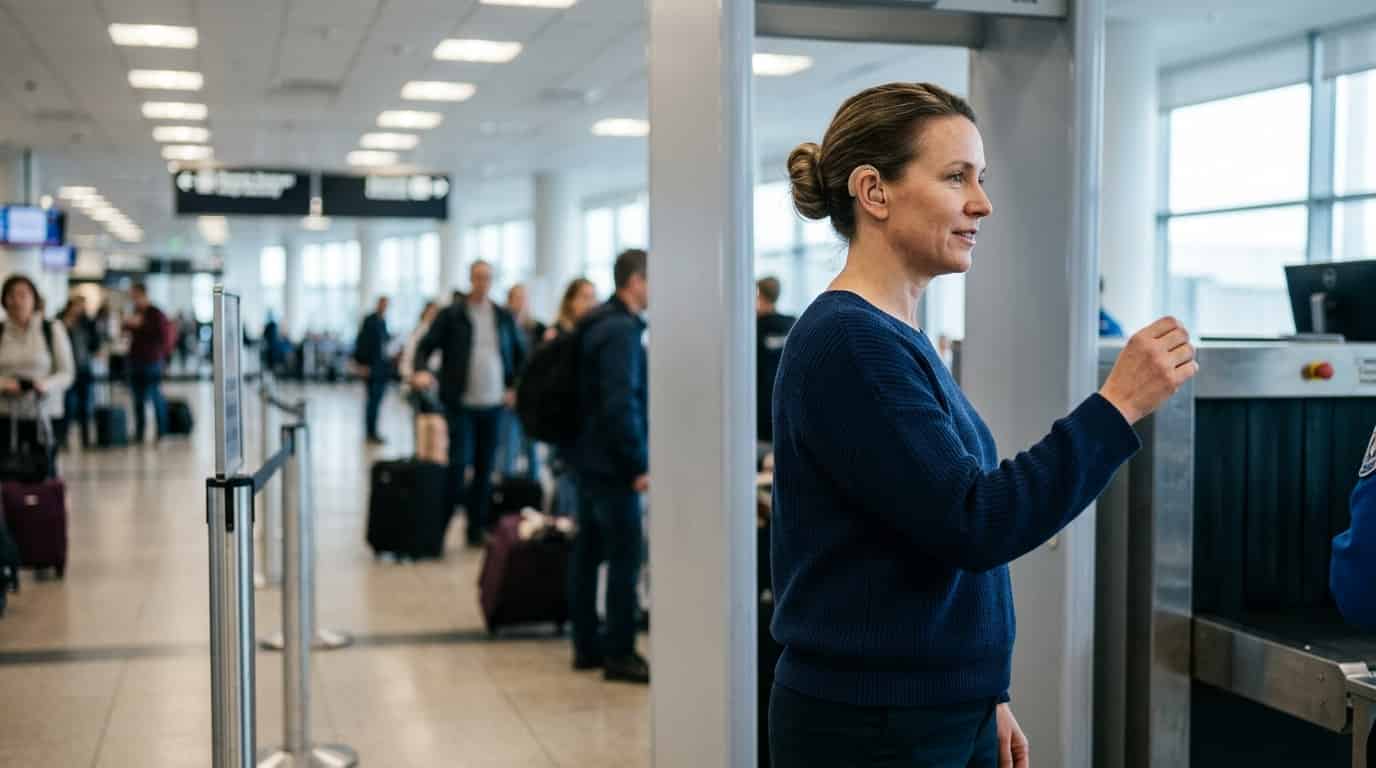
Air travel can be stressful enough without having to wonder what to do with the devices you rely on to hear. Does the TSA require you to remove hearing aids at security? Should you turn them off during takeoff? Do Bluetooth hearing aids need to be put in airplane mode?
Fortunately, flying with hearing aids is usually pretty straightforward. You don’t need to remove them for airport security or turn them off during takeoff or landing. Keeping them in can help you stay connected to announcements, crew instructions, and conversations throughout your trip.
Still, flying with hearing loss presents a few situations that can raise questions for hearing aid users. Here’s what to know about wearing hearing aids while flying within the U.S., from TSA and airplane mode to cabin pressure, batteries, and in-flight audio.
Should you wear hearing aids when flying?
Yes, in most cases you should wear your hearing aids during a flight.
Takeoff and landing tend to raise the most questions. Cabin pressure is changing, passengers are being told to put devices in airplane mode, and certain electronics may need to be turned off or stowed. It’s reasonable to wonder whether any of those instructions apply to hearing aids.
“I generally recommend keeping hearing aids in during takeoff and landing so patients can continue to hear announcements and communicate effectively,” says audiologist Dr. Ruth Reisman, .
Unless you have another reason to take them out, keeping your hearing aids in can be useful throughout the travel day. Airports and airplanes are communication-heavy environments, and hearing aids may help you catch gate changes, boarding instructions, safety announcements, or a flight attendant speaking to you.
Hearing Aids and TSA Security
According to the TSA’s guidance for travelers with disabilities and medical conditions, you don’t need to remove your hearing aids before going through security. Hearing aids contain only small amounts of metal and typically won’t trigger a metal detector. If you need additional assistance during screening, you can request support through TSA Cares, preferably at least 72 hours before your flight.
Travel Phase | What to Do |
|---|---|
TSA security screening | Leave them in. |
Takeoff and landing | Keep them on. |
Bluetooth/wireless features | Generally fine to leave on. |
Cabin pressure changes | No effect on the device. |
Cabin and engine noise | Optional adjustment. |
Sleeping in flight | Your choice. |
In-flight entertainment | May need to remove. |
Extending battery life | Optional. |
Do I have to turn off hearing aids during take off?
No. Hearing aids have long been exempt from the restrictions that apply to other portable electronic devices on airplanes, so you can leave them on during takeoff and landing.
That means when passengers are asked to power down electronics or put them into airplane mode, you don’t need to turn off your hearing aids. Wireless features and Bluetooth hearing aids may come with slightly different considerations.
Bluetooth Hearing Aids and Airplane Mode
You generally don’t need to turn off Bluetooth on your hearing aids when flying. While cellular connections must be disabled, the FAA permits low-power wireless communication such as Bluetooth during flight. Individual airlines and flight crews may have their own restrictions, so always follow crew instructions.
Some hearing aids have a flight or “Airplane Mode” that disables Bluetooth and other wireless features while keeping the hearing aids working. This can vary by brand and model; check your manufacturer’s instructions before traveling.
In general, with iPhones, turning on Airplane Mode usually won’t disconnect your hearing aids from the phone; it turns off cellular service, but Bluetooth should remain available. If it does disconnect, open up the Control Center and tap the Bluetooth icon to turn it back on.
The same generally applies to Android phones. If your Bluetooth disconnects, you can turn it back on by swiping down to open Quick Settings, then tapping the Bluetooth icon to reconnect.
“From my own experience, the only patients I’ve had who needed to access hearing aid ‘Airplane Mode’ were those who worked in secure government facilities, classified situations, or other tightly regulated spaces,” says audiologist Amy Sarow, . “The 'Airplane Mode’ term is, in this case, a bit misleading, as it’s not the typical use case.”
Does flying affect ear pressure or hearing aids?
Changes in cabin pressure during takeoff and landing affect your ears, not your hearing aids.
As an airplane climbs or descends, pressure in the cabin changes. Your Eustachian tubes help equalize pressure between your middle ear and the surrounding environment. When they don’t equalize quickly enough, you may experience pressure, popping, muffled hearing, or ear pain, often called “airplane ear.”
:format(webp))
Wearing a hearing aid doesn’t cause this pressure change, which is why taking your hearing aids out won’t necessarily prevent airplane ear.
“Cabin pressure changes affect the middle ear rather than the hearing aid itself, although pressure, congestion, or Eustachian tube dysfunction can make the ears feel plugged and temporarily change how amplified sound is perceived,” Dr. Reisman explains.
However, if pressure or swelling makes an in-ear device feel uncomfortable, you can temporarily remove it. This may be particularly noticeable with custom completely-in-the-canal () or in-the-ear () hearing aids.
Audiologist Matthew Allsop discusses how to avoid ear pain while flying. From using natural remedies to more high-tech solutions, like reusable earplugs that Navy pilots swear by, he shares his best hacks to keep your ears pain-free next time you travel on an airplane.
Airplane Noise Can Make Hearing More Difficult
Aircraft cabins are noisy, and even with hearing aids, understanding speech over the constant sound of engines and airflow can be difficult. That can make everything from ordering a drink to understanding an announcement challenging.
Hearing aid users in the HearingTracker Forum describe handling cabin noise in different ways. Some leave their hearing aids on throughout the flight but turn down the volume or use a noise-reduction program. Others mute or remove them once they’re settled in.
Melissa, a frequent flyer with profound hearing loss in both ears, has developed a combination of strategies depending on what she’s doing during the flight:
Hearing aids in the plane are essential, but I do need to charge them on long haul flights. My background noise cancelling program on my hearing aids is OK, but I generally find myself turning them off completely to cancel out the noise from the plane, especially when I want to sleep.
If available, try your hearing aids’ noise-reduction or speech-in-noise program. Seeing the person speaking can also provide useful visual cues, and a may help with one-on-one conversations.
If amplified cabin noise becomes uncomfortable, temporarily removing your hearing aids is another option. Just remember that removing hearing aids is not the same as using hearing protection.
:format(webp))
In-flight entertainment can present another challenge. Melissa says she has trouble understanding dialogue through an airplane’s entertainment system, so she relies on captions when she uses it. For content on her own devices, she’s found a workaround that helps reduce competing cabin noise.
“I do use Bluetooth from my laptop directly to my hearing aids and then wear noise cancelling headphones over the top to cancel out engine sounds,” she says.
For some travelers with hearing loss, the bigger challenge isn’t wearing hearing aids on the plane, it’s navigating the airport. That theme came up repeatedly among HearingTracker forum members, particularly around boarding announcements and gate changes.
:format(webp))
When one member posted about pre-flight nerves, navigating solo travel with hearing loss, several members chimed in to suggest things like using a flight-tracking app to keep tabs on departure times and gate numbers rather than relying solely on audible announcements. Asking your seatmate to alert you to important announcements can also help.
Melissa uses a similar strategy because hearing aids alone don’t necessarily make airport announcements accessible:
“Airport accessibility hasn’t been that easy to access, and I can’t hear most messages if I’m waiting at the gate, like requests for boarding groups,” she says. “I generally use an airline app to keep me updated on delays and changes to boarding gates, and I will ask questions when in doubt.”
So if airport or in-flight announcements are difficult to understand, don’t rely on your hearing aids alone. Airline staff can provide important information in other ways. Carly Sygrove’s guide to flying with hearing loss covers your legal rights, available accommodations, and accessibility policies at major U.S. airlines.
Reasons You May Choose to Remove Hearing Aids
Just because you can wear your hearing aids the entire flight doesn’t mean you have to. You may prefer to temporarily take them out if:
- They become uncomfortable. Pressure or swelling may make some in-ear devices feel tighter than usual.
- Cabin noise is bothersome. Some users may find amplified engine and airflow noise tiring or distracting.
- You want to use headphones. Hearing aids typically won’t connect directly to an airplane’s in-flight entertainment system. Depending on the aircraft and your devices, you may prefer to remove your hearing aids and use wired or Bluetooth headphones instead.
- You want to conserve battery life. Removing them for part of a long flight can extend the remaining charge.
- You’re sleeping. Hearing aids may be uncomfortable against a headrest or travel pillow. For overnight flights, consider letting the cabin crew know that you won’t be wearing your hearing devices while sleeping.
If you do take your hearing aids out, put them directly into their case rather than a seat pocket or tray table, where they can easily be forgotten or fall to the floor.
Tips for Flying With Hearing Aids
A little planning can help keep your hearing aids powered, accessible, and useful throughout your trip.
- Pack hearing aid essentials in your carry-on. Keep your case, charger or extra disposable batteries, cleaning supplies, , domes, and any accessories you rely on with you. If traveling internationally, don’t forget a plug adapter. Spare lithium batteries and power banks must be carried in your carry-on rather than checked baggage.
- Bring backup power. Charge rechargeable hearing aids before you leave and consider packing a compatible power bank for long travel days. If you use disposable batteries, bring extras in case of delays.
- Look for assistive listening systems at the airport. Some airports offer hearing loops at gates, information desks, and other areas, which can send audio directly to hearing aids or cochlear implants with a . is a newer option that can stream announcements to Auracast-enabled hearing devices. Adoption is still in its early stages (Frankfurt Airport became the first to test Auracast for gate announcements in January 2026) but more hearing aids are being designed to support the technology as it rolls out.
- Check your in-flight entertainment options. Bluetooth availability varies by airline and aircraft, and direct pairing with hearing aids isn’t guaranteed. Depending on your devices, a compatible transmitter or manufacturer accessory may provide another way to stream audio.
- Plan for cabin noise. If amplified engine and airflow noise becomes uncomfortable, try another hearing aid program or noise-management setting to help protect your hearing on a plane.
While these technologies can help, individual experiences with them vary. Melissa says haven’t worked particularly well for her, even when she was able to connect:
I have never had much success with hearing loops. I’m not sure if it’s something to do with Oticon hearing aids but even when connected, not much information would be transmitted. I would be interested in Auracast, although admittedly, I have become a little cynical after my hearing loop experience.
Beyond managing your hearing aids, a few communication strategies can make navigating the airport easier. When booking, identify yourself as a traveler with hearing loss and request any needed assistance. At the airport, let gate agents know you may not hear announcements and ask for important updates visually or in writing and, if needed, request preboarding. Monitor airport displays and your airline’s app for gate changes, delays, and boarding information. Lastly, consider obtaining a Hidden Disabilities Sunflower lanyard from the information center at participating airports.
Even for an experienced traveler, asking for help may simply become part of the routine as hearing changes. “I’ve been flying all the time as my hearing deteriorated, so it has been a progressive adjustment,” Melissa says. “I do have to ask for help a lot more now.”
The Bottom Line: You Usually Don't Need to Remove Your Hearing Aids
For most hearing aid users, flying doesn't require doing anything dramatically different: Wear your hearing aids if they help you communicate, and don't routinely remove them for takeoff or landing.
In fact, keeping your hearing aids in may make it easier to stay connected to important announcements, safety information, and conversations throughout your trip.
There's no single preferred way to manage hearing aids once you're in the air. Some travelers leave them on, some turn them down or mute them to manage cabin noise, and others remove them for part of the flight or while sleeping.
If pressure makes your hearing aids physically uncomfortable, it's fine to remove them temporarily and keep them safely in their case. And if you use Bluetooth hearing aids, check your manufacturer's instructions before flying so you know how to manage their wireless features.
Most importantly, flying with hearing aids doesn't require choosing between your devices and a safe, comfortable flight. A little preparation can help you use them in whatever way works best for you.
Frequently Asked Questions
Megan Looney
Hearing Tracker ContributorMegan Looney is a freelance writer and editor specializing in health, wellness, and education. She has severe high-frequency hearing loss, which gives her a personal connection to the topics she covers for Hearing Tracker. Megan holds a degree in journalism and multiple health coaching certifications, and is especially interested in making complex health information feel clear, practical, and approachable.
Amy Sarow, Au.D.
Director of Consumer Education & AudiologyDr. Amy Sarow is a Doctor of Audiology and nationally recognized hearing health expert. She helps consumers better understand hearing loss, hearing technology, tinnitus, and the role hearing health plays in healthy aging.
As HearingTracker’s Director of Consumer Education & Audiology, Dr. Sarow develops evidence-based, practical resources that empower people to make informed decisions about their hearing care and technology. She is especially passionate about translating complex medical and audiological information into clear, accessible guidance for consumers and their families.
Dr. Sarow serves on the Forbes Health Advisory Board and has been featured as an expert source by NPR, BBC Future, and other media outlets.