Amplified vs. Captioned Phones: Which Is Right for You?
Amplified phones boost sound, while captioned telephone services add real-time text at home or on a smartphone. Here’s how to choose the right option for you.
Featured Products
Compare allHearing aid glossary
Looking that up…
Terms are matched automatically. A definition may not fit every context.
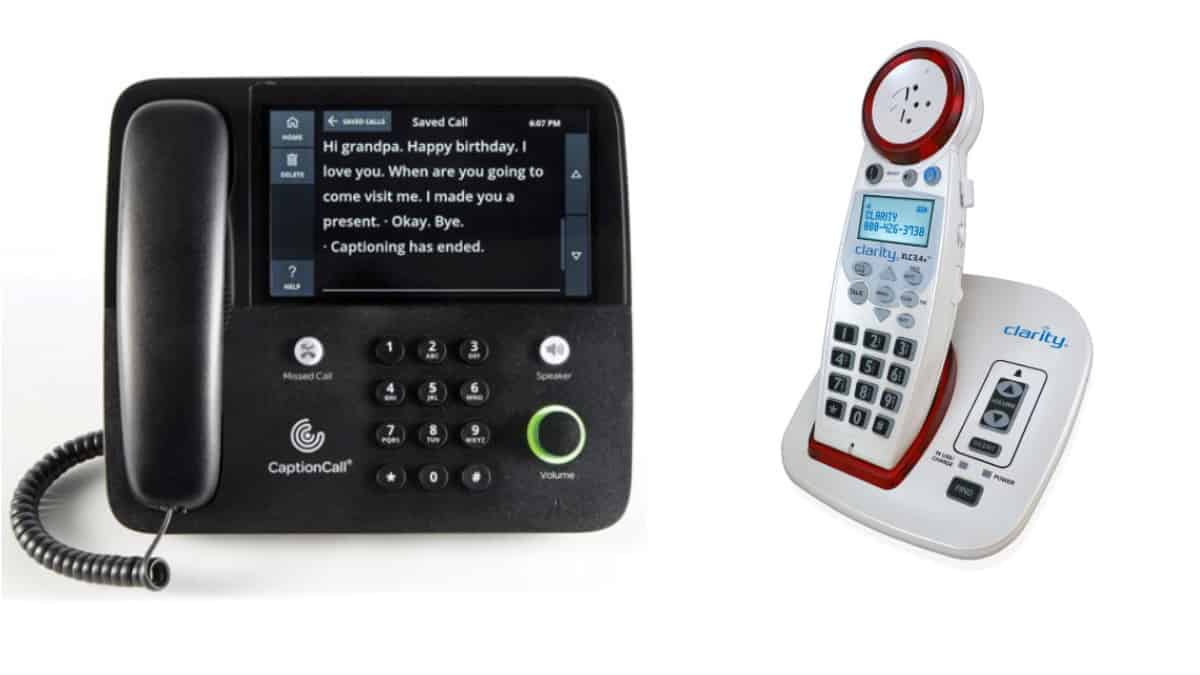
Amplified phones and captioned phones are two common solutions that make it easier for people who find telephone conversations more difficult to understand than face-to-face communication.
On the telephone, you cannot see facial expressions or lip movements. Most telephones reproduce a narrower range of sounds: traditional narrowband telephone audio is generally limited to about 300-3,400 Hz, although some modern mobile and internet-based calls offer wider-band audio, especially when transmitted to Bluetooth in-ear devices.


Although the features of captioned phones and amplified phones sometimes overlap, they address different communication needs: an amplified phone makes the caller louder and may adjust the audio’s frequency balance, while a captioned phone supplements that audio with text (most captioned telephones amplify sound just like amplified phones).
One important difference is that an amplified phone is primarily hardware, while a captioned telephone is a service. An amplified phone can make audio louder or adjust its frequency balance using built-in features. Captioned telephone service, by contrast, delivers written captions during calls and may similarly amplify sound. Although the captioning service may be accessed through a dedicated captioned home phone, some companies also make it available through a smartphone or tablet app, allowing eligible users to receive captioning both at home and on the go.
:format(webp))
What Is an Amplified Phone?
An amplified phone works much like a conventional telephone but provides additional volume and sound-adjustment controls. It may be helpful when a caller’s speech is understandable once it is made louder or certain frequencies are emphasized.
Common features include:
- Additional amplification: Depending on the model, amplified phones may provide up to approximately 40 or 50 of additional handset volume.
- Tone controls: These controls adjust the sound balance and place emphasis on different frequency ranges. For example, a user may increase the volume of higher-frequency speech sounds that are difficult for them to hear.
- Loud and visual ringing alerts: Some amplified phones include exceptionally loud ringers, adjustable ringing tones, flashing lights, or other visual notifications.
- Hearing aid compatibility: Many models are designed to reduce interference when used with hearing aids, and some may offer or Bluetooth-related features.
Who May Benefit from an Amplified Phone?
An amplified phone may be appropriate for someone who can understand telephone speech when it is sufficiently loud and properly adjusted. Although these phones are often marketed to people with mild-to-moderate hearing loss, the audiogram (i.e., test results that show the degree and frequency range of hearing loss) alone doesn’t necessarily determine whether amplification will be enough. Other key factors include speech understanding, hearing aid use, and individual listening needs.
What Is a Captioned Phone?
A captioned phone allows the user to hear the caller while reading near-real-time captions of what the caller is saying. The captions appear on a screen built into the telephone, providing visual reinforcement when words, names, numbers, or other details are difficult to understand through listening alone.
:format(webp))
CaptionCall is one provider of Internet Protocol Captioned Telephone Service, commonly called CTS. Its home phone combines a large captioning display with handset amplification and adjustable frequency settings.
Common features include:
- Audio and written captions: Users can listen to the caller’s voice and read the conversation at the same time.
- Adjustable sound: CaptionCall’s home phone provides volume and frequency controls for users who want both amplified sound and captions.
- Saved captions: Users may choose to retain captions on their device so that names, appointment information, addresses, or other details can be reviewed later.
- Installation choices: These can range from self-installation with or without assistance from a virtual trainer to in-person setup by a trained representative from the company. For example, CaptionCall offers its in-home Red Carpet installation and training service.

Captioning can greatly improve telephone understanding, but it is not necessarily word-perfect. Names, accents, background noise, rapid speech, and connection quality can occasionally result in an incorrect word or a slight delay between the spoken audio and the caption.
:format(webp))
Who May Benefit from a Captioned Phone?
Captioned telephone service is intended for registered users whose hearing loss makes captions necessary for effective telephone communication. Eligibility is based on that functional need rather than a particular category such as mild, moderate, severe, or profound hearing loss.


Someone might consider captions when making the telephone louder does not make speech sufficiently clear, when important details are frequently missed, or when following calls requires extra concentration and repeated requests for clarification or repeating.
Feature | Amplified Phone | Captioned Phone Service |
|---|---|---|
Primary functions | Amplify sound, usually with adjustable frequency control | Text captions on screen, sometimes with adjustable frequency amplification |
Works well when... | Speech becomes understandable when made louder or adjusted | Important parts of conversation remain difficult to understand through listening alone |
Captioning | No | |
Provides text of conversation for review | No | |
Frequency controls | Most models | Some models |
Connection | Varies by model and telephone service | Varies by provider and installation (e.g., CaptionCall may use internet, VoIP, a landline, or a smartphone-based connection). |
Cost | Purchased by consumer; prices usually range from $80-$200 | No cost to eligible registered users, although users remain responsible for their own telephone, internet, or mobile service |
Another practical consideration is how other household members use the phone. Anyone in the home can generally use an amplified phone, although family members without hearing loss may need to turn down the amplification.
A dedicated captioned phone can also be used as a regular household telephone, but only registered users with hearing loss can use it with the captions enabled. Other household members must turn off captioning when placing or receiving calls, usually done by simply pressing a button on the phone.

:format(webp))
CaptionCall is a leading provider of Internet Protocol Captioned Telephone Service (IP CTS). The service is designed for individuals with hearing loss and who need captions to use the phone effectively. CaptionCall allows eligible participants to simultaneously listen to their caller and read real-time captions of the conversation on a large, high-resolution screen at no cost because it is a federally funded program.
- High-Resolution Touchscreen
- Custom Audio Tailoring
- Hearing Aid Compatibility
- Speakerphone & Voicemail
Why Captioned Telephone Service Is Available at No Cost
CTS is one form of Telecommunications Relay Service (TRS) overseen by the U.S. Federal Communications Commission (FCC). Eligible captioning costs are supported through the federally administered TRS Fund.


CaptionCall is an FCC-authorized CTS provider; it is not itself a program operated by the FCC. CaptionCall’s parent company, Sorenson, provides the CaptionCall phone and captioning service at no cost to eligible registered users. CaptionCall by Sorenson also provides continuing service, support, and upgrades.
Eligibility for captioned phone service is based on the need for captions to communicate effectively over the telephone, regardless of whether the user has a hearing aid, implant, or assistive device (i.e., many people with hearing devices still struggle on the phone). Eligible users must have a hearing loss that requires a captioned telephone service, and they must complete the required self-certification and registration information under FCC rules.
Amplified phones are good for people who need added volume and sound adjustments to make conversations understandable. When louder sound still doesn’t provide enough clarity or ease of conversation, a captioned telephone can add important visual text and reduce the effort of communicating over the phone.
Acknowledgement
This article is sponsored by CaptionCall. The content, perspectives, and recommendations were written by the author and reflect HearingTracker’s independent effort to provide practical guidance for people with hearing loss, caregivers, and their families.
CaptionCall by Sorenson is a program of the FCC and is provided at no cost to eligible users via the TRS Fund. Captions are generated by Automated Speech Recognition (ASR) and/or a live Captioning Agent (CA). All calls are strictly confidential and are never recorded. Eligibility requires a medically recognized hearing loss that necessitates the use of captions to use the phone effectively. No financial incentives, gift cards, or rewards are provided for registration. Captioning services are intended as a complementary technology to be used in conjunction with a user’s standard clinical hearing care.
Tony Schwartz
ContributorTony Schwartz is a marketing and sales leader with 15 years of experience spanning eCommerce, B2B, direct to consumer, and mass media industries. He represents HearingTracker, HearAdvisor, and Audiologists.org as clients.