
Excellent sound quality
Sound quality rivals the best hearing aids in the industry
Product Review
Jabra Enhance Select 700 Review: Premium OTC Sound
The Select 700 offers GN's smartest noise management system yet with some of the best virtual support available.Our expert team selects and tests products rigorously. We may earn commissions if you buy through our links. Here's how we keep reviews independent.
Hearing aid glossary
Looking that up…
Terms are matched automatically. A definition may not fit every context.

Dr. Steve Taddei provides an overview of HearAdvisor's lab results of the Jabra Enhance Select 700 in this YouTube video.
The Jabra Enhance Select 700 is here, replacing the previous Select 500 and taking over as the company’s new flagship over-the-counter (OTC) hearing aid.
At $1,995*, the Select 700 offers Jabra’s most advanced hearing-aid technology yet: SoundScape™ with Auto Focus, a new adaptive noise-reduction system designed to help you hear speech more clearly in noisy environments. Add in Bluetooth , ™ support, hands-free calling for iOS and Android, a new music mode for live music listening, and you’ve got a complete hearing aid that is also futureproof in almost every way.
Jabra is part of Denmark’s GN Nord group, which also makes the ReSound, Beltone, and AGX brands, so it has access to some of the world’s most advanced amplification technology. The premium Select 700 sits above the Select 300 (mid-level tech) and Select 50R (essential tech) in Jabra’s hearing aid range. All models share the company’s telehealth platform, but the 700 adds the advanced features noted above. In short: if you want the most advanced version of Jabra and GN’s hearing technology—without stepping into a clinic—the 700 is it.
But manufacturer specs only tell part of the story. To see how the 700 really performs, we took it into the lab at HearAdvisor, tested it across multiple listening environments, and put it through everyday use. And to get a real-world perspective, we asked our expert consumer reviewer, David Cochran—who has a moderate hearing loss and has used many different OTC and prescription hearing aids—to try out the Series 700 for several weeks, as well. His impressions helped round out what the numbers and waveforms don’t always capture.
Compare prices & care
Compare sellers and the care included. Prices are per pair.
100-Day Returns
- Direct-to-Consumer Hearing Aids
- Telehealth and Remote Audiology Support
- Easy-to-Use Mobile App and Tech Features
- Backed by GN Hearing Expertise
$1,995-$200
$1,795
per pair
Never miss a price drop
Get notified when prices drop for this product
:format(webp))
What we like about Jabra Enhance Select 700
- Remote onboarding and support
Exceptional telehealth with licensed audiologist support for 3 years, as well as comprehensive video tutorials and online instructions for self-support and troubleshooting - Bluetooth streaming for iOS or Android
Audio streaming for calls, music, and media, including hands-free calling (see our note below about compatibility) - broadcasting now
One of the only hearing aids that can actually connect to Auracast broadcasts today - Great build quality and moisture resistance
Excellent design with IP68 rating, the highest Ingress Protection () from moisture and dirt available for a hearing aid - All-day power
Long battery life of up to 24 hours, with a portable charging case that carries 3 extra charges for on-the-go use - Generous return/trial period and warranty
You can return the hearing aid within 100 days to get a full refund; it comes with 3-year loss and damage protection
Drawbacks
- Premium price
At about $2,000, Select 700 is more expensive than most hearing aids, as well as Jabra Enhance Pro 30 prescription hearing aids at Costco - Not top device for speech in noise
Our lab testing indicates the 700's speech-in-noise improvement beats most, but is not best-in-class - No t-coil
No option for public-loop systems - Larger portable charging case
While not a deal-breaker, the portable case is slightly larger than most
:format(webp))
Ordering from JabraEnhance.com
When you order a Jabra Enhance Select 700 hearing aid from the Jabra Enhance website, you have 100 days to return it; if you don't like it, you can get a full refund, no questions asked, as long as it's returned within that time.
Jabra hearing aids are "self-fitting," meaning they rely on a hearing test and your actual hearing loss profile, which is more accurate than a "pre-set" hearing aid that only relies on 1-4 fixed program settings. You can take the hearing test on the Jabra website, but a better option is to submit a professionally administered hearing test (audiogram) when ordering the hearing aids. Jabra will pre-program the aids based on this information, and your package will arrive in about a week.


While it's technically possible to use Jabra hearing aids without a smartphone or the Jabra app, you'll benefit exponentially from having them. And you'll need the app if you want remote onboarding help, adjustments, and consultations with a professional—which we think are crucial for getting your money's worth. Jabra lists smartphones and other devices on its website that are compatible with its hearing aids. Make sure your phone is on it!
Unboxing Jabra Enhance Select 700
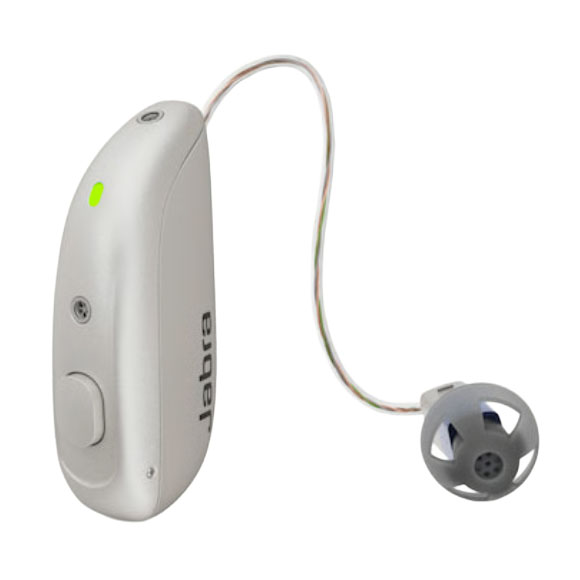
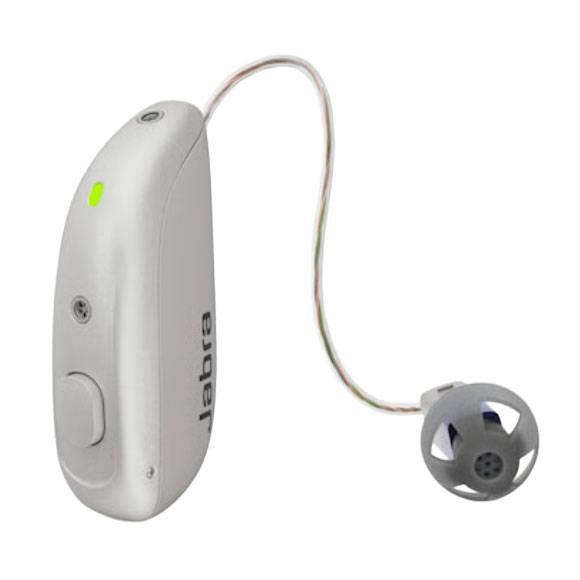
I’ve handled a lot of Jabra and GN products over the years, and the Select 700 immediately stood out for its compact, high-end feel. Jabra calls it the world’s smallest rechargeable receiver-in-ear () hearing aid—and honestly, that isn't marketing hype. These things are tiny. The new micro-RIE design makes them nearly invisible behind the ear, but they still feel solid and premium in hand.
:format(webp))
When David opened his box, he had the same reaction. “Right from the moment I unboxed them, the quality was apparent,” says David. “These hearing aids are sleek and modern, fitting comfortably behind my ears without feeling bulky.” He also liked the setup experience: “The initial setup was straightforward, and I appreciated the user-friendly interface that allowed me to customize my listening experience.”
Jabra has put a lot of thought into the unboxing and onboarding process. The charging case, cleaning tools, and documentation all feel carefully designed to help first-time users get started without anxiety—something brands still struggle with.
Built on GN’s Proven Hearing Aid Platform
As noted above, the GN Group is the Danish parent company of Jabra, ReSound, and Beltone hearing aids, and Jabra’s OTC hearing aid line often shares technology with its prescription-only siblings. In this case, the Select 700 borrows from the same processing platform as ReSound Vivia, a premium-level hearing aid launched in 2025. This isn’t some stripped-down consumer gadget. Its design DNA is a hearing aid through and through—just delivered in an OTC package with remote professional support instead of an in-person fitting.

That’s what makes Jabra’s model so interesting. The company essentially bridges the gap between accessibility and prescription-grade performance, offering a genuinely robust telehealth-driven care experience.
:format(webp))
SoundScape with Auto Focus: Tackling Noise with Smart Processing
Let’s get to what really matters: performance in noise. That’s where most hearing aids live or die, because it's the hardest task for them to accomplish.
Jabra’s SoundScape™ system is its proprietary blend of speech enhancement, spatial awareness, and noise reduction. In the 700, it gets an upgrade with Auto Focus, which automatically adapts microphone directionality to focus on speech in real time. Imagine the hearing aids recalibrating every second or two as you move from a quiet kitchen to a bustling café—it’s a responsive system that adapts to dynamic environments in real-time.
Our HearAdvisor testing showed that the 700 earned a SoundGrade of B, meaning it’s solidly competitive and right at the threshold of top-performing devices this year. The Select 700 ranked in the top 35% in the category and the top 45% of all devices tested by the HearAdvisor lab to date.It narrowly missed an A SoundGrade, mainly because its speech-in-noise scores were above average but underwhelming given its tech pedigree.
However, real-world listening painted a more nuanced picture: David found the noise reduction highly effective in practice. “They deliver clear audio, even in challenging environments, such as crowded places or busy restaurants,” he said. “I noticed a significant improvement in my ability to hear conversations without straining.”
From my perspective, the processing is clean and well-balanced. Some noise systems can make voices sound hollow or overly dampened, but Jabra avoids that trap. I did notice that the automatic system sometimes over-reacts in diffuse noise—say, a crowded food court—but overall, it’s among the best noise management I’ve experienced in an product.
Connectivity: Hands-Free, LE Audio, and Auracast-Enabled
When it comes to wireless performance, the Enhance Select 700 checks almost all the boxes. It supports Bluetooth for low-power, high-quality streaming across both Android and iOS, and it’s -enabled right now for the next-generation broadcast audio technology. In the not-too-distant future, as Auracast becomes more prevalent, you’ll be able to stream audio directly from public venues—think airports, theaters, or churches—without special hardware.
Hands-free calling is now standard, and Jabra nails the execution. With TapControl, you can answer or end a call with a simple double-tap on the ear—no need to dig out your phone.
Streaming quality is excellent. Music sounds full and natural, with less compression than I typically hear in wireless hearing aids. Phone calls were clear on both ends, and I didn’t experience any dropouts or pairing headaches.
David summed it up nicely: “It’s refreshing to see a product that truly understands the needs of the user and responds with a reliable power source and solid connectivity.”
App and Remote Audiology: Jabra’s Biggest Strength
The Jabra Enhance Select app has matured nicely. You can adjust volume, change listening environments, tweak bass and treble, and even book a video visit with a licensed audiologist. Every purchase includes three years of professional remote support, warranty coverage, and loss-and-damage protection.
Although HearingTracker is all for consumer choice, particularly when it comes to OTC hearing aids, we're happy that Jabra no longer offers what it called its "Basic Package." Although it was $200 cheaper, the basic package was a pre-programmed hearing aid with virtually no professional support—so some people were missing the all-important onboarding process and professional counseling. In our previous testing of the Select 100 and 300, I showed how much better you can do with some minor tweaking by an audiologist via online support. So yes, pro support may be more expensive, but taking the time to get the hearing aid programmed correctly is crucial for success with any hearing aid—especially with a premium OTC device.
:format(webp))
As someone who’s tested nearly every brand, I can confidently say Jabra’s telehealth model is one of the best in the business right now. Earlier versions of their service had frustrating delays, but things have changed. During my evaluation, I submitted tuning requests and received same-day responses. Adjustments synced quickly over the app, and the changes were spot-on.
This approach gives users much of what you’d get in a clinic—professional fine-tuning, -based fitting, and ongoing support—without the overhead of appointments or travel. Of course, it doesn’t replace in-person verification measures like real-ear testing, but it’s a massive step forward for accessible hearing care.
Battery Life and Durability
The 700 runs on a rechargeable lithium-ion battery that delivers over 24 hours of use on a single charge. The charging case adds three full recharges, so you can easily go several days without plugging in. That’s true “weekend trip” freedom.
David appreciated the reliability here too: “Battery life was a highlight for me—I could go a full day without worrying, and the app’s battery indicator helped me plan charging easily.”
An IP68 rating—which is the "gold standard” for Ingress Protection against moisture and dirt/debris—makes the 700 very durable, with a protective nanocoating on every component. While you should always try to keep your aids clean and dry, ordinary sweat, rain, and dust aren’t a problem. I even gave them a light splash test; they survived just fine.
Comfort and Everyday Use
Comfort is another area where Jabra continues to improve. The new micro- housing is about 20% smaller than the previous Select 500, and the receiver wires are thinner and more flexible. Combine that with soft ear tips and lightweight materials, and you get a device that disappears behind the ear.
David wore them for hours at a time. “Whether I was working, exercising, or relaxing, these hearing aids felt natural and unobtrusive,” he says. “It’s reassuring to use a product that prioritizes comfort without compromising functionality.”
That’s exactly how I’d describe them—comfortable, secure, and durable once they’re on. Jabra’s build quality feels premium, and I’d expect them to hold up well over years of use.
The hearing aids are available in six colors: Sparkling Silver, Sand, Gold, Bronze, Warm Gray, and Red.
Sound Quality: Clean, Balanced, and Realistic
In our objective HearAdvisor acoustic testing, the Enhance Select 700 scored 4.1 out of 5 overall, which puts it in the same ballpark as many prescription hearing aids. Subjectively, it delivers a sound that’s clear, balanced, and natural across environments. Music mode, a new addition, enhances low-frequency detail and warmth for live performances or streaming playlists.
Feedback suppression and transient noise control are excellent. Sudden sounds—like dishes clanking or keys jangling—are softened intelligently without chopping up the signal.
David agreed: “They combine style, comfort, and performance in a way that stands out in the market.” I’d have to agree—they sound great out of the box and get even better after fine-tuning through the app.
Final Verdict
If you’re someone who values professional support, advanced technology, and sleek design, and you don’t mind managing your hearing care remotely, the Jabra Enhance Select 700 should be at the top of your list.
When evaluating its overall offerings, we gave the Select 700 a HearingTracker Score of 4.1 (out of 5). It scored above average across all metrics measured (see "HearingTracker Score" section below). However, its score took slight dings because of its relatively high price for an device (reducing value), it was just above average for speech-in-noise, and it's an OTC hearing aid, so in-person care isn't available.
Really, the only major downside of the 700 is its price tag of $1,995, which makes it more expensive than some comparable prescription hearing aids (i.e., with in-person care) you can get from many independent hearing care practices, as well as at Costco and Sam's Club. But as Jabra Hearing President Steve Jacobs told HearingTracker when the 700 launched, “In terms of technology, we’ve always tried to offer a product for every budget and lifestyle. The Select 700 is really for people who want the very best in an OTC hearing aid, while the Select 300 and 50R provide exceptional technology at a lower price.”
After weeks of testing, we think the Select 700 is a worthy successor to the Select 500 and one of the best OTC hearing aids you can buy right now. It offers refined sound quality, stable streaming, great comfort, and a remote-care experience—for people looking for a convenient blend between an OTC and prescription hearing aid experience.
David summed it up best: “Overall, I would highly recommend the Jabra Enhance Select 700 for anyone looking to improve their hearing experience. They combine style, comfort, and performance in a way that stands out in the market.”
)
Dr Steve Taddei
Doctor of AudiologySteve Taddei, Au.D., is an audiologist, co-founder and lab director of HearAdvisor, and a hands-on hearing aid and earplug reviewer for HearingTracker. He holds an audio engineering degree from Columbia College Chicago and a doctorate in audiology from Northern Illinois University. He also teaches as an adjunct faculty member at several colleges.
)
David Cochran
Guest AuthorDavid Cochran is a retired design director who worked for over 40 years in biomedical communications, broadcasting, and publishing in Philadelphia. He now lives in Myrtle Beach, SC.