Bose ANC Technology in Orka O1 Pro Hearing Aids: Why It's a Big Deal
Andy Sabin and Linkai Li discuss how active noise cancellation (ANC) can give AI speech enhancement a cleaner acoustic canvas—and help make a more closed-fitting sound much less occluded.)
Featured Products
Compare allHearing aid glossary
Looking that up…
Terms are matched automatically. A definition may not fit every context.
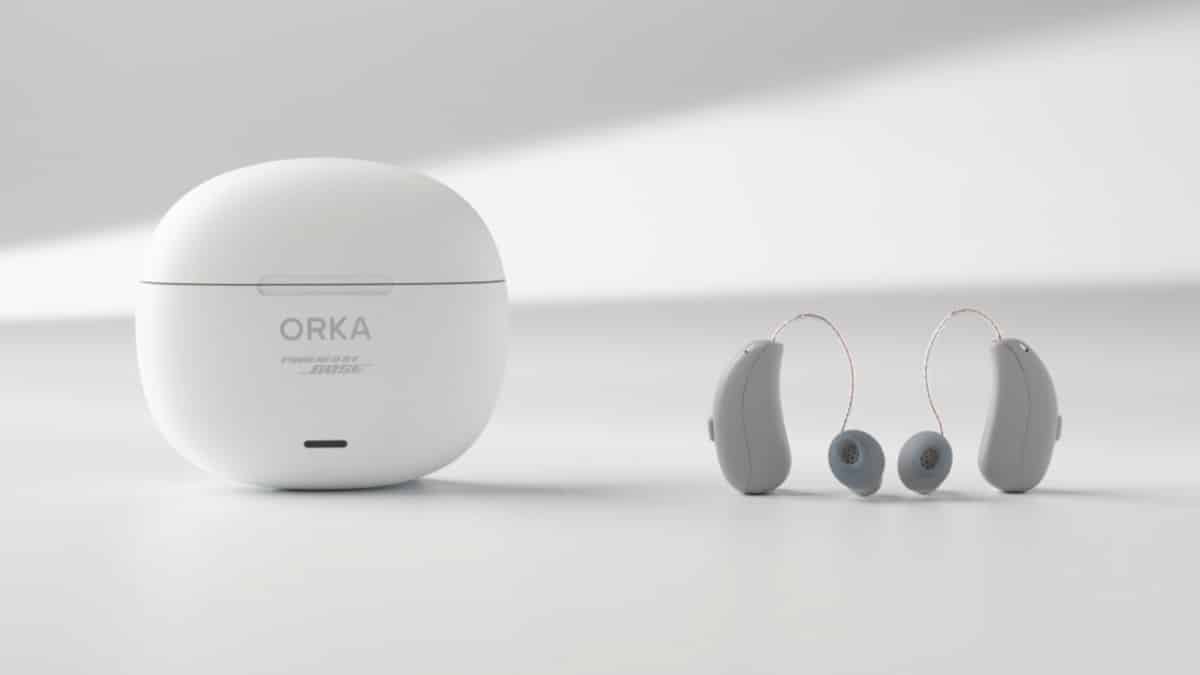
When HearingTracker first reported on the Orka O1 Pro’s debut at AWE in Shanghai in March, Orka described it as the world’s first receiver-in-canal () hearing aid with active noise cancellation (ANC).
I’ll admit I wasn’t entirely sure about the definition of ANC or how it worked—or whether other hearing aid manufacturers were using it. But I knew Bose researcher Andy Sabin, PhD, who helped bring Bose’s ANC technology to the Orka O1 Pro and, before that, Bose hearing aid products to market. I also knew him through his acoustic engineering work as a co-founder of the HearAdvisor lab along with HearingTracker co-founder Abram Bailey. I wanted to understand what ANC technology could offer hearing aid users.


So, what exactly is ANC? Active noise cancellation uses microphones to detect sound, then uses a speaker to create a sound wave that’s equal in amplitude but opposite in phase—causing the two waves to partially cancel each other. Used in products such as Bose QuietComfort earbuds and Apple AirPods Pro, it’s particularly effective at quieting low-frequency sounds like an airplane’s rumble. Similar to earbuds, in hearing aids, ANC reduces sound entering directly through the earmold or eartip vent allowing -enhanced speech to come through more clearly. It can also reduce the boomy own-voice sound associated with a more closed fit (i.e., the occlusion effect) by treating the body-conducted sound as cancellable noise.
To explore these possibilities, I interviewed Sabin and Orka’s Linkai Li, co-founder and head of R&D at Orka. Below, Sabin explains the acoustic principles and shared laboratory findings presented at the recent International Hearing Aid Research Conference (IHCON )1 and an upcoming paper,2 building on his earlier research published in Trends in Hearing.3 Li discusses translating that technology into a complete hearing aid solution, including fitting, user controls, battery life, and plans for availability.
:format(webp))
The following has been edited and condensed for length and clarity.
HearingTracker: In everyday terms, what does ANC do in the O1 Pro?
Andy Sabin: It’s better to think of ANC as something that operates in parallel to your hearing aid.
If you think about an open-fit , you’ve got these big holes in the dome. If you liken the entire sound output reaching your eardrum to an artist’s painting, it’s like painting on a dirty canvas. Even if you have algorithms that can boost , at some point you can’t turn down the noise any further because the signal leaking in through the direct path is coloring your canvas and interfering with the final work.

What ANC does is create a cleaner canvas by reducing the unprocessed [i.e., direct path] sound that enters through the vent. The O1 Pro still has a vent, but it runs through the receiver housing rather than the dome. ANC reduces the sound coming through that direct path, while the hearing aid delivers its processed signal in parallel. That allows more of the algorithm’s improvement in speech [relative to noise] to reach the eardrum.
HearingTracker: Does that also help with the boomy sound of the wearer’s own voice?
Andy Sabin: That’s the other thing it does. There’s a microphone that looks down your ear canal and senses the body-transmitted sound. It picks that up and, in real time, creates the opposite signal to cancel it.
If you have one of these earbuds in and you’re humming an “M” sound, you can turn ANC on and off and hear the occlusion turn on and go away.
There’s a trade-off people might not appreciate: with a more closed fit, you get more bandwidth and potentially more sound quality, but you also can have occlusion complaints. Active occlusion cancellation lets you have your cake and eat it too: the benefits of a closed fit without that drawback of your own voice sounding super boomy.
:format(webp))
Linkai Li: Bose has spent more than a decade developing the technology that makes this possible. Working together to turn it into a complete hearing aid has involved a lot of trade-offs and repeated refinement. We’ve had to consider how the acoustics, hearing processing, fitting, and hardware work together in everyday use.
Own voice is indeed a challenge; we need to make sure the theoretical benefits of ANC translated into a natural own-voice experience for users. In one development-stage test, the mean objective occlusion with ANC was lower than in the open-ear and other standard conditions. We also needed to listen to how the wearer’s own voice sounded through the complete hearing aid. That meant tuning the ANC and aided sound paths together, evaluating the results with users, and refining the balance between them.
HearingTracker: When should ANC make the biggest difference in a hearing aid application?
Andy Sabin: Sticking with the canvas metaphor, if you’re going to put a lot of paint on the canvas, it doesn’t matter as much whether it was dirty. So, if you’re adding a ton of gain—think of a profound hearing loss in quiet—you could turn ANC on and off and not hear a difference in the aided path. As gain comes down, having a blank canvas matters more.
Almost all hearing aids use wide dynamic range compression [] for sensorineural hearing loss, which applies less gain as incoming sounds get louder. With less amplification, the unprocessed sound entering through the vent can have a bigger effect at the eardrum. That’s why reducing this leakage with ANC can be particularly valuable in louder environments—especially when the can effectively separate speech from noise.
With AI sound separation, you also need to separate speech from noise and turn the noise down. The quality of that separation interacts with the ANC benefit. Less gain and better -enhancing algorithms mean a bigger ANC benefit for listening to other voices. And, for your own voice, the benefit is always there.
HearingTracker: If this is such an elegant solution, why hasn’t it been widely used in RIC hearing aids?
Andy Sabin: It’s hard to do under hearing aid constraints. It means getting the thing near invisible in your ear and lasting all day. So, it has been primarily a size and power issue.


The ANC system runs on a hearing aid’s digital signal processor (), using very little power. It also relies on a proprietary Bose speaker that can move a large volume of air for its small diameter. That combination lets it deliver ANC through a speaker small enough to fit inside the ear canal while supporting all-day battery life.
Linkai Li: Yes, as Andy mentioned, the tricky part is in the development. The idea is simple, but it is during the development where we make tons of trade-offs and discussions to balance each aspect. It takes a lot of effort on both sides.
One example of product-level challenge was bringing the acoustic and hearing-processing capabilities, careful tuning, and Bluetooth connectivity together in a compact hearing aid with a receiver that is invisible in the ear canal. The Orka O1 Pro has a size smaller to many hearing aids while still achieving up to 35 hours of battery life with ANC and everything on, where there many hearing aids cannot achieve this battery life even without classic Bluetooth and ANC.
HearingTracker: How long has this been in development?
Linkai Li: The first conversation between Bose and Orka happened at EUHA in 2023. That’s how our story got started.
HearingTracker: How does adding ANC affect sound quality when it’s combined with speech enhancement?
Andy Sabin: It’s actually somewhat counter-intuitive: You can hear the artifacts in the AI-processed sound more clearly because you’re painting on that clean canvas. You hear everything in higher resolution.
When we tuned an AI algorithm for an open fitting, it sounded good. But when we listened with ANC, we could hear artifacts we’d missed before. Without ANC, the unprocessed sound leaking into the ear had been masking those details.
HearingTracker: Are ANC and AI speech enhancement coordinated processing stages? Can users adjust the AI?
Andy Sabin: The AI operates on the aided path. The ANC and AI don’t need to know about each other. These are two things running in parallel: the thing cleaning your canvas and the thing painting it.
Linkai Li: At the algorithm level, ANC and AI speech enhancement operate on separate paths, as Andy described. At the product level, we’ve done a lot of system tuning to help them work well together. That also means tuning them alongside the other hearing aid features and processing algorithms. It takes repeated testing, listening, and refinement to get the balance right, because what ultimately matters is how the whole system sounds and performs when all those components work together. Our goal is to bring out their combined benefits while keeping the listening experience natural and comfortable.
Users can adjust the AI speech enhancement in the app, and audiologists have additional controls in the fitting software to tailor the settings to individual needs and different sound environments.
HearingTracker: What did your IHCON research poster1 and new paper2 compare, and what did you find?
Andy Sabin: We had three conditions that had the same hearing aid path processing: Orka O1, a standard hearing aid; O1 Pro with ANC off; and O1 Pro with ANC on. We tested each with AI speech enhancement on and off. With AI on, the standard O1 added about 1.6 relative to open ear, compared with 5.1 dB for the ANC-on condition.
Above about 2 kHz, the AI benefit is similar across the three conditions. With a more closed fit, you extend that benefit down in frequency. When you turn ANC on, you extend it even further.
:format(webp))
HearingTracker: Can you use different domes or customize cancellation for the individual ear?
Linkai Li: We have different sizes, but the vents are all the same on the O1 Pro product today.

HearingTracker: What about fitting support with the Orka O1 Pro?
Linkai Li: Orka O1 and O1 Pro support and Orka’s own fitting formula; NAL3 is coming in the future, as well. Our proprietary formula is designed to optimize naturalness and speech intelligibility while maintaining listening comfort. In our testing, it has also produced encouraging first-fit satisfaction, meaning that users responded well to the initial fitting before extensive fine-tuning.
:format(webp))
HearingTracker: Where is the product available, how much will it cost, and what comes next?
Linkai Li: Regulatory approval needs to be done country by country. We’ve obtained approval in China, so it’s available there. We’re also planning releases in Europe and the U.S.
Bose and Orka co-developed this product, and we’re trying to make it available to as many people as possible together. We have not yet determined pricing.


HearingTracker: What should readers take away from this combination of ANC and speech enhancement?
Linkai Li: Andy’s “cleaner canvas” analogy captures the opportunity well. By reducing unwanted sound that bypasses the hearing aid’s processing, ANC can help more of the AI speech enhancement benefit reach the ear. It also gives us a way to address the boomy own-voice sound associated with a more closed fit.
In developing this product together with Bose, our focus has been on bringing those capabilities into a complete hearing aid. For the wearer, the goal is clearer speech with sound that feels natural and comfortable—and that takes careful refinement and tuning of the whole system.
References
- Sabin A. Benefits of ANC and speech enhancement for and intelligibility in real hearing-aid recordings. Poster presented at: International Hearing Aid Research Conference (IHCON); August 5-9, 2026; Banff, Alberta, Canada. Poster 3000726.
- Sabin AT, Li L. Active noise cancellation extends the benefit of AI speech enhancement in real hearing aid recordings. In press.
- Sabin AT, McElhone D, Gauger D, Rabinowitz B. Modeling the intelligibility benefit of active noise cancellation in hearing devices that improve signal-to-noise ratio. Trends in Hearing. 2024;28. doi:10.1177/23312165241260029
Karl Strom
Editor in ChiefKarl Strom is the editor-in-chief of HearingTracker. He was a founding editor of The Hearing Review and has covered the hearing aid industry for over 30 years.