Phonak EON Takes Sphere’s AI Performance into a Smaller, More Accessible Era
At its U.S. launch at Ravinia near Chicago, Phonak explained how new chip and software efficiencies helped shrink Sphere, broaden access to its flagship speech-in-noise system, and rethink how it presents hearing technology to consumers.)
Featured Products
Compare allHearing aid glossary
Looking that up…
Terms are matched automatically. A definition may not fit every context.
With the launch of its new EON hearing aid, Phonak is building on the success of its popular Infinio and Infinio Ultra Sphere line—this time by removing some of the compromises that accompanied the original breakthrough.
At a special unveiling held at Chicago’s Ravinia Festival grounds on August 24, Phonak laid out the audiological, engineering, and scientific rationale for its latest flagship platform to about 400 hearing care professionals and media members.
Phonak’s Infinio line, introduced in mid-2024 and upgraded with the “Ultra” firmware update in late 2025, is hard to describe as anything but a home run. It generated tremendous buzz at launch and still tops HearAdvisor’s prescription hearing aid rankings for speech in noise—the No. 1 performance priority for many consumers.


EON doesn’t attempt to replace that winning formula. Instead, its main enabling change is replacing Sphere’s original DEEPSONIC chip with the new, more power-efficient HYPERSONIC chip. Paired with a retrained Spheric Speech Clarity 3.0 algorithm, the new processor allows Phonak to preserve Sphere’s real-time speech-separation performance while making the device 25% smaller and 20% lighter. EON also adds Auracast and WindBlock 2.0, and extends Spheric Speech Clarity to the Standard 50 performance level.
In other words, the Chicago event positioned EON less as a radical break from Infinio than as a more complete—and more broadly accessible—realization of it.
Removing the reasons for consumers to say “no”
Nicholai Dessypris, president of Sonova North America, placed EON within Sonova’s broader goal of bringing what the company calls the “delight of hearing” to 30 million people by 2030. He said the strategy rests partly on “innovation for adoption”—developing products and designs that persuade more people to take the leap and seek hearing help.
:format(webp))
In an interview following the presentation, Dessypris said consumers have many reasons for both accepting or rejecting hearing aids. “What drives someone to adopt hearing technology is such a wide gamut, and you never want to be in a position where you’re giving people a reason not to adopt,” he told HearingTracker. “By making EON Sphere smaller, it’s one less friction point. A lot of providers want to arm the patient with a choice, and sometimes that choice is very front-and-center because it’s physical, as opposed to performance-driven. Now the size issue is no longer a barrier.”
Jimena Garcia, chief marketing officer for Sonova North America, said Infinio Sphere’s performance generally outweighed concerns about its size. However, she encountered hearing care providers who cited its larger case as a drawback. EON removes that objection.
Phonak is also trying to create more consumer demand for its name—not just for a list of technical features. Garcia unveiled a refreshed brand identity still built around Phonak’s “Life is on” theme, but with warmer lifestyle imagery, brighter colors, and a promise to explain technology first through the moments it makes possible.
:format(webp))
The shift, she said, is from being the “most trusted” hearing aid brand to becoming the “most desired”—a goal that now seems more obtainable after many consumers were requesting “Sphere” by name in hearing care clinics. She said Phonak’s competition for the consumer’s attention is no longer limited to other hearing aid manufacturers; it includes mainstream technology brands that have set high expectations for design and customer experience, such as Apple and Dyson.
“With this launch, we’re not just launching a new platform; we are unleashing the Phonak brand,” Garcia told the audience. “We want to help shape the human connection. It’s not only about technology. We want to lead with what it means for patients and what patients notice—the everyday outcome first.”
Branding has never been a large factor in hearing aid selection. For hearing care professionals and Phonak, this new approach has a practical goal: more patients entering clinics already interested in and requesting a specific technology.
Clarity, connection, and a device that becomes transparent in use
Christine Jones, , vice president of audiology for Phonak U.S., and Michael Preuss, Phonak senior audiology manager and the lead audiologist for EON, organized the product story around three themes: intuitive design, unlimited connections, and adaptive clarity.
Preuss brought a user's perspective to the discussion. He is an audiologist, but has also worn hearing aids since age 3 and has a severe-to-profound hearing loss. A hearing aid, he said, is technology worn for more hours than almost any other device, so it should “just need to be put on and fade away.”
“Hearing aid design is not decoration,” Preuss explained. “What we mean by design is problem-solving. Great design happens when hardware, software, accessories, and workflows are harmonized to elevate the user experience.”
:format(webp))
The original Infinio Sphere proved highly effective at separating speech from noise, but its intensive processing also made it power-hungry—a drawback Phonak largely addressed with the subsequent Ultra firmware update.
EON takes that efficiency work further. Preuss reported wearing the devices for more than 15 hours during one demanding day, including nearly 5 hours of streaming and more than 7 hours logged in speech-in-loud-noise conditions, and finishing with about one-quarter of the battery remaining. Phonak specifies up to 38 hours per charge in less intensive use and approximately 22 hours in a mixed-use scenario that includes streaming and Spheric Speech Clarity.
This runtime is significant because EON still contains two processors. The new HYPERSONIC chip runs Spheric Speech Clarity 3.0, Phonak’s for separating speech from noise in real time. The ERA chip supports EON’s connectivity functions, including Bluetooth Classic, RogerDirect, communication, and now broadcast audio.
Phonak also announced that Auracast will be added to compatible Infinio and Infinio Ultra devices via a firmware update next year. The company is working with hearing accessibility advocate Andrew Bellavia and AuraFuturity on an Auracast installation at Ravinia, which offers a real-world demonstration of how public broadcast audio could eventually complement—or, in some settings, replace—traditional assistive-listening systems.
:format(webp))
For someone who spends much of his free time outdoors hiking, biking, and competing in endurance events, Preuss says EON’s most significant benefit remains its ability to help him hear in noise and challenging weather conditions. He described spending much of his life assuming that his hearing loss was the reason he could not understand speech in difficult environments. EON Sphere made him realize that his hearing loss was not the only limitation; earlier hearing technology—as good as it had been for its time—had also fallen short.
“For 35 years in my life, I thought my hearing loss was the reason I could not understand in challenging listening situations,” he said. “All that time, I thought my hearing loss was going to be a limitation for me performing well in these environments. I was wrong. We are now removing these limitations for people who have hearing loss and wear hearing aids.”
My own first impressions of EON
I was able to try out a set of EON Audéo Sphere hearing aids at Ravinia and the following weekend on a trip devoted to moving my son into his freshman dorm room at the University of Wisconsin-Madison. Previously, I had been impressed with the Infinio Audéo Sphere, but also commented about its artifacts in the “Sphere mode” when in very noisy environments. In these situations, the was working overtime and, at times, could make the speaker’s voice sound tinny or robotic. With EON, I used the Sphere mode on several occasions, and it worked very well; my perception was that I noticed fewer artifacts and voices seemed more natural-sounding. Mostly, I loved its ability to kick in automatically when needed instead of having to fumble for the app.
:format(webp))
After experimenting with the myPhonak app, I often gravitated to the Clarity equalizer setting (not to be confused with Spheric Speech Clarity 3.0). It made my wife’s voice easier to understand in a busy restaurant and, somewhat unexpectedly, even produced the sound I preferred while listening in a raucous dueling-pianos bar and at an outdoor samba concert. The Clarity setting emphasizes mid- and especially higher-frequency sounds (about +3 in the midrange and about +6 dB in the treble), which may have made speech consonants and musical details stand out more. My relatively mild sloping hearing loss and the initial (“first fit”) fitting of the demonstration devices probably influenced that preference, and I did not make controlled comparisons with EON’s dedicated Music program. However, the experience showed how a slight change in frequency balance can affect both speech understanding and enjoyment in everyday settings. Overall, I was impressed by how I could benefit from both natural sound and exceptional hearing in noise “on demand.”
It will be very interesting to see the results from the independent HearAdvisor lab’s testing of the EON, which we hope to publish soon. My prediction is that the lab will not find a substantial increase in the speech-in-noise metric (partly because Infinio Sphere already has the highest ratings to date), but I can see where overall sound quality, music, and value scores might increase.
Making Sphere smaller without sacrificing performance
Hearing aid design has always required engineers to balance competing priorities: greater computational power can improve sound processing, but it also increases energy demands, which may require a larger battery and housing. In a presentation hosted by Kevin Seitz-Paquette, , Director of the Phonak Audiology Research Center (PARC), Phonak researchers explained why shrinking Sphere without sacrificing sound quality, processing capability, or battery life involved far more than redesigning its exterior.
:format(webp))
Engineer Paul Meyer-Rachner, who works with the Sonova team behind Spheric Speech Clarity, distinguished between two broad uses of in hearing aids. A relatively low-complexity network can classify an acoustic scene and produce a set of probabilities—speech in noise, music, quiet, etc. Spheric Speech Clarity is different: it sits directly in the audio path, processing incoming sound and generating a cleaner output every few milliseconds.
That requires millions of computational elements and far more processing power. According to Meyer-Rachner, no suitable chip existed when development began in 2019, prompting Sonova to create the original DEEPSONIC chip and, now for EON, its more efficient successor, HYPERSONIC.
Improvement also came from software. The development team continually trains, evaluates, and modifies the network, adjusting its training data, architecture, and even training procedures. Automated perceptual models help screen candidate networks for speech enhancement, artifacts, sound quality, and energy/computational cost before human listening studies.
:format(webp))
“We train and we learn from the training data; we evaluate the resulting , and then we modify the training configuration,” Meyer-Rachner explained. “We do this over and over again. Every time we run this loop, we get a little bit better at every step.”
Stefan Launer, PhD, Sonova's vice president of audiology and health innovation, said Phonak optimized both sides of the equation: the DNN was retrained to deliver comparable or slightly better performance more efficiently, while the HYPERSONIC chip reduced the power required to run it. Phonak says the new chip is 25% more power-efficient, while the retrained Spheric Speech Clarity algorithm is 16% more efficient. Together, the hardware and software changes make Sphere processing 37% more power-efficient than Spheric Speech Clarity 2.0 running on Infinio Ultra.
Those gains allowed engineers to use a smaller battery and housing without giving up all-day operation. They also help AutoSense OS 8.0 activate Spheric Speech Clarity at lower noise levels and keep it engaged longer as sound levels fluctuate. In a 30-minute real-world lunchtime recording, Phonak EON spent about 20% more time in its Speech in Loud Noise program than Infinio Ultra.
With Phonak Target 12.0 fitting software, hearing care providers retain control over when Sphere processing activates and how strongly it operates—an important safeguard because not every patient will prefer the same degree of aggressive noise reduction.
“This is really in response to patient demand,” Jones said during our interview. “They love it, and they want more of it. They want to know, ‘Can this work in more situations in my life?’ But it is something that hearing care professionals can adapt to the specific patient. If somebody wants more of it—or less of it—they can change both how it activates and how strongly it performs.”
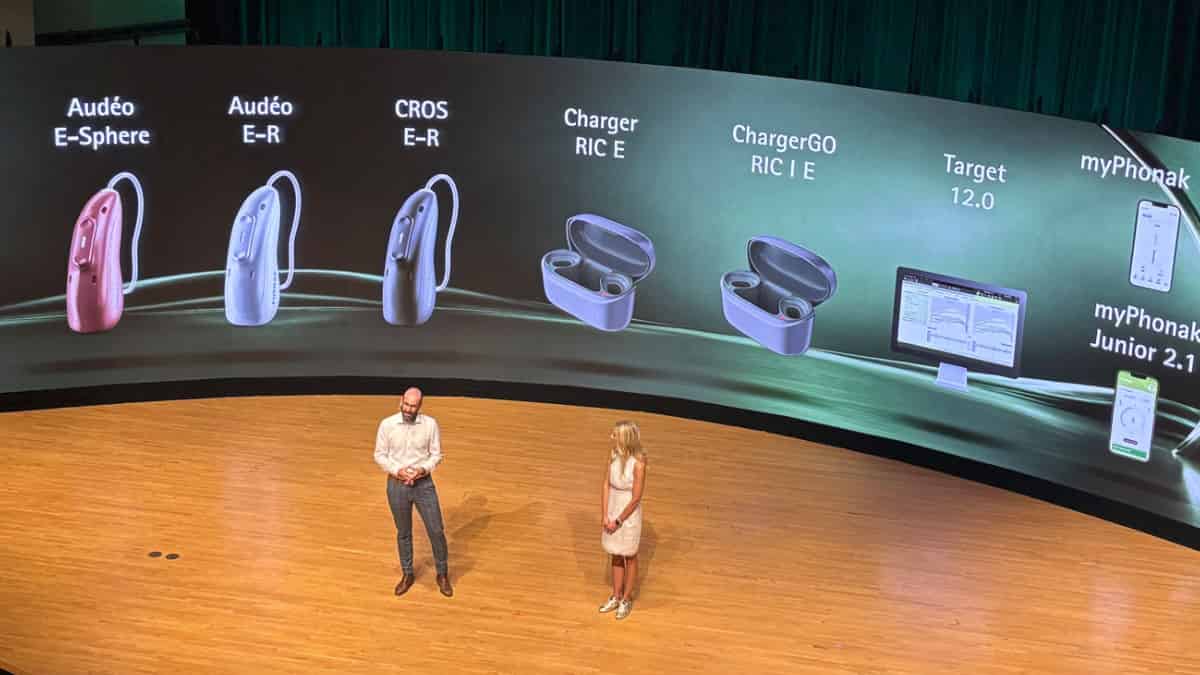
The new EON family includes the flagship Audéo EON Sphere (Audéo E-Sphere), the conventional Audéo E-R (rechargeable non-Sphere model), and E-R for people with single-sided deafness, along with two charging options: the cable-powered Charger E and the ChargerGo RIC I E, which has a built-in battery that provides up to three full recharges away from an outlet.
Evidence beyond the speech scores
Jason Galster, PhD, Phonak’s VP of clinical research, said the company has conducted seven premarket clinical studies at its audiology research centers in Switzerland, Canada, and the United States.
One research collaboration used both electroencephalography (EEG) and functional near-infrared spectroscopy (fNIRS) to examine listening effort. The latter measures changes in blood oxygenation in the brain; together, the two objective measures indicated that activating Sphere’s reduced the cognitive resources required for listening, according to Galster.
“Guess what happens when you turn on the Sphere denoising network? You use less oxygen,” Galster said. “This suggests less listening effort and fatigue. There is more fuel—more oxygen—in the participant’s brain to do other tasks. This is an objective measurement showing that Sphere reduces listening effort at a cognitive level within the brain.”
Phonak also evaluated WindBlock 2.0, which combines changes in the physical microphone system with an algorithm that favors the microphone experiencing less wind turbulence. In controlled testing, 19 experienced hearing aid users preferred WindBlock 2.0 over the previous version for speech clarity, listening comfort, effort, naturalness, and overall sound quality.
Preuss said the improvement was obvious to him when running, cycling, on ferry rides, on city walks with his kids, and even driving with a window open. WindBlock 2.0 is available across every EON performance level—a decision that received spontaneous applause from the audiologists in attendance.
So did the announcement that Spheric Speech Clarity will be offered at the 90, 70, and 50 levels. During our interview, Dessypris singled out that expansion as one of the launch’s most important elements because it puts Phonak’s defining Sphere technology within reach of more patients.
What EON means to consumers and hearing care professionals
EON arrives with large expectations. Infinio Sphere reset the industry’s speech-in-noise benchmark, but its success and popularity also exposed Phonak to supply and service pressures during the initial rush. Company leaders told HearingTracker they have applied those lessons and emphasized a renewed commitment to product quality, reliability, inventory, and customer support.
:format(webp))
For providers, EON offers an easier version of the Sphere story to recommend: leading speech-in-noise performance in a smaller package, more consistent automatic activation, strong battery life, broad phone and computer compatibility, Roger, , and improved outdoor listening. Extending Spheric Speech Clarity to the 50 level also gives clinicians more room to balance performance with consumers’ wallets.
For consumers, the proposition is simpler. EON is designed to remove more of the moments when a hearing aid—or the effort of hearing—gets in the way.
That may ultimately be the best way to envision the launch at Ravinia. EON is not a “remake” of Infinio Sphere. Instead, it’s Phonak’s attempt to preserve what made Sphere exceptional while eliminating reasons providers might hesitate to recommend it and removing consumer obstacles to wearing it.
Dr. Jones summed it up: “That’s the reason for EON: adaptive clarity, so you can focus less on complexity and more on confidence; unlimited connections for frictionless integration into everyday life; and intuitive design, so every interaction feels purposeful and human-centered. This is EON—clarity you hear and connection you feel.”
Acknowlegement: Phonak hosted HearingTracker and other members of the hearing care media at its EON launch event in Chicago and covered associated travel expenses. HearingTracker retained full editorial control over this coverage.
Karl Strom
Editor in ChiefKarl Strom is the editor-in-chief of HearingTracker. He was a founding editor of The Hearing Review and has covered the hearing aid industry for over 30 years.