Are Real Ear Measurements Worth It?
A thin probe tube checks whether your hearing aids deliver the sound your prescription calls for. Here’s when it matters most.

Hearing aid glossary
Looking that up…
Terms are matched automatically. A definition may not fit every context.
For years, HearingTracker forum member bradw wondered whether something was missing from otherwise successful hearing care. Their audiologist did not use real ear measurements, often shortened to . The hearing aids worked well, but repeated advice about the importance of REM left a nagging question: Could they work better?
Eventually, bradw tried two different hearing aid models fitted with REM. The experience was useful, though less dramatic than the online discussion might suggest.


“We just got there a little faster,” bradw wrote. Their earlier audiologist had reached a similarly satisfying result through experience, patient feedback, and several follow-up visits. With , that process took less back-and-forth.1
Audiologist Amy Sarow notes that this is a common experience, though “it can also depend on a person’s hearing loss, coupling to the ear (e.g., open domes versus earmolds), and ear canal size or shape.”
Personally, I've seen a lot of 'underfit' patients (fit by a previous provider) who didn't realize how much benefit they were missing out on. —Amy Sarow, Au.D.

In any case, hearing better sooner matters, especially when every appointment means time away from work or another long drive. Other forum members describe a much larger improvement after a fitting that included .
So, are real ear measurements worth it?
For people buying professionally fitted hearing aids, REM is worth seeking out, particularly when it is included in the price. It gives the provider direct evidence about the sound reaching your ear and can reveal problems that software predictions miss.
The research supports that recommendation, but with qualifications. Benefits vary, newer studies have produced mixed results, and REM does not guarantee that you will prefer the sound. Its value also depends on the cost and quality of the care surrounding it.
What real ear measurements actually measure
Your hearing test measures which sounds you can detect. Hearing aid fitting software uses those results to calculate how much amplification to provide at different pitches.
The software can account for the hearing aid model, speaker strength, and earpiece. It still has to estimate how that combination will behave inside your ear.
checks the result. A clinician places a thin tube connected to a microphone into your ear canal, alongside the hearing aid. A speaker plays test sounds, often recorded speech. The equipment measures the sound near your eardrum while you wear the device.2
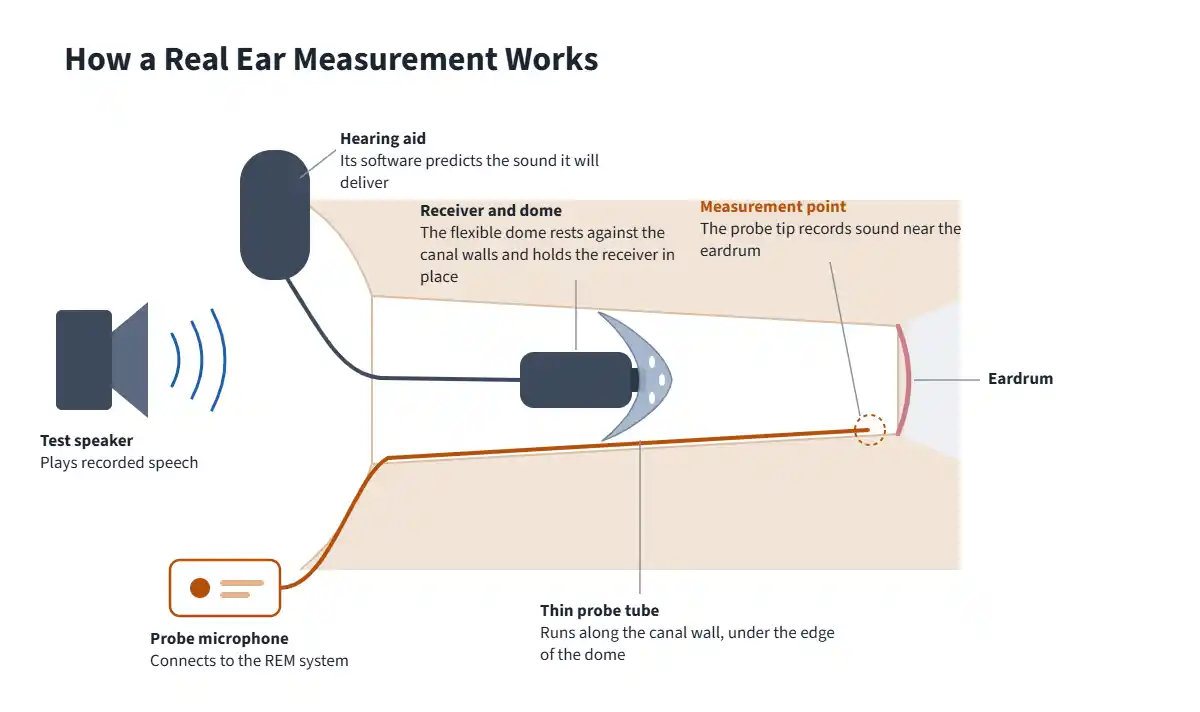
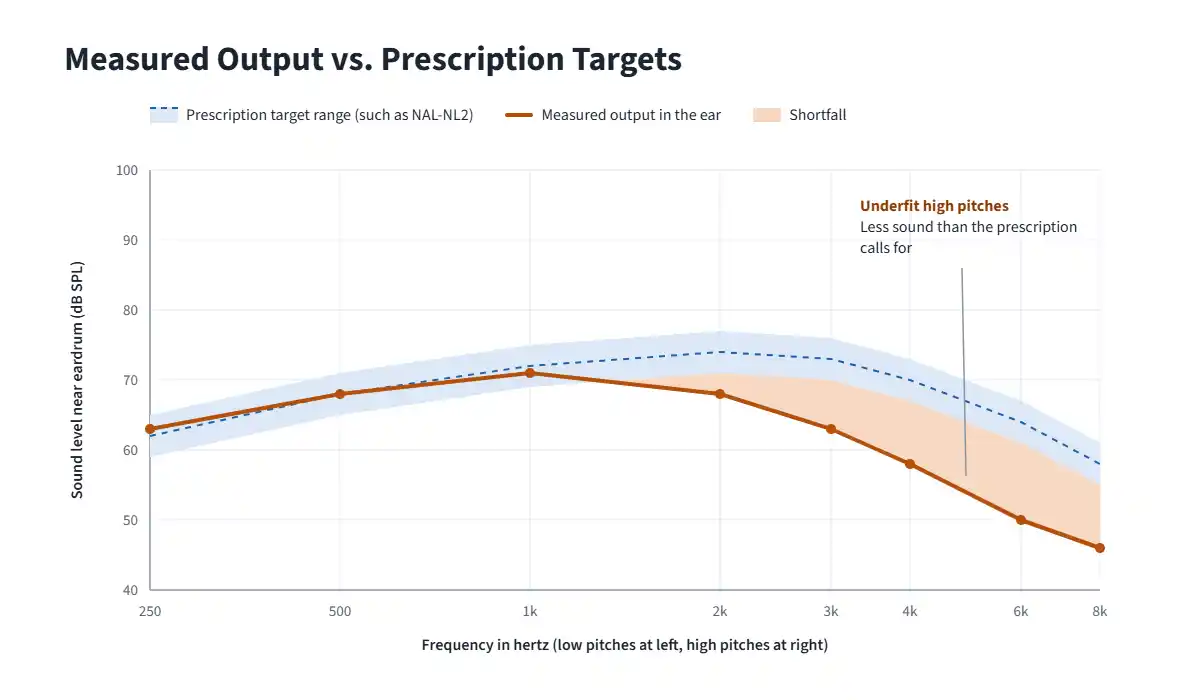
The clinician compares that output with targets from a hearing aid prescription. Those targets, originally determined from research to help improve outcomes and speech intelligibility, describe how much sound should reach the ear at different pitches and listening levels. Software curves labeled with a prescription name, such as , are predictions until the output is measured.3
This matters because ears differ in size and shape, even between the left and right ears of the same person. Earpieces also change how sound travels. An open dome lets more sound escape than a tightly fitted earmold. The settings on a computer screen cannot fully describe those effects in an individual ear.3


The measurements can guide adjustments to make soft speech audible, conversational speech useful, and louder sounds tolerable. Adult fitting standards also call for checking that the maximum output of the device does not exceed the hearing aid wearer’s level of discomfort at each frequency.4
If the starting settings already produce an appropriate response, the clinician may have little to change. An uneventful measurement can still provide useful confirmation.
Why users describe such different results
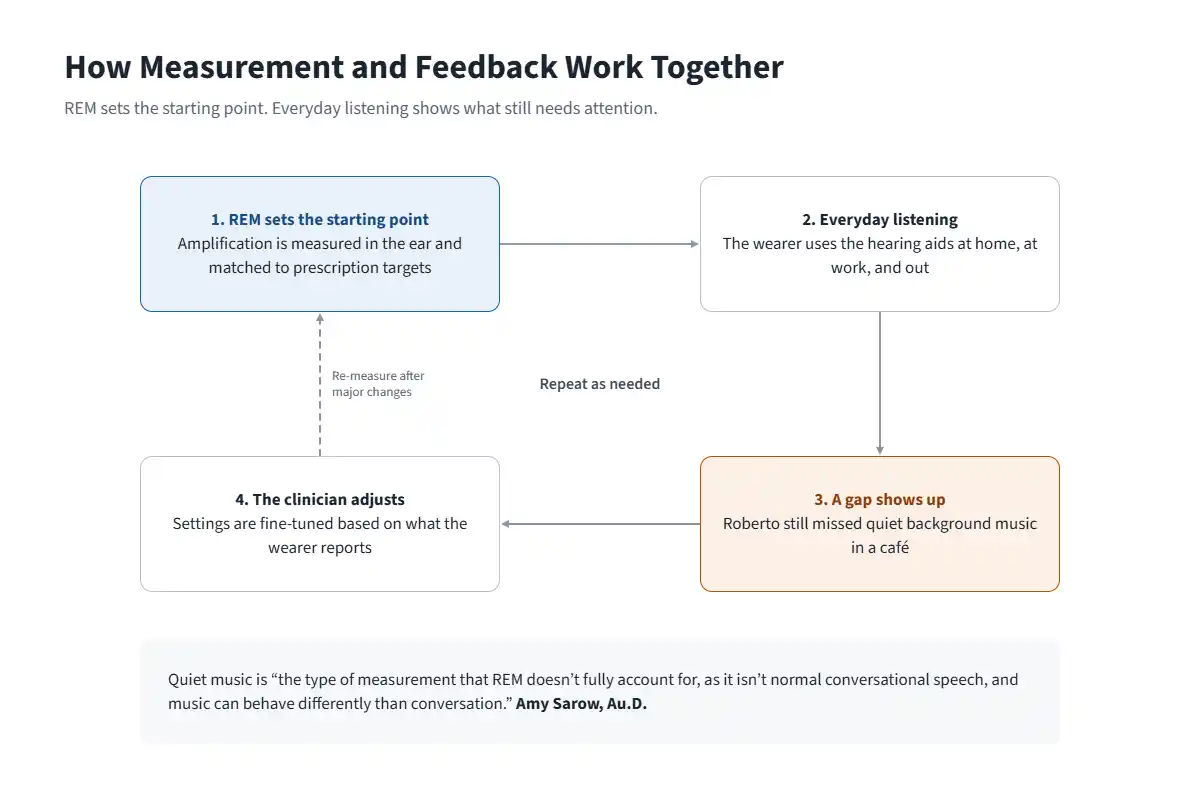
Forum member Roberto reported that had made a large difference on two occasions, particularly when other people’s speech seemed too quiet. Yet the measurement did not finish the job.

After a recent fitting, Roberto still struggled to notice quiet background music in a coffee lounge. Amy Sarow, Au.D., highlights that this is “the type of measurement that doesn’t fully account for, as it isn’t normal conversational speech, and music can behave differently than conversation.” Nevertheless, another appointment and further adjustment helped. Later, they described hearing distant oven beeps and laptop fans that had previously gone unnoticed. They credited both REM and their audiologist’s skill.5
That account captures how measurement and patient feedback can work together. REM helped establish the amplification. Everyday experience revealed something that still needed attention.

Another member, Bucco, described being unimpressed by loaner Oticon Real hearing aids programmed from their without . When their own pair arrived and the fitting included REM, the improvement felt like “night and day.”6
That is a striking report, though it was not a controlled comparison. The devices were different physical pairs, and other fitting details could have changed. It cannot tell us exactly how much improvement came from REM.


Bradw’s experience was more modest. A skilled clinician had already achieved good results without it. seemed to shorten the route to a satisfying fit.1
These accounts raise a useful question for interpreting both testimonials and research: What is REM being compared with? An untouched software first fit, months of careful adjustments, and a rushed appointment are different alternatives.
Forum stories help explain what matters to wearers. They cannot establish how often a particular result occurs. People who post are a self-selected group, and details about their hearing, devices, and fittings are often incomplete.
What the earlier research found
Several controlled studies support fitting hearing aids to a verified prescription.
In a 2012 study by Harvey Abrams and colleagues, 22 experienced hearing aid users tried manufacturer initial settings and a prescription verified with probe microphone measurements. Self-reported benefit favored the verified fitting, and 15 participants preferred it, compared with seven who preferred the initial settings.7

Amy Sarow, Au.D., cautions that “Preference is a tricky one to account for. If these are users who were previously underfit, bringing them up to targets might feel like it’s too much or uncomfortable at first. Sometimes we have to bring them up to target gradually over time and not on the first visit in the clinic/real world.”
A larger study by Monique Boymans and Wouter Dreschler compared two fitting approaches in 73 people. One used REM to match a prescription. The other used patient responses to recordings of everyday listening situations to guide adjustments.
Participants tried each setup for six weeks using the same hearing aids. The REM-based approach performed better on some speech tests, and 67% preferred it overall. This suggests that listening feedback alone can sometimes leave useful amplification unrealized. The study also involved older technology and a particular feedback-based fitting method, which limits direct comparisons with today’s care.8
When someone has had a gradual hearing loss slowly over years, they may not realize what they are not getting. —Amy Sarow, Au.D.
A frequently cited 2018 trial by Michael Valente and colleagues involved 24 new hearing aid users. Each person tried the same devices with the manufacturer’s proprietary first fit and with -guided fitting to .
The verified fitting produced a median improvement of 15 percentage points in word recognition for soft speech in quiet. At a conversational level, the median advantage was four percentage points. The sentence-in-noise test did not show a statistically significant difference. Seventy-nine percent preferred the verified fitting.9


The largest benefit, then, concerned quiet speech presented softly. That finding should not become a promise of a similar improvement in restaurants. The trial also changed both the fitting prescription and the verification approach, so it did not isolate the measurement’s contribution.
What the research review adds
In 2021, Ibrahim Almufarrij, Harvey Dillon, and Kevin Munro published a systematic review of six experimental studies, including the trials discussed above. Five studies contributed to the pooled analyses.
The combined results favored -guided fitting. Average benefits were moderate for speech understanding in quiet and small for speech understanding in noise and self-reported listening ability. Much of the quiet-speech testing used soft presentation levels.10
The authors also emphasized the limits. Participant numbers were small, evidence quality varied by outcome, and none of the included studies measured their chosen primary outcome of hearing-related quality of life.
A statistically reliable difference does not automatically mean a noticeable improvement in daily life. For several outcomes, researchers lacked an established threshold for deciding how much change would be meaningful to patients. The review called for better evidence about clinical importance and cost effectiveness.10
The practical reading is that REM can improve outcomes, with clearer support for some benefits than others. The review does not establish a universal improvement or a dollar amount every patient should pay.
Newer studies complicate the picture
A 2023 trial by Almufarrij and colleagues tested two programs in 45 new adult hearing aid users. One began with the manufacturer’s approximation of ; the other was adjusted using . Both allowed changes based on the patient’s immediate feedback.
The initial fitting was already close to prescription targets for average-level speech, apart from higher frequencies where REM brought it somewhat closer. Clarity ratings did not differ, and comfort ratings favored the initial fit. Only 10 participants, or 22%, preferred the REM program overall.11

This was a blinded comparison using two Oticon hearing aid models in adults with mild to moderate hearing loss. It assessed listening preference rather than objective speech recognition. The result challenges claims that always produces a preferred sound, while leaving questions about other devices, hearing losses, and outcomes.
A September 2026 study examined records from 105 adults using a hearing aid in one ear. Sixty followed an REM-based fitting pathway; 45 received manufacturer first fit followed by routine fine-tuning. After three months, the researchers found no statistically significant differences in the reported hearing and questionnaire outcomes.12
However, this was a review of clinical records, not a randomized trial. The groups were treated in different periods, and the study did not establish that the two methods were equivalent. It also did not measure speech recognition in noise.
Taken together, these newer findings suggest that the extra benefit of REM can narrow when initial settings are accurate and follow-up adjustments are available. They do not tell us which individual patients would have benefited from a measured correction.
Why a good REM result can still leave you struggling
measures sound in the ear canal. It cannot repair the damage that causes hearing loss or fully predict how clearly you will understand that sound. Hearing aids also have limits in separating speech from competing noise.13
A well-verified fitting may therefore leave a difficult restaurant difficult. The next useful step could involve another listening program, a , communication strategies, or further assessment. Adult fitting standards place verification within a broader process that includes listening needs, outcome measures, counseling, and follow-up.4
The quality of that follow-up varies, as forum members pointed out while discussing the 2026 study. Forum member ellenb18 described returning four or five times for adjustments after an initial fitting. Another member, d_Wooluf, said that level of support had not been their experience.14
That difference affects how useful any research comparison will be in practice. “First fit plus routine fine-tuning” describes much better care when a provider welcomes detailed feedback and has time to act on it.
Comfort also deserves attention. More amplification can make speech clearer while making some sounds unpleasant. The aim is a useful, wearable fitting. A clinician should explain the tradeoff, consider gradual changes when appropriate, and take persistent discomfort seriously. A graph alone cannot determine whether the result works for you.
Does REM make hearing aids more expensive?
For many shoppers, there is no separate purchase decision. The measurement is part of the fitting service included with the hearing aids.
That makes a simple price comparison difficult. One package may include testing, verification, several years of adjustments, and maintenance. Another may charge separately for professional visits. Comparing the device prices alone can hide those differences.
Costco provides a useful example of within a lower-priced service model. Its current U.S. Hearing Aid Center page lists several pairs of prescription hearing aids starting at $1,599.99, with free service appointments for devices bought there. A Philips fitting guide for Costco explicitly directs clinicians to perform real ear measurements according to Costco protocols.15, 16
This shows that access to REM does not inherently require a costly private-practice package. It does not mean REM costs the provider nothing. Equipment, training, and appointment time still have to be funded.
Having the equipment also doesn’t guarantee a good fitting. As audiologist Amy Sarow, Au.D., points out, the measurement only helps if the provider acts on it. If REM shows the hearing aids are delivering less amplification than the prescription calls for and the provider doesn’t adjust the programming to match targets, running the test accomplishes nothing.
An experienced independent audiologist may reasonably charge more for the time and expertise they devote to your care. Longer appointments, complex troubleshooting, and dependable follow-up can be valuable. Those services should be assessed as part of the overall package rather than attributing the entire price difference to REM.
A higher price does not, by itself, establish a better fitting. Ask what the fee covers and how the provider will evaluate whether the treatment has helped.
Conversely, a lower price does not establish that verification has been omitted. Ask the same questions at a warehouse hearing center as at an independent clinic.
How much do real ear measurements cost?
Some clinics offer separately, but it is worth arranging before buying hearing aids elsewhere.
In a HearingTracker discussion about finding REM in New York City, member ronross described buying hearing aids online and being pleased with the remote programming. They wanted a local measurement for reassurance that the devices were reaching their potential. Finding that service was the practical problem.17
Provider | Price | What it covers | Source |
|---|---|---|---|
Costco | Included in the aid price | REM during fitting, | |
Designer Audiology | $250 | REM ($150), | |
Academic audiology clinic | $218 | Initial fitting with REM, | |
Hello Hearing Studios | $275 | Hearing evaluation, | |
Private audiology practice | $600 | REM; adjustments not stated | |
Hospital-based clinics, New Jersey | About $800 | New hearing test, |
Some clinics publish separate fees. As of October 2026, Designer Audiology lists real ear measurements at $150 and reprogramming separately at $100. Hello Hearing Studios lists a $275 service that includes a hearing evaluation, reprogramming, , and an adjustment within 30 days. These are individual examples, not national average prices.18, 19
A quoted measurement fee may therefore be only part of the cost. A new clinic may also need an assessment, programming time, or a follow-up appointment. It must be able and willing to work with your hearing aid model. The prices quoted here are in U.S. dollars.
Before booking, ask whether the appointment includes adjustments if the measurement finds a problem. Paying for a graph has less practical value if nobody can act on it. Also ask how the new settings will be shared with your regular provider.
If you are buying new aids, choosing a provider who already includes verification and follow-up may be easier than assembling those services later.
What about self fitting and OTC hearing aids?
The value of does not mean people can only benefit from hearing aids after an in-person verified fitting.
A 2023 randomized trial by Karina De Sousa and colleagues compared self-fitting hearing aids, with remote support available, against the same devices fitted by audiologists using best practices, including REM. Among 64 adults with mild to moderate hearing loss, outcomes after six weeks were comparable on self-reported benefit and speech-in-noise measures.20
An eight-month follow-up included 44 of the original participants and found no significant group differences in the main self-reported outcomes. Losing some participants to follow-up limits confidence, and the results concern one device and service approach. These studies also compare whole fitting pathways, so they cannot isolate REM’s effect.21
For someone choosing among care options, they show that a supported self-fitting route can work well. They do not establish that every device or every hearing loss will produce similar results.
Access has value too. In another forum discussion, member comeagain explained how appealing remote support was when travel, appointments, and age-related health issues made clinic visits harder.22
REM should be considered alongside those practical needs. An appointment that is affordable and reachable may serve someone better than an idealized service they cannot use. Persistent difficulties are a reason to seek further help and consider whether verification could reveal a correctable fitting problem.
What to ask before a fitting
You do not need to master the technical details to find out whether a provider takes verification seriously. A few questions can clarify the service:
- Will you measure the sound in my ears with a probe microphone while I wear the hearing aids?
- Will you check soft, average, and loud speech, as well as maximum output?
- Is that included in the price, and does the fee cover adjustments?
- How will we assess whether I am hearing better in the situations that matter to me?
- What follow-up is available if the sound remains uncomfortable or unclear?
A hearing test played through the aids, or a test to prevent whistling, is not automatically . Ask which procedure was performed. In a conventional REM appointment, a separate probe tube measures the output in your ear.2, 16
describes probe microphone measurement as the gold standard for verifying hearing aid fittings. The procedure depends on correct calibration, tube placement, and other technical details, so the provider’s training matters.2
The clinician should also explain what the measurements show and why a final setting may differ from the prescription. Adult fitting standards allow minor changes after verification when needed for patient acceptance.4
If hearing changes, or a different dome, earmold, or speaker changes the fitting, ask whether verification should be repeated. Keep a copy of your results when possible.
When REM is most worth seeking out
If you are choosing a provider for new prescription hearing aids, favor one who includes within a thorough fitting and follow-up service. When it adds no separate fee and little inconvenience, there is a strong practical case for checking the sound actually reaching your ears.
If you already own aids and remain dissatisfied, a paid appointment that combines verification with skilled adjustment may be worthwhile. It can help investigate whether the problem includes too little amplification, an unsuitable earpiece, or another fitting issue. It may also show that the existing response is appropriate, directing attention elsewhere.
If you hear well, wear your aids comfortably, and have a responsive provider, the evidence does not give you a reason to assume your fitting has failed simply because REM was never performed. Ask about verification at your next visit and weigh any extra expense against the questions you want answered.
The research cannot supply a universal break-even price. A modest charge to investigate an unresolved problem presents a different decision from paying thousands more for a package whose other benefits are unclear.
Bradw’s account offers a useful expectation. REM helped reach a good result sooner. Roberto’s experience adds another: measurement helped, and further listening-based adjustments still mattered. Both describe outcomes worth pursuing.
For most professionally fitted hearing aid purchases, REM is a sensible service to seek. Its strongest value comes when a capable provider uses the results, listens to your experience, and keeps working with you until the fitting is useful in daily life.
References
HearingTracker Forum. Importance of REM. Comments by bradw and other members, October 2026. Source
American Speech-Language-Hearing Association. Hearing Aids For Adults. Practice Portal. Sections on fitting, verification, and real-ear measures. Source
Jorgensen LE, Novak M. Verification and validation: just the standards. Seminars in Hearing. 2022;43(2):85–93. doi:10.1055/s-0042-1749208. Source
Audiology Practice Standards Organization. S2.1 Hearing Aid Fitting for Adult and Geriatric Patients. Standards 10–15 address verified output, patient acceptance, outcomes, and follow-up. Source
HearingTracker Forum. Real Ear Measurement (R.E.M.). Roberto, June 21, 2026. Personal report of REM, further adjustments, and improved audibility. Source
HearingTracker Forum. My Oticon Real experience. Bucco, April 4, 2023. Comparison of unverified loaners and a later REM-based fitting. Source
Abrams HB, Chisolm TH, McManus M, McArdle R. Initial-fit approach versus verified prescription: comparing self-perceived hearing aid benefit. Journal of the American Academy of Audiology. 2012;23(10):768–778. doi:10.3766/jaaa.23.10.3. Source
Boymans M, Dreschler WA. Audiologist-driven versus patient-driven fine tuning of hearing instruments. Trends in Amplification. 2012;16(1):49–58. doi:10.1177/1084713811424884. Source
Valente M, Oeding K, Brockmeyer A, Smith S, Kallogjeri D. Differences in word and phoneme recognition in quiet, sentence recognition in noise, and subjective outcomes between manufacturer first-fit and hearing aids programmed to NAL-NL2 using real-ear measures. Journal of the American Academy of Audiology. 2018;29(8):706–721. doi:10.3766/jaaa.17005. Source
Almufarrij I, Dillon H, Munro KJ. Does probe-tube verification of real-ear hearing aid amplification characteristics improve outcomes in adults? A systematic review and meta-analysis. Trends in Hearing. 2021;25:2331216521999563. doi:10.1177/2331216521999563. Source
Almufarrij I, Dillon H, Adams B, Greval A, Munro KJ. Listening preferences of new adult hearing aid users: a registered, double-blind, randomized, mixed-methods clinical trial of initial versus real-ear fit. Trends in Hearing. 2023;27:23312165231189596. doi:10.1177/23312165231189596. Source
Lee JM, Kong TH, Lee JW, Lee HJ. Outcomes of real-ear measurement-based fitting in unilateral hearing aid users: influence of contralateral hearing. PLOS One. Published September 24, 2026. doi:10.1371/journal.pone.0358875. Source
National Institute on Deafness and Other Communication Disorders. Hearing Aids. Consumer guidance on amplification, hearing aid limitations, and adjustment. Source
HearingTracker Forum. Just released study finds no clear 3-month advantage for REM-based fitting in unilateral hearing aid users. Ellenb18 and d_Wooluf, October 4, 2026. Differing experiences of follow-up care. ellenb18’s post · d_Wooluf’s post
Costco. Hearing Aid Center. U.S. advertised prices and included service appointments. Prices vary by state; custom earmolds may cost extra. Accessed October 27, 2026. Source
Demant. Philips HearSuite first fit guide for HearLink 9050 miniRITE. Costco clinician guide, 2024. Step 4 calls for real-ear verification according to Costco protocols. Source
HearingTracker Forum. Real ear measurement NYC. Ronross, January 30, 2025. Seeking local verification for hearing aids purchased online. Source
Designer Audiology. Our Prices. Lists real ear measurements at $150 and reprogramming separately at $100. Accessed October 27, 2026. Source
Hello Hearing Studios. Terms and Conditions. Lists hearing evaluation, reprogramming, REM, and a follow-up adjustment for $275 outside its service plan. Accessed October 27, 2026. Source
De Sousa KC, Manchaiah V, Moore DR, Graham MA, Swanepoel DW. Effectiveness of an over-the-counter self-fitting hearing aid compared with an audiologist-fitted hearing aid: a randomized clinical trial. JAMA Otolaryngology–Head and Neck Surgery. 2023;149(6):522–530. doi:10.1001/jamaoto.2023.0376. Source
De Sousa KC, Manchaiah V, Moore DR, Graham MA, Swanepoel DW. Long-term outcomes of self-fit vs audiologist-fit hearing aids. JAMA Otolaryngology–Head and Neck Surgery. 2024;150(9):765–771. doi:10.1001/jamaoto.2024.1825. Source
HearingTracker Forum. Real Ear Measurement: Real Significant? Comeagain, May 2, 2026. Practical value of remote care when clinic visits are difficult. Source
Abram Bailey, AuD
Founder and PresidentDr. Bailey is a leading expert on consumer technology in the audiology industry. He is a staunch advocate for patient-centered hearing care and audiological best practices, and welcomes any technological innovation that improves access to quality hearing outcomes. Dr. Bailey holds an Au.D. from Vanderbilt University Medical Center.
Amy Sarow, Au.D.
Director of Consumer Education & AudiologyDr. Amy Sarow is a Doctor of Audiology and nationally recognized hearing health expert. She helps consumers better understand hearing loss, hearing technology, tinnitus, and the role hearing health plays in healthy aging.
As HearingTracker’s Director of Consumer Education & Audiology, Dr. Sarow develops evidence-based, practical resources that empower people to make informed decisions about their hearing care and technology. She is especially passionate about translating complex medical and audiological information into clear, accessible guidance for consumers and their families.
Dr. Sarow serves on the Forbes Health Advisory Board and has been featured as an expert source by NPR, BBC Future, and other media outlets.