Fortell AI 2.5 Update Targets More Natural Sound Without New Hearing Aids
The free firmware update is designed to cut processing delay by 15%, improve speech and music quality in company laboratory testing, and add Find My Hearing Aids.
Hearing aid glossary
Looking that up…
Terms are matched automatically. A definition may not fit every context.
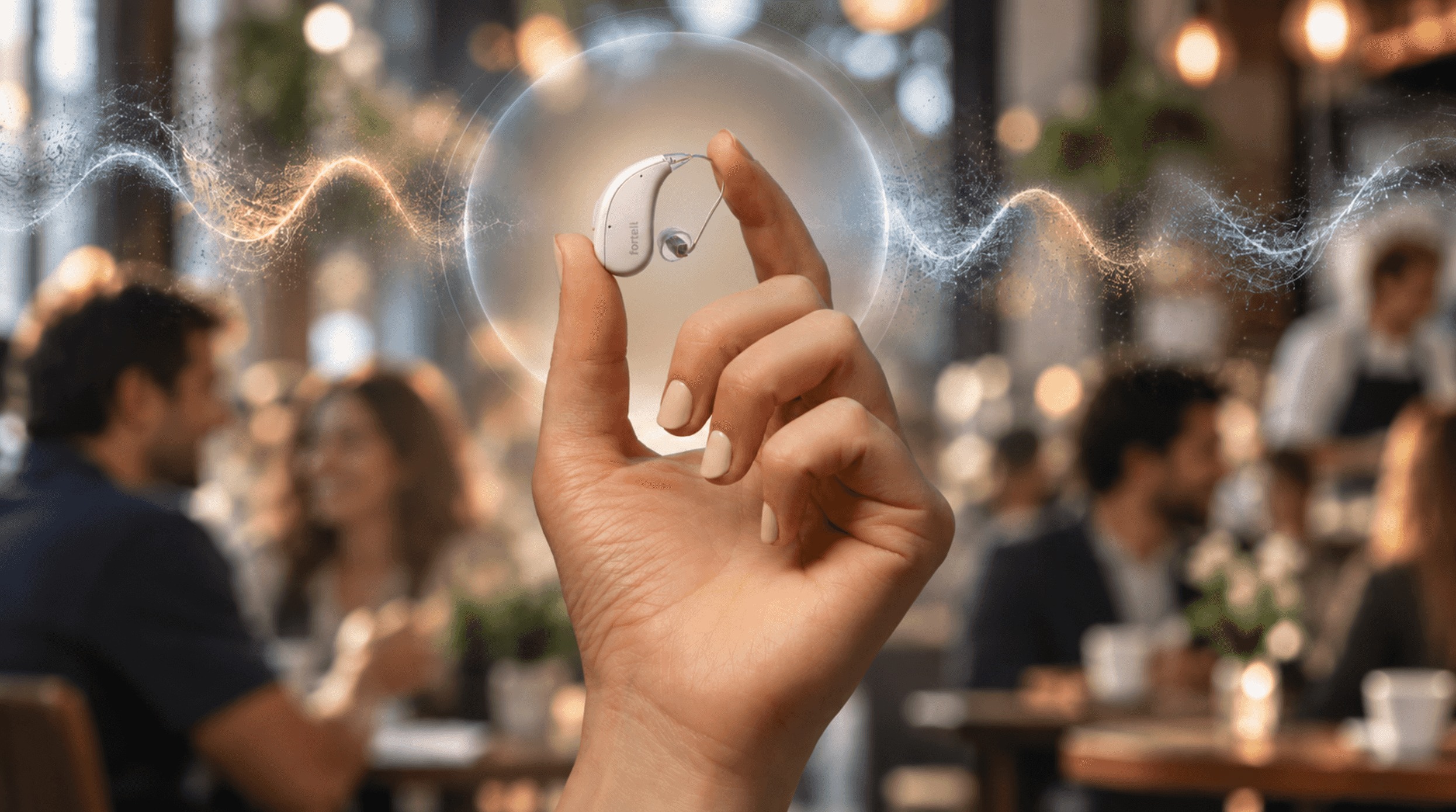
Fortell is releasing 2.5, a free firmware update that brings faster sound processing, improved sound quality, and a Find My Hearing Aids feature to its existing prescription hearing aids. Running AI 2.0, those devices earned HearingTracker’s highest performance rating in background noise and was the winner of its recent AI hearing aid battle.
Like the AI 2.0 update HearingTracker covered in August, AI 2.5 requires no purchases or new hardware. It began rolling out November 16 through the Fortell iOS app, with distribution continuing throughout the week. Owners can install it themselves without visiting a hearing care professional.


The free 2.0 and AI 2.5 updates address different aspects of the listening experience while continuing Fortell’s approach to improving its hearing aids after purchase. In our August launch coverage, CEO Matthew de Jonge said the company had been delivering frequent software updates. Released less than three months ago, AI 2.0 retrained Fortell’s deep neural network () to better separate speech from competing sounds; AI 2.5 improves the digital signal processing that supports AI, reducing latency and improving sound quality.
“When you trust Fortell with your hearing, you trust us to keep you on the bleeding edge,” says de Jong. “AI 2.5 rewards that trust. Today, the bleeding edge got faster.”
Less delay for better own-voice perception
While Fortell 2.0 earned HearAdvisor’s highest scores for speech in noise, it fared less well on the lab’s Own Voice measure. As audiologist Steve Taddei, , explained in HearingTracker’s review, Fortell’s relatively closed power domes help maximize noise reduction but can make the wearer’s voice sound slightly boomy—a physical effect called occlusion.
AI 2.5 addresses a different contributor to unnatural own-voice sound: processing delay. According to Fortell, the update reduces the time that sound takes to pass through the hearing aid by about 15%, from 9.1 milliseconds to 7.7 milliseconds in All Voices mode.
A 1.4-millisecond difference might not seem like much. However, when we speak, we hear our voice naturally through the air and bone-conducted vibrations through the head. Hearing aids add the amplified version that arrives slightly later, and that timing difference can affect how natural our own voice sounds. Research in open-fit hearing aids has linked shorter processing delays with better own-voice perception, suggesting a potential benefit from 2.5’s reduced delay.
Although that improvement would not be reflected in HearAdvisor’s existing Own Voice score—which measures physical occlusion with the hearing aids switched off—the new firmware upgrade could make a wearer’s voice sound more natural when using closed ear tips. Fortell’s AI 2.5 study did not directly evaluate wearers’ own-voice perceptions, so the benefit remains to be confirmed through listening evaluations.
Fortell also reports measuring 13.5 milliseconds of delay in an unnamed competing hearing aid which it says is the only other device with source-separation AI—likely either Phonak Infinio Sphere or the newer Eon Sphere (although the white paper does not identify the device or generation tested). AI 2.5’s 7.7-millisecond result represents about 43% less delay than that device.
Igor Lovchinsky, Fortell’s co-founder and Chief Scientist, told HearingTracker, "Running a deep neural network on sound in real time usually costs you time, so the industry has generally accepted that AI means more delay. We didn’t want to accept that. With AI 2.5, our goal was to have the lowest latency possible without sacrificing how voices and music sound.”

Lab tests show improved speech and music quality
Fortell also compared both 2.0 and AI 2.5 firmware versions on the same hearing aids mounted on a KEMAR acoustic manikin. The devices used the most popular prescriptive hearing aid fitting method () for a typical moderate sloping hearing loss and were fitted with power domes.
Using numerous sound clips, the company’s researchers tested speech at soft, conversational, and loud levels, along with 14 tracks of music spanning different genres, including piano, orchestral, string, vocal, and pop selections. Two established, widely-used computer-based measures—the Hearing Aid Speech Quality Index (HASQI) and Hearing Aid Audio Quality Index (HAAQI)—estimated how hearing aid listeners would rate the recordings’ quality. Speech was tested in the hearing aid app's All Voices listening program; music was tested in the Live Music program.
The results show that average speech-quality scores improved by 4.6%. When averaged across presentation levels, 54 of the 60 clips scored higher with the latest 2.5 update. Improvements occurred at all three volume levels, with larger gains for soft and conversational speech.
Average music-quality scores showed a relative improvement of 9.1%, with gains on all 14 tracks.
According to Fortell, the differences were statistically significant. However, these percentages reflect changes in predictive quality scores (HASQI/HAAQI) and do not include wearer ratings or speech-in-noise testing for AI 2.5.
For perspective on the earlier AI 2.0 release, HearingTracker contributor Ben Gailor’s 50-hour trial of AI 2.0 in New York City reported easier conversations on busy streets, in his car, and at social gatherings.
Availability and care
2.5 also adds a Find My Hearing Aids feature through the Fortell app to help locate misplaced devices. Although now fairly common in most premium prescription hearing aids, this feature can be extremely useful when searching for a device that has been misplaced or fallen out of the ear.
Fortell’s hearing aids cost $6,800 per pair, including 5 years of audiological care, a 3-year warranty, and a 100-day home trial. The app and direct streaming currently support only Apple devices. In October, the company announced expanded access across more than 30 states through clinics and its Fortell Anywhere remote audiology service.
For current owners, 2.5 offers another opportunity to improve the hearing aids they already own. Alongside Fortell’s AI 2.0 release and Phonak’s Infinio Ultra firmware upgrade, it reflects a trend we welcome at HearingTracker: meaningful improvements that reach existing users without requiring another hearing aid purchase. Although software cannot replace every hardware advance, updates that enhance performance or add useful features can extend a device’s effective service life and help owners benefit from innovation between product generations, giving them more value from their hearing aid purchases.
“This is our second meaningful, zero-cost improvement in three months and it won’t be our last,” de Jonge told HearingTracker.
Karl Strom
Editor in ChiefKarl Strom is the editor-in-chief of HearingTracker. He was a founding editor of The Hearing Review and has covered the hearing aid industry for over 30 years.