Inside Omega AI+: Starkey Makes the Case for Smarter Hearing Care
At Starkey Day in Minneapolis, the company connected its latest advances in AI processing, custom hearing aids, and health monitoring to a practical question: How will they improve the experience for patients and providers?)
Featured Products
Compare allHearing aid glossary
Looking that up…
Terms are matched automatically. A definition may not fit every context.
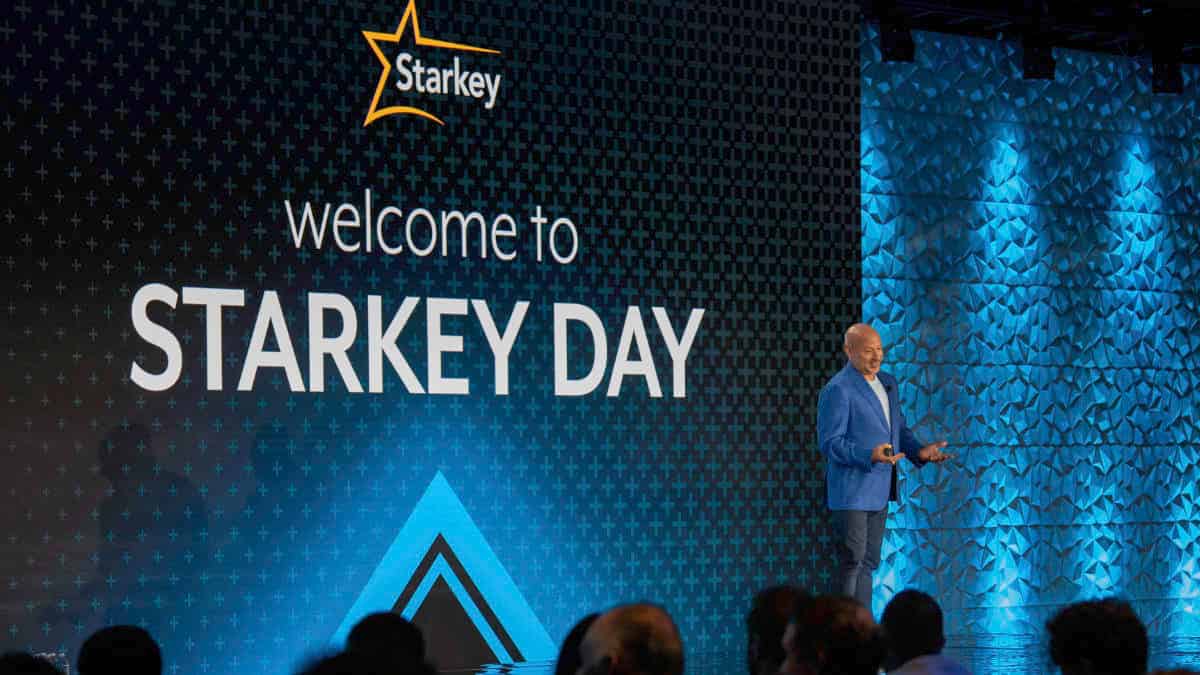
Starkey launched its new flagship hearing aid, Omega AI+, on Thursday, October 1, to about 700 hearing care professionals and an online audience at the Hilton Minneapolis Downtown hotel during the annual event the company calls “Starkey Day.”
The new hearing aid will replace Omega and include an advanced super-fast processing chip, retrained deep neural networks () within a new Quad DNN Architecture, a DNN Dual Compressor that balances speech audibility with natural sound quality, a redesigned feedback management system, and an enhanced Edge Mode that can remain continuously active. The platform also extends DNN 360 to rechargeable custom hearing aids, adds Sleep Tracking for wearers, and alerts users when they leave their hearing aids behind.
But Starkey’s messaging extended beyond a new hearing aid. Across the Starkey Day presentations, executives and researchers explained how the technology fits into a broader vision for the future of hearing care—and offered evidence for what patients might gain from it.


President and CEO Brandon Sawalich described Starkey as “legacy built, future driven,” connecting founder Bill Austin’s commitment to hearing and health care with a February 2017 conversation among Austin, Sawalich, and CTO Achin Bhowmik about reinventing the hearing aid. That vision took tangible form in August 2018 with Livio AI, which combined artificial intelligence () and integrated motion sensors with activity and social-engagement tracking and language translation. The launch established Starkey’s approach to hearing aids as multifunctional devices—a strategy that continues through Omega AI+ and its three pillars of intelligent hearing, health and fitness monitoring, and personal assistance.
Better hearing remains the foundation of everything Starkey does. However, in interviews with HearingTracker, Sawalich and Chief Audiology Officer and Executive VP of Product Strategy Sara Burdak, , repeatedly returned to another requirement: Innovation must work within the realities of professional care and the evolving healthcare landscape.
“It’s meeting what the patient needs,” Sawalich said. Burdak’s emphasis was equally practical: New processing must be integrated into fitting software so professionals can select appropriate, personalized settings for the individual in front of them.
Brandon Sawalich, Starkey President and CEODoes it help you deliver a better experience and a better patient outcome? If so, that’s meaningful innovation because you know you can trust the technology—and your patients have to hear the difference.
Four networks with distinct jobs
Chief Technology Officer and Executive Vice President of Engineering Achin Bhowmik, PhD, opened Starkey Day by describing the ear-brain relationship, emphasizing that the ears receive sound, but the brain gives it meaning. Healthy cochlear function helps make soft sounds audible and intelligible, while central auditory processing helps listeners understand speech, locate sound, remain aware of their surroundings, and gauge loudness.
:format(webp))
Starkey’s G4 Gen Neuro Processor and Quad Architecture take inspiration from those complementary functions. Four specialized deep neural networks (DNNs) address:
- Speech enhancement and noise reduction,
- Directionality,
- Spatial awareness (DNN 360), and
- Dynamic listening via the new DNN Dual Compressor.
The goal is coordinated processing that supports clarity, comfort, and awareness as listening conditions change.
Compression is especially important because hearing loss often narrows the dynamic range between sounds that are too soft to hear and those that become uncomfortably loud. Fast compression can help make brief speech components audible; slower compression can preserve a steadier, more natural listening experience. For years, hearing aid manufacturers have used one or the other for different programs and listening situations.
Bhowmik described the Dual Compressor as “the all-new and innovative industry-first deep neural network compression system,” designed to balance speech audibility with sound quality and listening comfort. It combines an ongoing slow compressor with faster processing when the network detects speech. It is designed to distinguish speech from other rapidly changing sounds, such as keyboard clicking, reducing the audible “pumping” that can occur when amplification responds unnecessarily to those transient sounds.
Burdak said translating this capability into useful clinical controls is essential. “We have to take something from ideation to true implementation to the level where the hearing care provider is fitting it,” she told HearingTracker.
Preserving awareness while improving speech in noise
DNN 360 combines directionality with spatial awareness, using acoustic information, motion sensors, and user intent to guide the response. The aim is to improve access to speech without leaving wearers unaware of other important sounds.
:format(webp))
Chief Hearing Health Officer David Fabry, PhD, captured the tradeoff in his afternoon summary: “We cannot sacrifice spatial awareness to just have this little flashlight of sound” that effectively acts as blinders to other sound inputs. Speech in noise is a major driver of hearing aid benefit, he emphasized, but it is not the only one—and shouldn’t cut off people from real-world sounds.
The updated Edge Mode adds stronger -based noise management with the option to remain active as environments change. However, Burdak stressed that always-on operation is a fitting decision. Some patients want to choose when to prioritize speech, comfort, or best sound; others already benefit from Edge Mode and want that support continuously.
“So they still can—the professional decides,” she said in the interview. For providers, the practical opportunity is simpler everyday operation while preserving choices that matter to individual patients.
Personalized feedback control
Burdak’s morning presentation focused on an extensively redesigned feedback-management system. It considers the hearing aid’s acoustic characteristics, canal depth, venting, , fitting prescription, gain targets, and measured feedback path to build a personalized profile and guide automatic adjustments.
The system also pays closer attention to mid-frequency feedback. In the interview, Burdak noted that occasional artifacts and chirps remain worth addressing even when a manufacturer’s previous feedback control already performs well.
:format(webp))
Starkey reported 11 of additional gain margin over its legacy system. Separately, Burdak presented a 21 dB reduction in mid-frequency audible feedback amplitude and a 32 dB reduction in feedback artifacts under the demonstrated test conditions. These describe different measurements, rather than interchangeable gains in usable amplification.
In fitting evaluations involving head and jaw movement and bringing a phone near the device, she reported feedback occurred 2.2 times less often at the initial fit. When feedback did occur, Omega + cases were classified as easy to resolve.
For hearing care professionals, this flexibility should allow them to meet gain targets and manage acoustic challenges with fewer interruptions to the fitting conversation.
What changes inside—and beyond—the hearing aid
Four researchers provided a brief look behind the new innovations in Omega AI+. Amit Shahar, set the stage by showing that the global private investment in AI in the United States ($286 billion) dwarfs that of Europe ($21 B) and China ($12B). He provided a long list that improves in hearing aids, including fusing multiple sensors, interpreting content and user intent, parallel processing of information, handling rapidly-changing environments, enabling personalized solutions, scene classification, and sound source separation.
Shahar also explained the advantages of integrating neural processing and conventional digital signal processing onto one chip, as opposed to the dual-chip solutions found in several competing hearing aids. He said comparative testing for the G4 Quad architecture measured approximately 5 milliseconds of processing delay, versus roughly 8 to 13+ milliseconds in the other devices evaluated.
Lower delay can help reduce interference between direct and amplified sound, particularly in open fittings. Beyond that, he says the Quad DNN system allows for greater power efficiency (up to 51 hours of battery life per charge in its RT model), faster DNN execution, multi-DNN parallel processing, and better system optimization.
Martin McKinney, PhD, director of algorithms and data technology at Starkey, contrasted conventional hearing aid processing with data-driven DNNs, which can learn complex speech and noise patterns rather than rely on fixed rules
Why Use a Data-Driven DNN?
Data-driven DNN processing | Conventional processing |
|---|---|
Learns from many speech, noise, and acoustic examples | Hand-designed rules |
Adapts processing to complex, changing acoustic scenes | Strong within anticipated conditions |
Generalizes across speakers, languages, and real-world soundscapes | Limited when acoustics vary in ways not fully captured by the rule set/algorithm |
Estimates a time-frequency mask that preserves speech-dominant regions |
His presentation helped explain the foundation for technologies such as 360, which combines acoustic information, motion, and user intent to balance speech clarity with awareness of surrounding sounds. Rather than continually narrowing the listener’s focus, the system adapts its directional response as listening conditions change, helping wearers follow conversations while remaining connected to their environment.
Henning Schepker, PhD, Starkey’s manager of algorithm development, further explained why bringing DNN 360 to dual-microphone custom devices required training that accounts for microphone rotation, shell protrusion, and faceplate angle. Even small differences in how a custom aid sits in the ear can affect directionality. Starkey research found that listeners could maintain the same subjective effort at an average 2.1 poorer with DNN 360 than with its previous adaptive directional system.
TeleHear: Closing a clinical blind spot and reducing returns
Golbarg Mehraei, PhD, Starkey’s lead data scientist, described upcoming Patient Insights capabilities in the TeleHear portal that address a critical blind spot in hearing aid dispensing: the roughly 2 weeks between the initial fitting and follow-up visit. During this adjustment period, patients may encounter difficulties that remain invisible to the hearing care professional while frustration builds with the new hearing aid user—or they have already decided to return the devices.
:format(webp))
Using historical device and patient data, TeleHear’s predictive models can identify patterns associated with returns and flag potential problems for earlier clinician follow-up. Declining wear time or repeated volume adjustments, for example, could prompt the portal to suggest directed programming adjustments and counseling.
Fabry described this as “moving beyond data logging’s traditional role of looking in the rearview mirror,” and making it a proactive tool that can lead to better patient outcomes and reduce returns.
Clinical evidence behind Omega AI+
Burdak said Omega + underwent five clinical studies involving 130 participants, with approximately 30,000 hours of field wear before release. Separately, pilot accounts had fitted approximately 8,000 of the new devices using the newer Pro Fit software version, providing feedback on usability and implementation.
One study found that participants rated 360 an average of 1.2 points higher (out of 10) on the SSQ12 than their own hearing aids, reflecting better perceived hearing across speech, spatial awareness, and sound-quality measures. Improvements included following multiple speakers and conversations in which unfamiliar speakers joined the group.
Burdak also presented data indicating that Omega + provides better comfort, lower loudness aversion ratings, and reduced subjective listening effort in Edge Mode compared with the everyday Personal program. In our interview, she made it clear that performance and usability must advance together: “If professionals are not able to seamlessly fit that or the patient has to engage with the technology all the time, that to me, would mean we haven’t been successful.”
Starkey’s Pro Fit hearing aid programming software now provides controls for the new processing and always-on Edge Mode, and supports firmware updates without removing the devices from the patient’s ears.
The Omega AI+ custom non-wireless lineup also gains Automatic Edge Mode and an updated T2 remote control that uses new, discreet, high-frequency acoustic commands.
Custom products remain an important part of that fitting philosophy. Burdak raised concerns about gaps in ear-impression training and advocated for more individualized options. Sawalich likewise said improving custom care requires considering the entire process, from users’ needs, to the impression, to the final fit.
Health monitoring and the connected future
Fabry positioned the new Sleep Tracking function of Omega AI+ within Starkey’s longer progression toward multifunctional hearing aids: activity and social-engagement tracking and translation (2018), fall alerts and medication reminders (2019), self-guided balance assessment (2024), and Balance Builder exercises and respiratory-rate monitoring (2025).
:format(webp))
He then connected that progression to physician Peter Attia’s “Medicine 3.0” concept: medicine is evolving from merely extending lifespan to focusing on healthspan, with a greater emphasis on prevention and preserving healthy, functional, enjoyable years. Hearing care fits naturally into this discussion, says Fabry, because communication supports so many aspects of daily participation. In fact, about five blocks away at the Academy of Doctors of Audiology () AuDacity Conference, researchers made the same point, presenting on how hearing health is integral to many aspects of mental and physical health.
With the release of Omega +, the My Starkey app now offers Sleep Quality Tracking, which includes sleep scores, estimated sleep-cycle, and body position information. It requires wearing the devices overnight, which may not appeal to some patients. However, Fabry noted that many would likely welcome regular or occasional use of the feature, citing that travelers with significant hearing loss may already prefer overnight wear to hear alarms or a knock at the door. Additionally, the long battery life and quick charging of Starkey hearing aids make daytime-plus-nighttime use more practical.
The new sleep tracking data can support conversations about sleep habits, but the feature is not intended as a diagnostic or screening tool.
Additionally, a new Hearing Aids Left Behind Alert adds another practical daily-life function, which may be especially useful for first-time users.
Connectivity was another major theme. Fabry described Auracast as an increasingly popular access layer for public audio in airports, theaters, worship spaces, and conference venues. Attendees could experience an broadcast at the event, while the My Starkey assistant lets them select available broadcasts.
“Auracast isn’t about streaming; it’s about access,” he said.
Leadership lessons—and the human side of innovation
Through interviews with Sawalich, this year’s Starkey Days also offered insights and practice leadership tips from former NFL quarterback and Hall of Famer Peyton Manning and Shark Tank’s Kevin O’Leary and Daymond John, as well as a recap of the Starkey race car team’s accomplishments.
:format(webp))
Shark Tank entrepreneurs Kevin O’Leary and Daymond John shared personal perspectives on the everyday value of hearing technology. John recalled not realizing the extent of his hearing difficulties until he was fitted, even though he turned up the television and spoke loudly enough for his wife to point it out. Better hearing, he said, “has just improved my life drastically.”
O’Leary described his hearing aids as invaluable productivity tools, not just for amplification. He explained that discreet wireless connectivity lets him stay connected to his many businesses while working on television or involved in other activities. “Because if you can shave 10% of your day off because you can do two things at once for some portion of the time, what’s that worth?” he asked.
:format(webp))
Peyton Manning brought his conversation with Sawalich back to preparation, accountability, integrity, and continuous learning. Recalling coach Tony Dungy’s steady leadership, Manning said, “When your leader is calm, it’s easy for the people following that leader to remain calm as well.” Manning emphasized that paying attention to the smallest details also helps you achieve success. After describing numerous mentors, including his father Archie and brothers Cooper and Eli, he urged professionals to keep seeking guidance and to mentor others: “We should never stop being coached and mentored ourselves.”
Starkey-sponsored NASCAR drivers William Sawalich and Sam Mayer also joined Brandon Sawalich for a brief onstage interview. William, Brandon’s son, recorded nine top-10 finishes during his 2025 rookie season with Joe Gibbs Racing before earning his first NASCAR O’Reilly Auto Parts Series victory at Rockingham in April 2026—becoming the first Minnesota-born driver to win in any of NASCAR’s three national series. Mayer’s 2025 highlights included his eighth career series victory at Iowa Speedway, delivering Haas Factory Team its first win, along with 13 top-five finishes. In 2026, Mayer has continued racing the team’s No. 41 car, earning three pole positions and six top-five finishes through September’s Bristol race.
:format(webp))
Can Starkey keep up the winning pace? In our interview, Sawalich said Starkey was outperforming a relatively flat hearing aid market, citing company growth that is roughly 2 to 3 times that of U.S. sales.
He predicted the industry’s next opportunity remains rooted in service. When asked what trend might be most overlooked trend in hearing care in the coming years, he said it’s about understanding patients, providing expertise, and delivering a better experience: “It all comes back down to the same tenets when Bill [Austin] started the company: service and care.”
Karl Strom
Editor in ChiefKarl Strom is the editor-in-chief of HearingTracker. He was a founding editor of The Hearing Review and has covered the hearing aid industry for over 30 years.