If My Hearing Test Is Normal, Why Can’t I Understand Speech?
What if you hear the beeps and pass your hearing test but still struggle in conversation? Here's what a normal audiogram can miss, how additional hearing testing can help explain real-life listening difficulty, and what you can do about it.
Hearing aid glossary
Looking that up…
Terms are matched automatically. A definition may not fit every context.
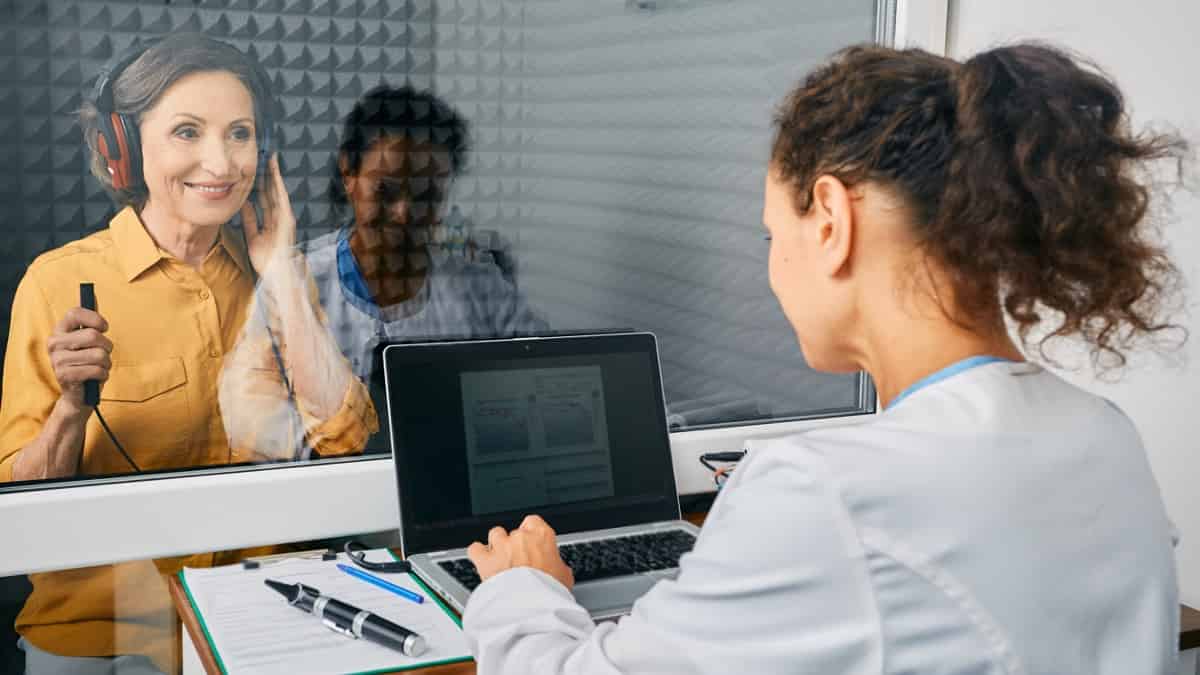
You sit in a sound-treated booth. You listen carefully. Each time you hear a beep, you press the button. This test is called “audiometry,” and the results are plotted on a graph called an “audiogram.”
A few minutes later, you may be told, “Your hearing is normal,” "Your hearing loss is mild,” “Your hearing is ‘normal for your age,” or "Your hearing is not bad enough to be concerned about at this time.” Then you go back to real life—and your hearing problems.
At dinner, you hear people talking, but the words are not clear. At a family gathering, you lose the thread when several people speak at once. In a restaurant, voices, music, dishes, and background noise blend together. You may hear that someone is speaking, but still miss what was said.


That can be confusing and discouraging. Many people leave a hearing appointment wondering, “If my hearing test is normal, why is listening so hard?” Others are told their hearing loss is “not too bad,” even though they work harder than they used to.
After more than 30 years as an audiologist, I can say this with confidence: people don’t get their hearing checked because they are having trouble hearing beeps in a quiet booth. They seek help from hearing care professionals because they struggle to understand conversations in the situations that matter to them.
The is important, but it is not the whole story.

Hearing vs. Listening
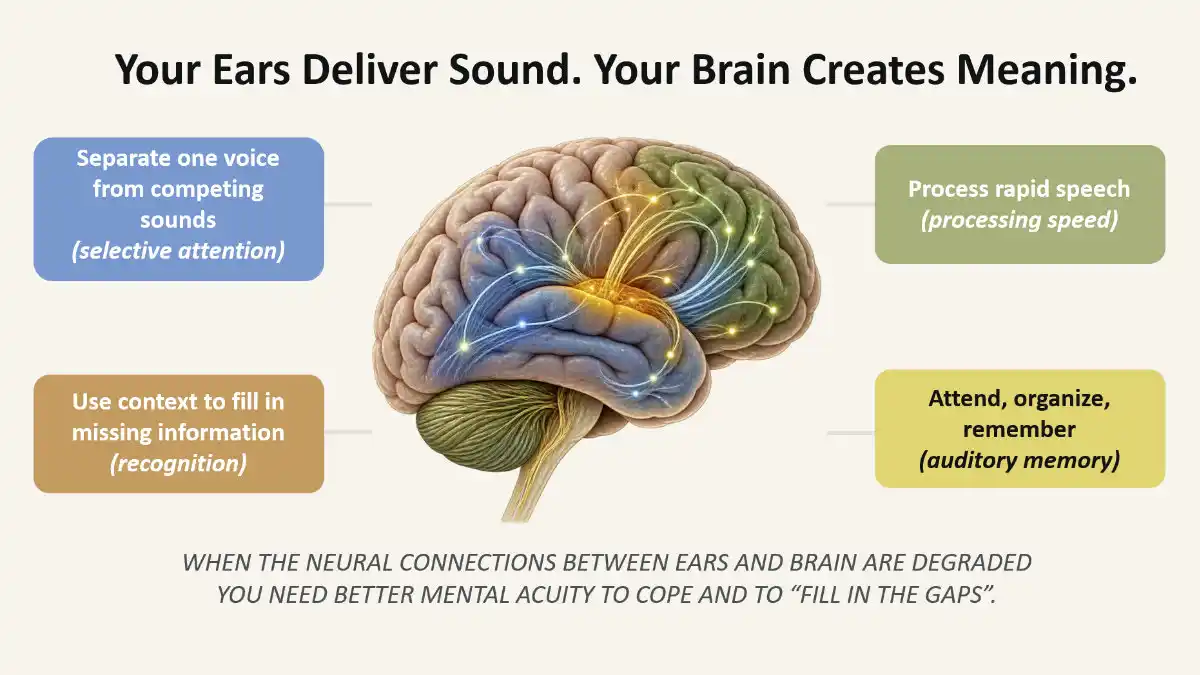
Hearing and listening are related, but they are not the same. Hearing begins when the ears collect sound and send information toward the brain. Listening requires the brain to turn that sound into meaning. Your ears deliver sound; your brain creates meaning.

To understand speech, your brain may need to separate voices from noise, selectively attend to one voice among many, recognize words in spite of unfamiliar voices or accents, use context to fill in gaps, keep up with rapid speech, detect timing loudness and frequency differences, organize information, and remember what was said.
Basic hearing test results may not reveal your ability to do any of these things. That is one reason two people with similar can have very different real-life experiences and hearing needs.
What the Audiogram Does and Does Not Measure
The standard “hearing test,” called audiometry, is usually the best-known part of a basic hearing evaluation. It measures the softest sounds a person can detect at different frequencies, one at a time, in a quiet and controlled environment.
The can identify the degree and pattern of hearing loss and guide hearing aids, medical referral, hearing protection, and follow-up care. But it mainly answers one question: how soft can a sound be before you no longer detect it? Real-world listening asks a different question: can you understand speech clearly, comfortably, and accurately even when the listening conditions are not ideal
“Normal Hearing” Does Not Always Mean “Normal Listening Ability”
Some audiologists will point out that, in reality, there is no such thing as “normal hearing loss”—any more than there is “normal vision loss.” People can have significant listening complaints even though their hearing thresholds fall within what is commonly called the “normal range.” Others fall into a slight or mild range of hearing loss, yet are told their hearing loss is “not bad enough to worry about.” That can unintentionally minimize a real problem.


Terms such as normal, slight, mild, moderate, severe, and profound are useful, but imperfect. They are based on hearing sensitivity, not on real-life understanding. The American Speech-Language Hearing Association () classification materials include slight hearing loss from 16 to 25 and mild hearing loss from 26 to 40 dB HL.1 A person near these boundaries may still struggle, especially in background noise.
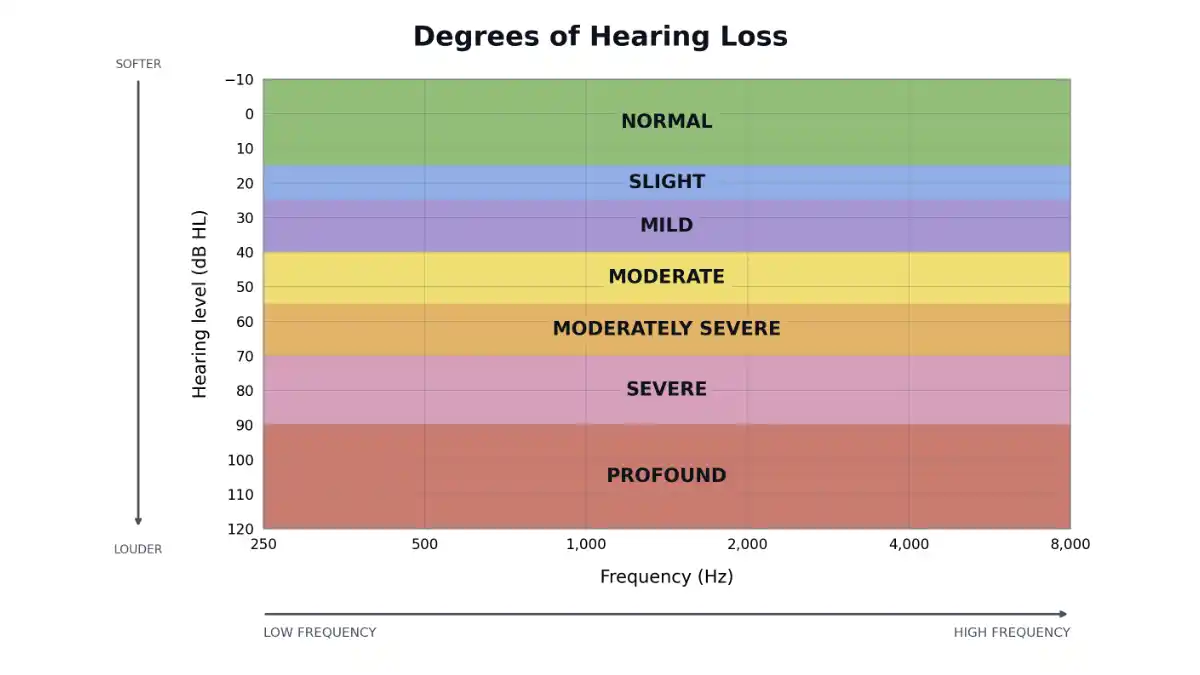
In recent years, researchers have increasingly focused on people with normal results who still report difficulty understanding speech in noise.2,3 The labels mild, moderate, severe, etc., matter less than the practical reality: if you are struggling to understand conversation, your experience deserves to be taken seriously—regardless of what audiometric classification your results fall into.
Listening Difficulty Has More Than One Possible Cause
Difficulty understanding speech—especially in challenging listening conditions—can have multiple causes.
Possible contributors include, but are not confined to:
- Reduced hearing sensitivity
- Inner ear damage
- Difficulty separating speech from noise
- Reduced cochlear function not obvious on the audiogram
- Neural connection changes between inner ear and brain
- Auditory processing
- Attention
- Memory loss
- Processing speed
- Listening fatigue
- Stress
- Sleep problems
- Vison loss or lack of visual cues
- Room acoustics
Because there are so many possible contributors, it is important not to self-diagnose from a single symptom. Someone who struggles mainly in restaurants may need different guidance than someone who misses soft speech in quiet settings. The right next step depends on the full picture.
Inner Ear Changes
The cochlea, or inner ear, is complex. The audiogram gives important information about sound detection, but it does not directly measure every part of cochlear function.
Standard audiograms usually stop at 8,000 Hz, but extended high-frequency (EHF) testing checks hearing above that range and can reveal early changes even when standard results appear normal.4 Hearing loss at these higher frequencies is associated with difficulty understanding speech in noise, locating sounds, and greater listening effort and fatigue—making EHF testing a useful addition when everyday listening problems don’t match the audiogram.

Otoacoustic emission () testing measures very soft sounds generated by the cochlea, especially by outer hair cell activity. While the tells us what sounds a person can detect, OAE testing gives information about cochlear function. In some cases, OAE results may reveal cochlear dysfunction or early auditory-system deterioration before it is obvious on a standard audiogram.5
Another area of research involves the connections between the inner ear and the auditory nerve, often discussed as cochlear synaptopathy or hidden hearing loss. Animal research has shown that substantial synapse loss can occur after certain noise exposures even when hearing thresholds recover.6 In people, researchers are still studying how best to measure this clinically. Neural connection changes may help explain some listening problems, but they should not be assumed to be the cause for everyone.
The take-home message is practical: the standard audiogram does not capture all the reasons a person struggles in complex listening situations.
Speech Testing
Most hearing evaluations include some type of speech testing. A common test asks you to repeat words presented at a comfortable loudness level in quiet. This can show how clearly each ear understands speech when the words are audible and conditions are favorable.
But many people do well on speech testing in quiet and still struggle in noise. Speech-in-noise testing measures how well you understand speech when background noise is present. Examples include the , Words-in-Noise test, , in noise, and similar measures.7 These tests get closer to real complaints: restaurants, meetings, family gatherings, and group conversations.
Speech-in-noise testing—which is now considered a key part of best practices for all hearing healthcare disciplines8-11—can answer practical questions. How much does noise affect understanding? Are the difficulties greater than typically expected from the audiogram alone? Would hearing aids, , structured auditory training, communication strategies, or environmental changes help?
Cognitive Function
Listening also depends on cognitive abilities such as attention, working memory, processing speed, and the ability to organize information quickly. This does not mean every listening problem is a cognitive problem. It means difficult listening situations place demands on both the auditory system and the brain.
In some settings, tools such as Cognivue or other cognitive screening measures may be used. These are merely screening tools and do not diagnose dementia or replace medical evaluation. Used appropriately, however, they can help clarify whether attention, processing speed, memory, or listening load may be contributing factors to address.
The goal is not to make listening difficulty sound more alarming; it’s to understand the situation more completely, so recommendations are more useful in real life.
Understanding Your Communication Needs
An important part of a comprehensive hearing evaluation is understanding how listening difficulties affect your everyday life. This is sometimes called a communication needs assessment. A communication needs assessment can help identify the situations in which you struggle most, how those difficulties affect your relationships and activities, and what improvements matter most to you. This information, combined with your hearing test results, helps your hearing care professional recommend solutions tailored to your goals and evaluate whether those solutions are making a meaningful difference in your daily life.
Possible Solutions
The encouraging news is that real-world listening difficulty usually can be addressed. The right solution depends on the person’s test results, listening goals, health history, lifestyle, and communication environments.
For some people, the answer may include more advanced hearing technology. For those with slight or mild hearing loss, properly selected low-gain hearing aids with advanced technology may be helpful.
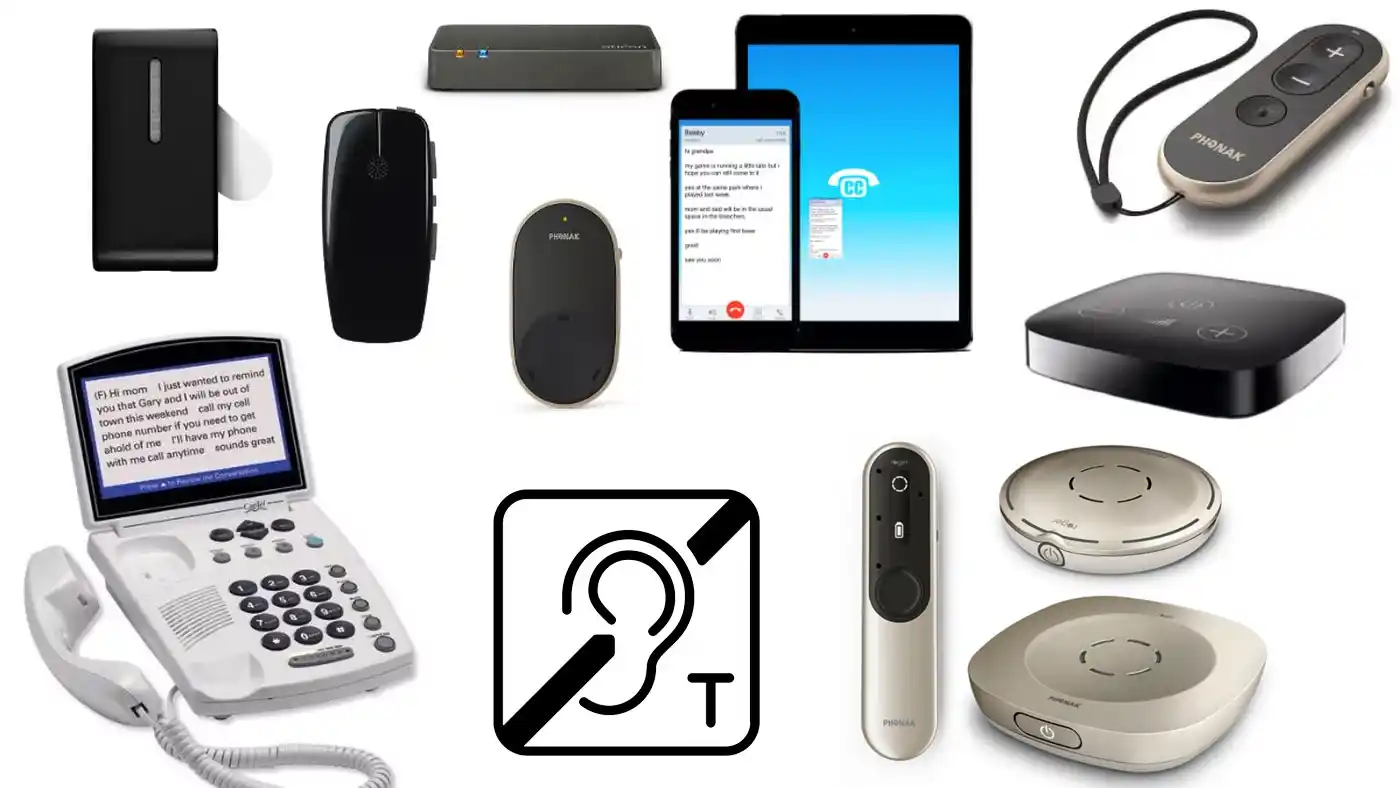
In some cases, hearing technology accessories can also help. Remote microphones can bring a speaker’s voice closer. Captioning apps, captioned phones, television streaming, venue-based hearing systems, captioned eyeglasses, and other emerging captioning devices can provide additional information when sound alone is not enough.
Communication strategies and listening techniques can also play a large role. Better seating, quieter environments, good lighting, facing the speaker, specific repair requests when something is missed, planned listening breaks to avoid listening fatigue, and clear self-advocacy can reduce frustration and improve understanding and relationships.
Structured auditory training may also be useful. This systematic listening practice can help you make measurable improvements in listening skills, such as understanding speech in background noise and keeping up with rapid speech. This often leads to more confidence in challenging listening conditions.
Questions for Your Hearing Care Professional
If real-world listening difficulties do not match your hearing test results, bring specific questions to your hearing care professional.


You might ask:
- Did we test my speech understanding in quiet AND in noise, and what did those results show?
- If my hearing is considered “normal,” am I close to the edge of the normal range or in the slight hearing loss range at any frequencies?
- Would otoacoustic emission testing, extended high-frequency hearing tests, or other measures provide useful information?
- Should I have some version of cognitive function screening?
- Are listening fatigue, attention, auditory processing, cognitive load, or other factors contributing?
- What types of assistive technology, communication strategies, environmental changes, or structured auditory training might help with the situations I care about most?
These questions can shift the conversation from “Is my hearing bad enough?” to “What explains the difficulty I am actually having, and what can we do about it?” That is a better conversation that can lead to a more impactful outcome.
Your Experience Matters
One of the most discouraging experiences for people with hearing difficulty (and tinnitus) is feeling that their concerns have been dismissed because their test results do not look severe enough from a clinical standpoint. But the and test results are not representative of the whole person; they are only part of the story.
Your listening and communication abilities are extremely important for your quality of life. If you hear people talking but cannot understand the words clearly, that’s a hearing problem. If noisy places are exhausting, that’s a hearing problem. If you avoid group conversations or have been told your hearing is normal while daily life says otherwise, that deserves further discussion.
One of my mentors put it this way:
“We have lots of ways of testing our patients in the office, but the real test of whether we have done our job in helping people improve their listening and communication abilities is asking them if we have improved their listening and communication abilities in real life.”
That is the goal of hearing healthcare. A hearing evaluation should not only determine whether you can hear soft beeps in a sound booth. It should help you understand where listening breaks down and what can help you stay connected to the people and activities that matter most.
References
- American Speech-Language-Hearing Association (). Type, Degree, and Configuration of Hearing Loss [PDF]. ASHA Audiology Information Series. Also see ASHA Practice Portal: Hearing Loss in Adults.
- Beck DL, Danhauer JL, Abrams HB, et al. Audiologic considerations for people with normal hearing sensitivity yet hearing difficulty and/or speech-in-noise problems. Hearing Review. 2018;25(10):28-38.
- Pienkowski M. On the etiology of listening difficulties in noise despite clinically normal audiograms. Ear Hear. 2017;38(2):135-148. https://doi.org/10.1097/AUD.0000000000000388
- Helfer KS, Maldonado L, Matthews LJ, Simpson AN, Dubno JR. Extended high-frequency thresholds: Associations with demographic and risk factors, cognitive ability, and hearing outcomes in middle-aged and older adults. Ear Hear. 2024 Jul 11;45(6):1427-1443. doi: 10.1097/AUD.0000000000001531
- Abdala C, Visser-Dumont L. Distortion product otoacoustic emissions: A tool for hearing assessment and scientific study. Volta Review. 2001;103(4), 281-302. See also: Otoacoustic Emissions, StatPearls, NCBI Bookshelf.
- Kujawa SG, Liberman MC. Synaptopathy in the noise-exposed and aging cochlea: Primary neural degeneration in acquired sensorineural hearing loss. Hearing Research. 2015;330(Pt B):191-199. https://doi.org/10.1016/j.heares.2015.02.009
- Billings CJ, Olsen TM, Charney L, Madsen BM, Holmes CE. Speech-in-noise testing: An introduction for audiologists. Seminars in Hearing. 2024;45(1), 55-82. https://doi.org/10.1055/s-0043-1770155
- Turton L, Souza P, Thibodeau L, et al. Guidelines for Best Practice in the Audiological Management of Adults with Severe and Profound Hearing Loss. Seminars in Hearing. 2020;41(3), 141-246. https://doi.org/10.1055/s-0040-1714744
- Valente M. Guideline for Audiologic Management of the Adult Patient. AudiologyOnline. Oct 30, 2006.
- Basura G, Cienkowski K, Hamlin L, et al. American Speech-Language-Hearing Association Clinical Practice Guideline on Aural Rehabilitation for Adults With Hearing Loss. Am J Audiol. 2023 (Mar 1).
- International Hearing Society. IHS Best Practices Recommendation for Fitting and Dispensing Hearing Aids [PDF]. March 3, 2020.
- National Academies of Sciences, Engineering, and Medicine (NASEM). Hearing Health Care for Adults: Priorities for Improving Access and Affordability. Washington, DC: The National Academies Press;2016.

Correspondence: Dr. Cardano welcomes any questions or comments you may have at: LawrenceCardano365@gmail.com
Lawrence Cardano, AuD, CPD
Hearing Tracker ContributorLawrence Cardano, AuD, CPD© is a Doctor of Audiology and Certified Dementia Practitioner with more than 30 years of experience helping adults with hearing loss improve their communication and quality of life. He is the founder of Meaningful Pursuits, a personal coaching practice dedicated to helping adults with hearing loss live with greater purpose, connection, and vitality. Correspondence can be sent to Dr. Cardano at LawrenceCardano365@gmail.com.